


Upcycled Food Products Market Overview
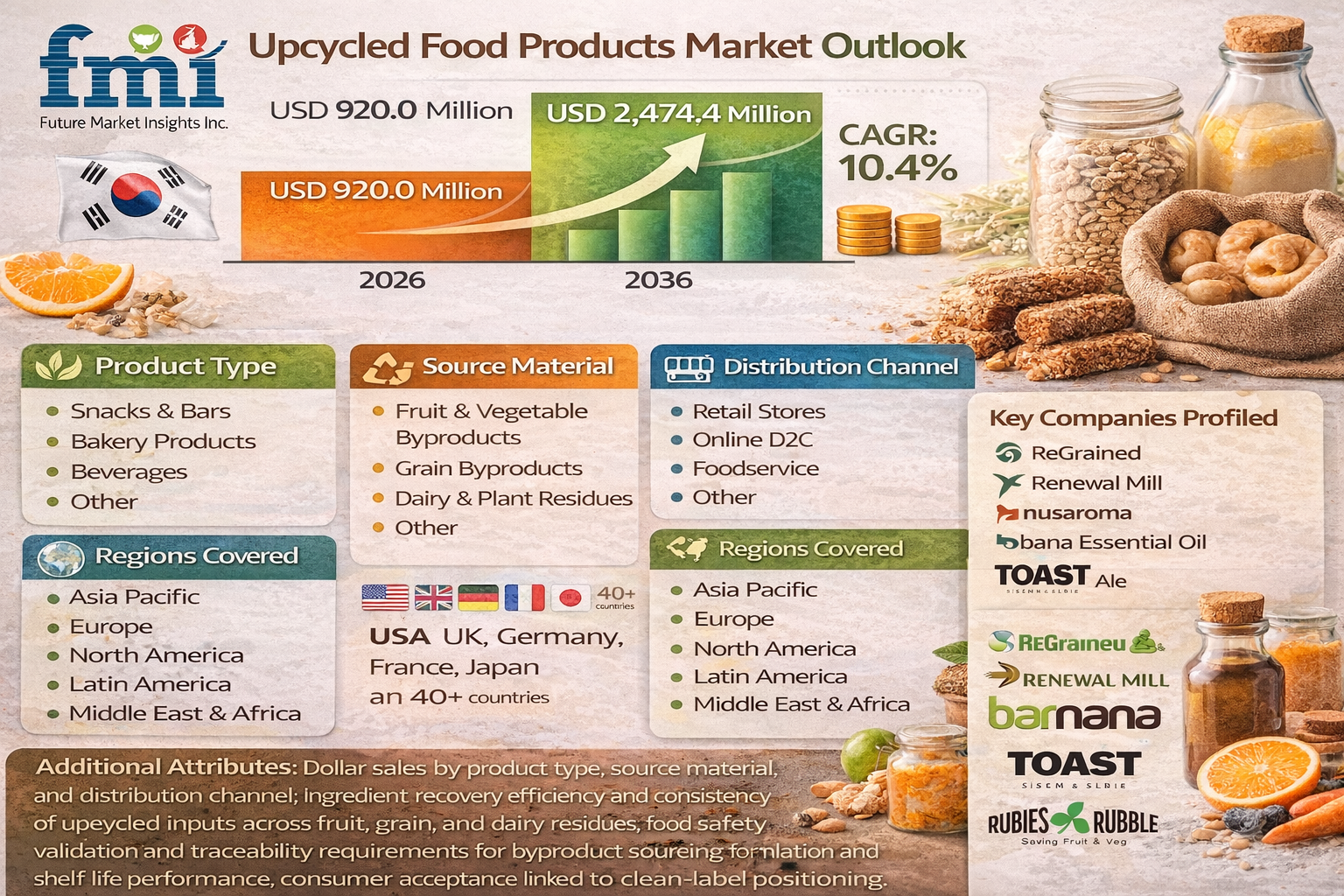
The global upcycled food products market is emerging as a high-growth segment within the sustainable food industry, driven by increasing awareness of food waste reduction, circular economy initiatives, and rising consumer demand for environmentally responsible products. The market is expected to be valued at approximately USD 920.0 million in 2026 and is projected to reach USD 2,474.4 million by 2036, expanding at a robust compound annual growth rate (CAGR) of 10.4% during the forecast period. This strong growth trajectory highlights the growing commercial viability of transforming food byproducts into value-added consumer products while addressing sustainability challenges across the global food system.
Upcycled food products are developed using ingredients that would otherwise be discarded, including fruit and vegetable byproducts, grain residues, and dairy or plant-based processing remnants. These materials are repurposed into nutritious and commercially viable food offerings, aligning with global sustainability goals and food waste reduction strategies. Product innovation remains a critical growth factor, particularly across key product types such as snacks and bars, bakery products, beverages, and other specialty food categories. Among these, snacks and bars hold a significant market share due to their convenience, portability, and compatibility with clean-label and functional nutrition trends. Bakery products and beverages are also gaining traction as manufacturers increasingly incorporate upcycled ingredients into familiar consumption formats.
Based on source material, fruit and vegetable byproducts represent a dominant segment, supported by their high availability, nutritional value, and versatility in food formulations. Grain byproducts, particularly from brewing and milling processes, have gained prominence due to their fiber content and functional properties. Dairy and plant residues are also increasingly utilized as advances in ingredient recovery technology improve consistency, safety, and scalability. The effectiveness of ingredient recovery, including efficiency and consistency across different residue types, plays a vital role in ensuring formulation stability, shelf life performance, and overall product quality.
Distribution channel diversification further supports market expansion. Retail stores remain the leading channel, benefiting from growing shelf space for sustainable and ethical food products. Online direct-to-consumer (D2C) platforms are expanding rapidly, enabling brands to educate consumers, communicate sustainability narratives, and reach niche audiences more effectively. Foodservice channels, including cafés, restaurants, and institutional catering, are also adopting upcycled ingredients as part of sustainability commitments and waste-reduction initiatives. Balancing channel mix across retail placement, online fulfillment, and foodservice partnerships is increasingly critical for market success.
Regionally, North America leads the upcycled food products market, driven by strong consumer awareness, supportive regulatory frameworks, and the presence of pioneering upcycled food brands. Europe follows closely, supported by stringent food waste regulations, sustainability-focused consumers, and innovation in circular food systems. The Asia Pacific region is expected to witness accelerated growth, fueled by urbanization, expanding food processing industries, and rising sustainability awareness. Latin America and the Middle East & Africa present emerging opportunities as food waste reduction gains policy and commercial attention.
The competitive landscape includes innovative players such as ReGrained, Renewal Mill, Barnana, Toast Ale, and Rubies in the Rubble, all of which emphasize sustainability-driven branding, ingredient transparency, and clean-label positioning. These companies compete on product differentiation, sourcing traceability, food safety validation, and formulation performance. Consumer acceptance is closely linked to clean-label claims, taste parity with conventional products, and trust in sourcing practices.
Browse Report – Explore the report’s contents, sections, and key insights by browsing through its detailed information. https://www.futuremarketinsights.com/reports/upcycled-food-products-market
In conclusion, the upcycled food products market is poised for significant expansion through 2036, underpinned by sustainability imperatives, technological advancements in ingredient recovery, and shifting consumer preferences. Companies that successfully integrate operational efficiency, transparent sourcing, and compelling sustainability messaging are well-positioned to capture long-term value in this rapidly evolving market.
About Future Market Insights (FMI)
Future Market Insights, Inc. (ESOMAR certified, recipient of the Stevie Award, and a member of the Greater New York Chamber of Commerce) offers profound insights into the driving factors that are boosting demand in the market. FMI stands as the leading global provider of market intelligence, advisory services, consulting, and events for the Packaging, Food and Beverage, Consumer Technology, Healthcare, Industrial, and Chemicals markets. With a vast team of over 400 analysts worldwide, FMI provides global, regional, and local expertise on diverse domains and industry trends across more than 110 countries.
Contact Us:
Future Market Insights Inc.
Christiana Corporate, 200 Continental Drive,
Suite 401, Newark, Delaware – 19713, USA
T: +1-347-918-3531
For Sales Enquiries: sales@futuremarketinsights.com
Website: https://www.futuremarketinsights.com
LinkedIn| Twitter| Blogs | YouTube

 English
 Arabic
 French
 Spanish
 Portuguese
 Deutsch
 Turkish
 Dutch
Dutch
 Italiano
 Russian
 Portuguese (Brazil)
 Greek
Greek