


The global automated border control (ABC) market is undergoing a major transformation as governments, airport authorities, and border security agencies modernize immigration and customs processes. Rising international travel volumes, heightened security concerns, and rapid advances in biometric and artificial intelligence technologies are accelerating the adoption of automated border control systems worldwide.
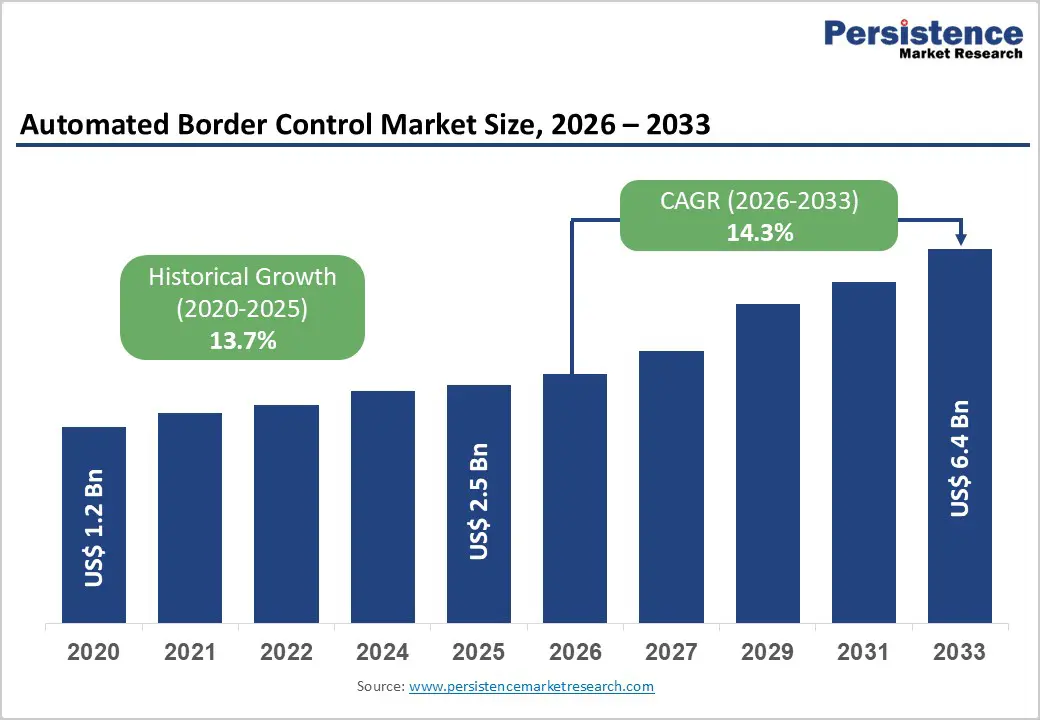
According to current market estimates, the global automated border control market size is expected to be valued at US$ 2.5 billion in 2026 and is projected to reach US$ 6.4 billion by 2033, expanding at a robust compound annual growth rate (CAGR) of 14.3% between 2026 and 2033. This growth trajectory reflects the global shift toward smart borders, seamless passenger experiences, and data-driven identity verification.
As international travel volumes are forecast to exceed 5.6 billion passengers by 2027, border agencies face increasing pressure to process travelers efficiently without compromising security. Automated border control systems, particularly biometric e-gates and self-service kiosks, are emerging as essential infrastructure to meet these demands.
Understanding Automated Border Control Systems
Automated border control refers to the use of technology-driven systems that automate identity verification and border clearance processes. These systems typically rely on biometric authentication—such as facial recognition, fingerprint scanning, and iris recognition—combined with electronic travel documents and centralized databases.
ABC systems are designed to reduce reliance on manual passport inspections by border officers, enabling faster passenger throughput, enhanced security screening, and improved traveler experience. The most common form of automated border control is the ABC e-gate, widely deployed at international airports, seaports, and increasingly at land border crossings.
Modern ABC platforms integrate advanced technologies such as artificial intelligence, machine learning, real-time risk assessment, and multimodal biometrics. These innovations allow authorities to identify travelers accurately, detect fraud, and flag potential security threats with greater precision.
Market Growth Drivers
Surge in Global Travel Volumes
One of the most significant drivers of the automated border control market is the rapid recovery and long-term growth of international travel. Passenger volumes are expected to surpass 5.6 billion globally by 2027, driven by tourism growth, business travel, and expanding middle-class populations in emerging economies.
This surge is placing unprecedented strain on traditional border control processes, particularly at major international airports and land border crossings. Automated border control systems offer a scalable solution by enabling high-volume, self-service processing while maintaining security integrity.
Government Investments in Border Modernization
Governments across the world are investing heavily in modernizing border security infrastructure. Smart border initiatives, digital identity programs, and national biometric databases are becoming central to immigration and security strategies.
Large-scale investments in border modernization are especially evident in regions such as North America, Europe, and Asia Pacific. These initiatives aim to improve border efficiency, reduce wait times, and strengthen national security through automated risk assessment and real-time data sharing.
Regulatory Mandates and Compliance Requirements
Regulatory frameworks are also accelerating ABC adoption. A prominent example is the European Union’s Entry/Exit System (EES), which will apply across 29 Schengen countries. This system mandates automated registration of entry and exit data for non-EU travelers, including biometric information.
Such regulatory mandates require advanced automated identity verification infrastructure, driving demand for ABC e-gates, biometric systems, and backend data management platforms.
Advancements in AI-Powered Multimodal Biometrics
Technological innovation is another major growth catalyst. The latest ABC systems increasingly rely on AI-powered multimodal biometrics, combining facial recognition, fingerprint scanning, and iris recognition into a single verification process.
These technologies improve accuracy, reduce false positives, and enhance fraud detection capabilities. AI-driven algorithms can adapt to variations in lighting, facial expressions, and document quality, ensuring consistent performance even in high-traffic environments.
Market Size and Growth Outlook
The automated border control market has demonstrated strong historical growth, expanding at a 13.7% CAGR between 2020 and 2025. This momentum is expected to continue through the forecast period as automation becomes a standard component of border management.
- Automated Border Control Market Size (2026E): US$ 2.5 billion
- Market Value Forecast (2033F): US$ 6.4 billion
- Projected Growth CAGR (2026–2033): 14.3%
The sustained double-digit growth reflects rising adoption across airports, land borders, and seaports, as well as continuous technology upgrades in existing installations.
Regional Market Analysis
North America: Market Leader
North America leads the global automated border control market, accounting for 29% of the market share in 2025. The region benefits from advanced border security infrastructure, strong government funding, and the presence of some of the world’s busiest international airports.
The United States and Canada have been early adopters of biometric border technologies, deploying ABC e-gates, facial recognition systems, and trusted traveler programs at major airports and land border crossings. Ongoing investments in smart border initiatives and U.S.-Mexico border modernization continue to support market growth.
Europe: Regulation-Driven Adoption
Europe represents a mature and regulation-driven market for automated border control. The implementation of the EU Entry/Exit System is significantly accelerating the deployment of biometric e-gates and automated identity verification solutions across Schengen countries.
European airports are among the most advanced globally in terms of ABC adoption, with widespread use of ICAO-compliant e-gates and integrated border management systems.
Asia Pacific: Fastest Growing Region
Asia Pacific is the fastest-growing region, expected to expand at a CAGR of 18.8% through 2033. Rapid growth in international travel, expanding aviation infrastructure, and government-led border modernization initiatives are driving demand across the region.
Countries such as China, India, Singapore, Japan, and Australia are investing heavily in biometric border control technologies to manage high passenger volumes and strengthen security at airports and land borders.
Segment Analysis
ABC E-Gates: Dominant Segment
ABC e-gates dominate the market, accounting for 66% of total market share in 2025. Their dominance is driven by widespread deployment at airports, compliance with International Civil Aviation Organization (ICAO) standards, and their ability to handle high passenger throughput efficiently.
E-gates offer faster processing times, reduced staffing requirements, and improved traveler satisfaction, making them the preferred solution for airport authorities worldwide.
Land Borders: Fastest Growing Application
While airports currently represent the largest application segment, land borders are the fastest-growing, with a projected CAGR of 17.5%. Growth is fueled by increasing cross-border trade, stricter security mandates, and large-scale border modernization projects.
The U.S.-Mexico border, in particular, is seeing increased investment in automated inspection lanes, biometric verification, and smart border technologies.
Seaports: Emerging Opportunity
Seaports represent a significant growth opportunity for the automated border control market. Compared to airports, seaports have relatively lower penetration of automated systems, creating untapped potential.
Rising cruise tourism, cargo security requirements, and international maritime regulations are driving demand for biometric access control and automated identity verification at ports.
Competitive Landscape and Industry Trends
The automated border control market is characterized by strong competition among technology providers specializing in biometrics, AI, and border management systems. Vendors are increasingly focusing on end-to-end solutions that integrate hardware, software, analytics, and cloud-based data management.
Key industry trends include the shift toward contactless biometrics, mobile-based identity verification, and interoperability between national and international border databases. Partnerships between governments, airport operators, and technology firms are becoming more common to accelerate deployment and ensure regulatory compliance.
Future Outlook and Opportunities
The future of the automated border control market is closely tied to global mobility trends, technological innovation, and evolving security requirements. As borders become smarter and more data-driven, ABC systems will play a central role in balancing efficiency and security.
Seaports and land borders are expected to offer the strongest growth opportunities, supported by smart border investments and lower infrastructure penetration compared to airports. Continued advances in AI-powered multimodal biometrics will further enhance system accuracy and scalability.
Conclusion
The global automated border control market is poised for sustained, high-growth expansion through 2033. With the market expected to grow from US$ 2.5 billion in 2026 to US$ 6.4 billion by 2033, automated border solutions are becoming a cornerstone of modern border management.
Driven by rising international travel, government modernization initiatives, regulatory mandates, and rapid biometric innovation, automated border control systems are transforming how people and goods move across borders. As adoption expands beyond airports into land borders and seaports, the market is set to play a critical role in shaping the future of global mobility and security.
Related Reports:

 English
 Arabic
 French
 Portuguese
 Deutsch
 Turkish
 Dutch
Dutch
 Italiano
 Russian
 Romaian
 Portuguese (Brazil)
 Greek
Greek