


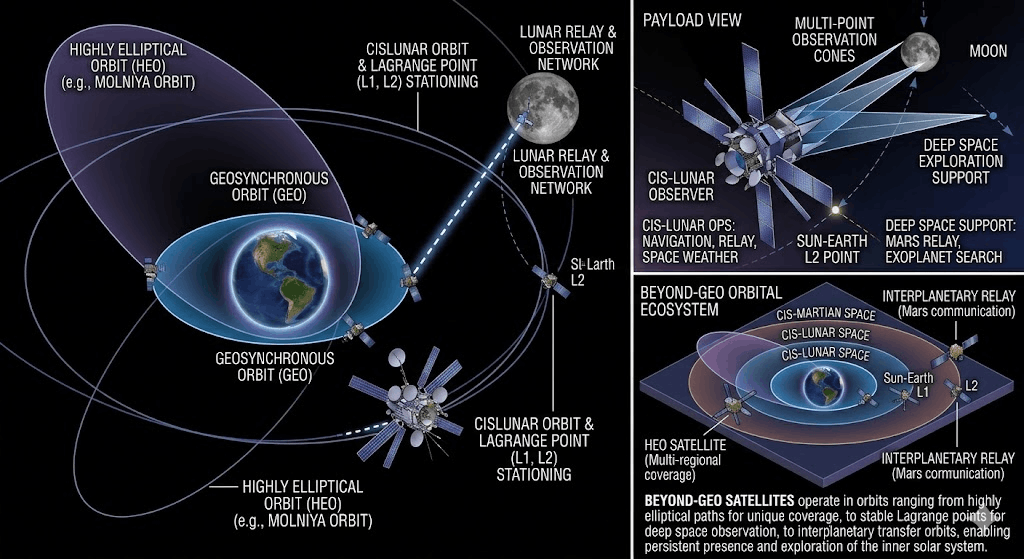
Lockheed Martin built the Orion spacecraft, the primary crew vehicle for NASA's Artemis lunar program, giving it an integration depth in cislunar mission architecture that positions it naturally for beyond GEO satellite procurement within programs where it already holds prime contractor relationships. Northrop Grumman is building the HALO module for the Lunar Gateway, the first element of permanent cislunar space infrastructure, creating a similar program integration advantage in the Gateway architecture. Boeing's long history with NASA deep space missions and its Space Launch System prime contractor role create comparable proximity to the beyond GEO satellite procurement decisions being made within NASA programs. These are not coincidental positions. They reflect decades of investment in deep space mission capability, radiation-hardened systems heritage, and government program relationship depth that defines the competitive structure of a market where technical qualification barriers and program access are the primary competitive dimensions. The Beyond GEO Satellite Market Competitive Landscape from The Insight Partners upcoming study profiles ten companies whose technology positions and market access define where the confirmed 14.5% CAGR from 2025 to 2031 is captured.
Get exclusive insights into the Beyond GEO Satellite Market – https://www.theinsightpartners.com/sample/TIPRE00025975
Airbus Defense and Space: The European Deep Space Heritage Leader
Airbus Defense and Space built Herschel and Planck space observatories at the second Lagrange point 1.5 million kilometers from Earth, the BepiColombo Mercury mission spacecraft, and is contributing modules to the Lunar Gateway. These programs collectively represent one of the deepest non-US beyond GEO satellite manufacturing heritage bases in the world, providing the technical reference experience and radiation qualification data that subsequent beyond GEO program competitions will require.
Northrop Grumman and Lockheed Martin: The Cislunar Infrastructure Primes
Northrop Grumman's Gateway HALO module prime contract and Lockheed Martin's Orion crew vehicle prime contract create positions at the center of the Artemis cislunar infrastructure architecture from which beyond GEO satellite procurement opportunities flow naturally. Both companies have decades of radiation-hardened systems development, deep space communications engineering, and classified government program manufacturing experience that provide barriers to competitive entry that cannot be overcome through technology investment alone in short time periods.
Space Systems/Loral (Maxar Technologies), Viasat and OHB SE
SSL/Maxar brings GEO satellite manufacturing scale that it is adapting for beyond GEO applications. Viasat's multi-orbit communication systems expertise positions it for commercial HEO connectivity applications. OHB SE's European institutional program relationships provide access to ESA beyond GEO mission procurement alongside its domestic German space program customer base.
JSC Information Satellite Systems, Thales Group and INVAP S.E.
JSC ISS brings Russian deep space satellite heritage including its Molniya HEO communication satellite program legacy. Thales Group contributes through its planetary science spacecraft heritage at Thales Alenia Space. INVAP S.E. provides Latin American satellite manufacturing capability serving national program and international export markets.
Competitive Landscape
- Airbus Defense and Space
- Boeing Defense Space and Security
- JSC Information Satellite Systems
- Lockheed Martin Corporation
- Northrop Grumman Corporation
- Thales Group
- OHB SE
- Space Systems/Loral (Maxar Technologies)
- Viasat Inc.
- INVAP S.E.
Q1. What competitive advantage does Northrop Grumman's Gateway HALO module prime contract create?
Program integration at the center of NASA's permanent cislunar infrastructure architecture creates natural access to adjacent beyond GEO satellite procurement decisions within the Gateway program, established working relationships with NASA program offices managing the full Artemis architecture, and technical system interface knowledge that makes Northrop Grumman a preferred supplier for Gateway-compatible satellite assets requiring integration with the primary station.
Q2. How does Airbus Defense and Space's Lagrange point and interplanetary spacecraft heritage differentiate it competitively?
In-flight performance data from spacecraft operating at the first and second Lagrange points and in interplanetary cruise provides radiation-hardened component qualification evidence and deep space communications system performance reference data that fewer than ten organizations in the world possess, creating a technical heritage differentiation that program managers for new beyond GEO missions value above all other competitive criteria.
Q3. What market opportunity does Viasat's multi-orbit commercial communication expertise create in beyond GEO?
Commercial HEO satellite system development for Arctic broadband connectivity combining GEO, HEO, and LEO coverage represents a commercial beyond GEO satellite opportunity where Viasat's experience designing multi-orbit communication architectures for commercial operator requirements provides directly applicable capability that pure deep space satellite manufacturers without commercial connectivity expertise cannot immediately match.
Q4. How does JSC Information Satellite Systems' Molniya program heritage create competitive positioning?
Decades of operational experience designing, manufacturing, and operating HEO satellites for Russian polar coverage communications programs provides JSC ISS with the most extensive flight-proven HEO satellite operational heritage of any manufacturer globally, creating qualification evidence for HEO satellite system performance across decades of operational cycles that competitors entering this orbit class for the first time cannot replicate.
Q5. What competitive strategies are beyond GEO satellite market players most actively pursuing through 2031?
Cislunar relay satellite development for NASA and commercial lunar mission communication relay requirements, HEO polar connectivity system design for commercial and defense Arctic coverage applications, small satellite radiation-hardened platform development enabling cost-effective beyond GEO missions, advanced electric propulsion integration for efficient cislunar and HEO orbit achievement, and commercial lunar navigation service development for the emerging cislunar economy are the most active competitive strategy themes.
About The Insight Partners
The Insight Partners is a one-stop industry research provider of actionable solutions. We help our clients in getting solutions to their research requirements through our syndicated and consulting research services. We specialize in industries such as Semiconductor and Electronics, Aerospace and Defense, Automotive and Transportation, Biotechnology, Healthcare IT, Manufacturing and Construction, Medical Devices, Technology, Media and Telecommunications, Chemicals and Materials.
Contact Us
The Insight Partners
Phone: +1-646-491-9876
E-mail: sales@theinsightpartners.com

 English
 Arabic
 French
 Spanish
 Portuguese
 Deutsch
 Turkish
 Italiano
 Russian
 Romaian
 Portuguese (Brazil)
 Greek
Greek