


Krill Oil Supplements Market to Surpass USD 2.78 Billion by 2036 as Bioavailability Advantages Drive Consumer Migration
Phospholipid-bound omega-3 format in krill oil offers measurably higher absorption rates than traditional fish oil, catalyzing a shift in the global preventive health landscape.
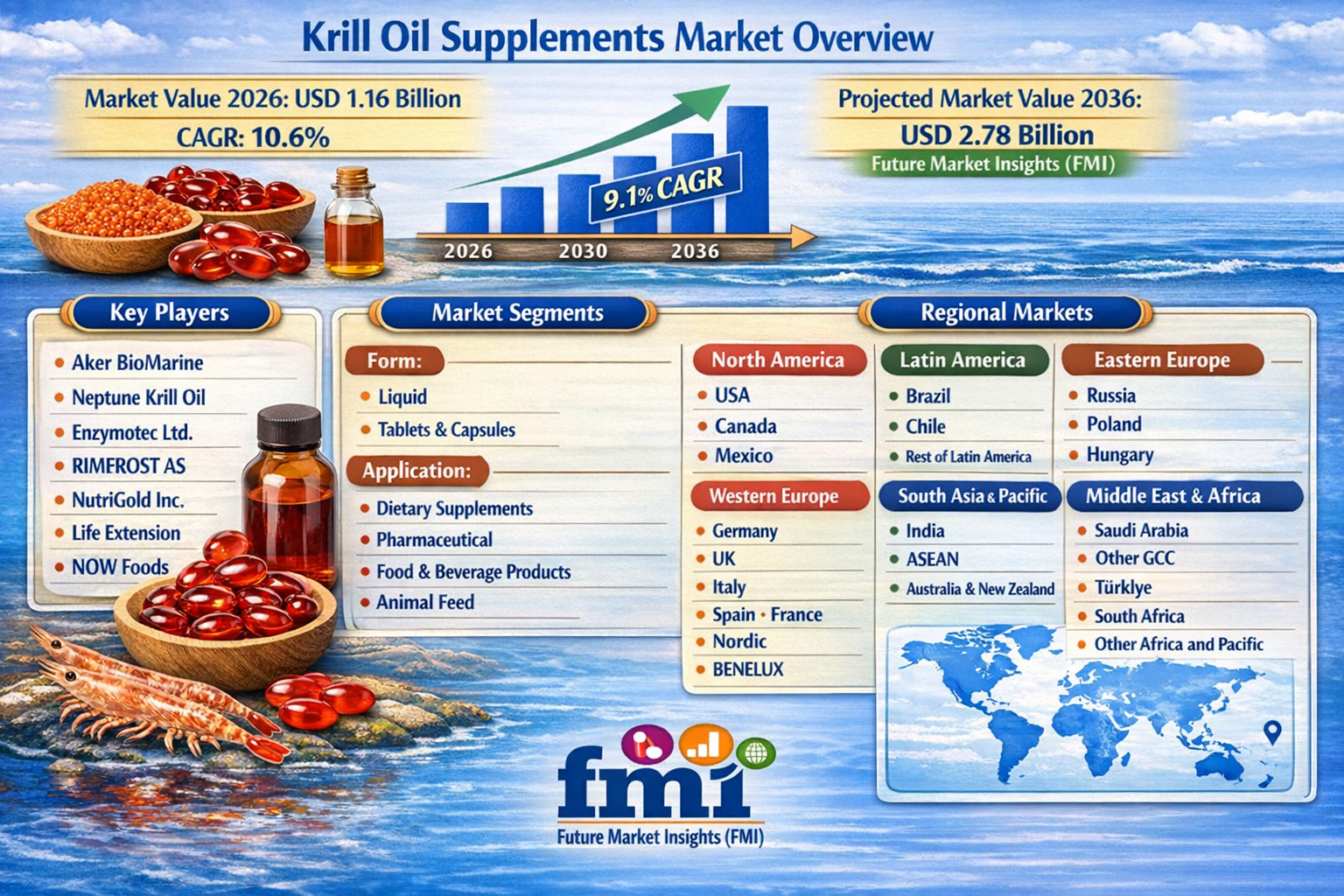
NEWARK, DELAWARE | March 24, 2026 — The global Krill Oil Supplements market is witnessing a significant transition, as clinical evidence of superior bioavailability reshapes consumer purchasing patterns. Valued at USD 405.4 million in 2025, the sector is projected to reach USD 1.16 billion in 2026. With a steady CAGR of 9.1%, the market is forecast to expand to USD 2.78 billion by 2036, according to Future Market Insights (FMI).
The industry’s growth is anchored in the structural advantages of krill-derived omega-3s. Unlike fish oil triglycerides, krill oil contains phospholipid-bound EPA and DHA, which studies suggest deliver 30% to 60% higher plasma levels at equivalent doses. This functional edge is positioning krill oil as a premium alternative in the cardiovascular and cognitive health categories.
Key Market Insights & Segment Performance
The market is currently supply-gated, governed by strict international environmental mandates. The Commission for the Conservation of Antarctic Marine Living Resources (CCAMLR) sets annual catch limits to ensure ecosystem stability, creating a unique market dynamic where volume is capped by sustainability quotas rather than processing capacity.
- Liquid Form (58.4% Market Share): Dominates the market due to its high purity, faster absorption, and consumer preference for liquid-filled softgels over traditional tablets.
- Dietary Supplements (46.9% Market Share): Remains the primary application, though pharmaceutical-grade krill oil is gaining traction as clinical trials validate its anti-inflammatory properties.
- Health & Wellness Drivers: Expanding clinical evidence for joint health and C-reactive protein reduction is attracting a broader demographic of aging consumers and fitness enthusiasts.
Regional Velocity: China and India Set the Pace
While the United States remains a mature stronghold for nutraceuticals, the highest growth rates are concentrated in Asia, where rising disposable incomes and a formalizing wellness sector are driving demand.
| Country | Projected CAGR (2026-2036) | Strategic Driver |
| China | 12.3% | Rapid e-commerce expansion and large-scale domestic distribution networks. |
| India | 11.4% | Rising urban health consciousness and growing adoption of preventive supplements. |
| Germany | 10.5% | Strict quality standards and high consumer trust in clinically validated ingredients. |
| United Kingdom | 8.6% | Innovation in sustainable sourcing and environmental responsibility narratives. |
| USA | 7.7% | Widespread retail penetration and high awareness of omega-3 benefits. |
Strategic Takeaways for Stakeholders
- Supply Chain Security: Procurement directors must prioritize multi-year offtake agreements. With Aker BioMarine controlling a significant portion of global harvesting, securing consistent ingredient supply is critical to mitigating price volatility.
- Formulation Differentiation: Manufacturers should focus on odor-controlled, high-potency extracts and functional blends (e.g., combining krill oil with astaxanthin or herbal extracts) to defend premium price points.
- Regulatory Navigation: Entry strategies must be tailored to regional labeling requirements and purity certifications, which vary significantly between the FDA (USA), EFSA (Europe), and local Asian regulators.
"The krill oil market is a supply-gated category where harvesting quotas—not factory capacity—dictate the ceiling," says Nandini Roy Choudhury, Principal Consultant at FMI. "Brands that can secure long-term supply and effectively communicate the 'bioavailability premium' will capture the margin shift away from commodity fish oils."
Competitive Landscape
The competitive environment is characterized by high vertical integration. Leading players such as Aker BioMarine, Neptune Krill Oil, and RIMFROST AS derive their advantage from specialized harvesting fleets and proprietary extraction technologies that preserve the delicate phospholipid structure.
Recent trends show a move toward "eco-efficiency," with suppliers implementing real-time data monitoring to protect Antarctic ecosystems. This commitment to sustainability is no longer optional but a prerequisite for tier-one retail placement in North American and European markets.
Key Companies Profiled: Aker BioMarine, Neptune Krill Oil, Enzymotec Ltd, RIMFROST AS, NutriGold Inc., Life Extension, and NOW Foods.
Unlock In-Depth Krill Oil Supplements Market Intelligence Access the Full Report Now: https://www.futuremarketinsights.com/reports/krill-oil-supplements-market
Why FMI: https://www.futuremarketinsights.com/why-fmi
Future Market Insights (FMI) is a leading provider of market intelligence and consulting services, serving clients in over 150 countries. Headquartered in Delaware, USA, with a global delivery center in India and offices in the UK and UAE, FMI delivers actionable insights to businesses across industries including automotive, technology, consumer products, manufacturing, energy, and chemicals.
An ESOMAR-certified research organization, FMI provides custom and syndicated market reports and consulting services, supporting both Fortune 1,000 companies and SMEs. Its team of 300+ experienced analysts ensures credible, data-driven insights to help clients navigate global markets and identify growth opportunities.
AVP - Marketing and Growth Strategy
Future Market Insights, Inc.
+91 8600020075
+1-347-918-3531
For Sales - sales@futuremarketinsights.com

 English
 Arabic
 French
 Spanish
 Portuguese
 Deutsch
 Dutch
Dutch
 Italiano
 Russian
 Romaian
 Portuguese (Brazil)
 Greek
Greek