


Market Overview
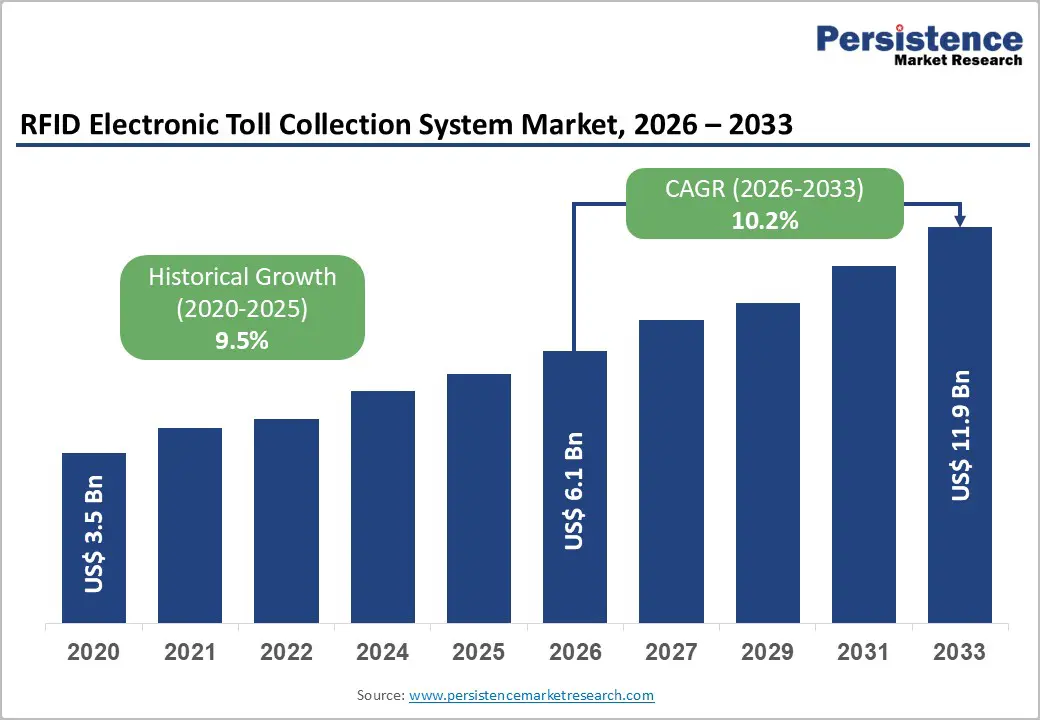
The global RFID Electronic Toll Collection (ETC) System market is entering a phase of strong expansion, driven by rapid urbanization, rising vehicle ownership, and increasing demand for efficient transportation infrastructure. The market is projected to reach US$ 6.1 billion in 2026 and is expected to grow to US$ 11.9 billion by 2033, registering a CAGR of 10.2% during the forecast period.
This growth trajectory reflects the urgent need to address global traffic congestion, which affects nearly 71% of major cities worldwide. Traditional toll systems—characterized by manual cash collection and long waiting times—have become inefficient and environmentally unsustainable. RFID-based tolling systems, which enable seamless, contactless transactions, are rapidly replacing these legacy systems.
Government initiatives are playing a pivotal role. More than 67 countries have mandated or are transitioning toward cashless toll collection, supported by global smart transportation investments exceeding US$ 428 billion. At the same time, the global vehicle population has surpassed 1.4 billion units, further intensifying the need for scalable tolling solutions. Declining RFID technology costs—down nearly 48% over the past decade—combined with environmental benefits such as 35% emission reduction at toll plazas, are accelerating adoption worldwide.
Key Market Highlights
The RFID ETC market is characterized by strong technological advancements and evolving deployment models:
- Hardware dominates the market with a 55% share, driven by RFID tags, readers, and antennas.
- Distance-based tolling leads with a 34% share, reflecting fair usage-based pricing models.
- Highways remain the largest application segment, accounting for 56% of total demand.
- Asia Pacific leads globally with a 36% market share, fueled by large-scale deployments in China and India.
- North America and Europe show steady growth due to interoperability initiatives and all-electronic tolling adoption.
- Emerging strategies include hybrid RFID-GNSS-5G systems, AI-powered toll management, and integrated mobility platforms.
Market Dynamics
Market Drivers
Escalating Traffic Congestion and Urban Mobility Challenges
Urban congestion has become a critical global issue, with significant economic and environmental consequences. Traffic delays result in billions of dollars in lost productivity and fuel wastage annually. Manual toll systems exacerbate the problem by creating bottlenecks, reducing highway throughput by up to 40%.
RFID-based ETC systems address these challenges by enabling vehicles to pass through toll points without stopping. This results in:
- Up to 300% improvement in traffic throughput
- Reduced fuel consumption
- Lower greenhouse gas emissions
- Enhanced commuter experience
As urban populations continue to grow, the need for efficient tolling solutions becomes even more pressing.
Government Smart City Initiatives and Intelligent Transportation Systems
Governments worldwide are investing heavily in smart city projects and intelligent transportation systems (ITS). These initiatives are designed to improve mobility, reduce congestion, and enhance urban sustainability.
Key developments include:
- Large-scale deployment of electronic tolling systems in Asia
- Interoperability mandates in Europe enabling cross-border toll payments
- Nationwide programs like India’s FASTag, which has achieved near-universal adoption
Such initiatives are transforming toll collection from a standalone function into a critical component of integrated urban mobility ecosystems.
Market Restraints
High Development Costs and Design Complexity
Despite its advantages, RFID ETC implementation involves significant capital investment. The cost of deploying toll infrastructure—including gantries, RFID readers, and backend systems—can range from US$ 2.8 million to US$ 7.5 million per plaza.
Additional challenges include:
- Integration with legacy systems
- Interoperability across regions
- Long payback periods in low-traffic areas
These factors can deter adoption, particularly in developing regions with limited budgets.
Privacy Concerns and Data Security Risks
As RFID systems track vehicle movement, concerns around data privacy and surveillance have emerged. A significant portion of users remains apprehensive about continuous monitoring and potential misuse of personal data.
Challenges include:
- Rising cybersecurity threats
- Compliance with stringent data protection regulations
- Risk of data breaches exposing sensitive travel and payment information
Addressing these concerns is essential to building user trust and ensuring long-term adoption.
Market Opportunities
Integration with Connected Vehicle Technologies
The convergence of RFID tolling with connected vehicle technologies and Vehicle-to-Everything (V2X) communication is opening new growth avenues.
Future systems will enable:
- Seamless integration of toll payments with parking, fuel, and public transport
- Real-time traffic management and dynamic toll pricing
- Enhanced user convenience through unified mobility platforms
With connected vehicles expected to reach hundreds of millions globally by 2030, this integration represents a significant opportunity for market expansion.
Distance-Based Road User Charging Systems
The shift from fuel taxes to distance-based road user charging is another major opportunity. As electric vehicles reduce fuel tax revenues, governments are exploring alternative funding mechanisms.
Distance-based tolling offers:
- Fair, usage-based pricing
- Sustainable infrastructure funding
- Improved traffic distribution
Pilot programs in multiple countries demonstrate the feasibility of this model, which is expected to play a key role in future transportation systems.
Segmentation Analysis
By Component
Hardware remains the backbone of the RFID ETC market, accounting for over 55% of total revenue. Key components include:
- RFID vehicle tags
- Readers and antennas
- Enforcement cameras
The widespread adoption of RFID tags—now exceeding hundreds of millions globally—is driven by lower costs and longer lifespans.
Meanwhile, software solutions are witnessing the fastest growth, supported by:
- Cloud-based toll management platforms
- AI-driven analytics
- Mobile payment integration
These systems enhance operational efficiency, reduce fraud, and improve customer experience.
By Toll Charge Type
Distance-based tolling leads the market due to its fairness and efficiency. It calculates tolls based on actual distance traveled, making it suitable for highways and long-distance corridors.
Point-based tolling, on the other hand, is gaining traction in urban areas, particularly for congestion pricing and zone-based access control.
By Application
Highways dominate the application segment, as they benefit the most from high-speed, uninterrupted toll collection. RFID ETC systems on highways deliver:
- Reduced congestion
- Lower operational costs
- Increased revenue efficiency
Urban applications are expanding rapidly, driven by smart city initiatives and congestion management strategies.
Regional Insights
Asia Pacific
Asia Pacific leads the global market with a 36% share, driven by:
- Massive highway infrastructure development
- Government mandates for electronic tolling
- High vehicle ownership growth
Countries like China and India are at the forefront, implementing large-scale RFID-based tolling systems with millions of daily transactions.
North America
North America is witnessing steady growth, supported by:
- Transition to all-electronic tolling
- Strong interoperability frameworks
- High adoption of digital payment systems
The region continues to innovate with dynamic pricing models and integrated mobility solutions.
Europe
Europe holds a significant market share, driven by:
- Cross-border interoperability initiatives
- Advanced truck tolling systems
- Urban congestion charging programs
The region is also focusing on sustainability, using tolling as a tool to reduce emissions and manage traffic demand.
Competitive Landscape
The RFID ETC market is highly competitive, with key players focusing on innovation, partnerships, and global expansion. Leading companies include:
- Kapsch TrafficCom AG
- Thales Group
- TransCore (Roper Technologies)
- Conduent Transportation
- Siemens Mobility
- Cubic Transportation Systems
- Mitsubishi Heavy Industries
These companies are investing in:
- AI-powered toll management systems
- Multi-protocol RFID readers
- Cloud-based back-office platforms
Strategic collaborations with automotive manufacturers are enabling the integration of RFID transponders directly into vehicles, eliminating the need for aftermarket installations.
Strategic Developments
Recent developments highlight the market’s evolution toward integrated and automated systems. For example, partnerships between toll technology providers and automotive manufacturers are enabling embedded RFID solutions in new vehicles, streamlining toll payments and enhancing user convenience.
Additionally, companies are focusing on building mobility ecosystems, integrating tolling with parking, fuel payments, and public transportation.
Future Outlook
The future of the RFID Electronic Toll Collection System market lies in digital transformation, interoperability, and integration with broader mobility ecosystems. Key trends shaping the market include:
- Adoption of AI and machine learning for traffic prediction and fraud detection
- Expansion of 5G-enabled tolling systems
- Growth of vehicle-integrated toll payment solutions
- Increasing focus on sustainability and emission reduction
As governments continue to invest in smart infrastructure and mobility solutions, RFID ETC systems will play a central role in shaping the future of transportation.
Conclusion
The RFID Electronic Toll Collection System market is poised for significant growth, driven by the need for efficient, sustainable, and scalable transportation solutions. While challenges such as high deployment costs and privacy concerns persist, ongoing technological advancements and government support are expected to overcome these barriers.
With the integration of connected vehicle technologies, AI-driven analytics, and distance-based charging models, RFID ETC systems are evolving into comprehensive mobility platforms. As a result, they are not only transforming toll collection but also redefining how transportation networks operate in the digital age.

 English
 Arabic
 French
 Portuguese
 Deutsch
 Turkish
 Dutch
Dutch
 Italiano
 Russian
 Romaian
 Portuguese (Brazil)
 Greek
Greek