


The global logistics industry is undergoing a profound transformation, driven by rapid digitalization, the explosion of e-commerce, and the need for real-time visibility across increasingly complex supply chains. At the heart of this transformation lies cloud logistics—a technology-driven approach that leverages cloud computing to optimize logistics operations, enhance efficiency, and improve decision-making.
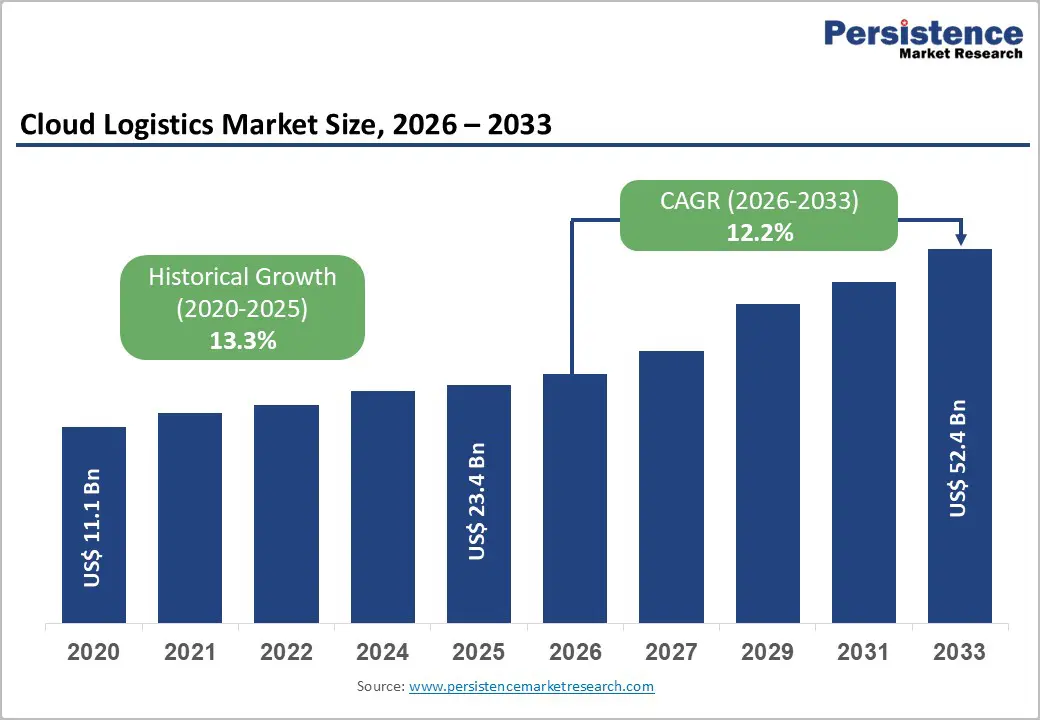
According to recent analysis, the global cloud logistics market is expected to grow from US$ 23.4 billion in 2026 to US$ 52.4 billion by 2033, expanding at a CAGR of 12.2%. This strong growth trajectory reflects the rising demand for scalable, cost-effective, and intelligent logistics solutions capable of meeting modern supply chain challenges.
What is Cloud Logistics?
Cloud logistics refers to the use of cloud-based platforms and technologies to manage and optimize logistics operations, including transportation, warehousing, inventory management, and demand forecasting. These platforms enable seamless integration of various supply chain functions, allowing businesses to operate more efficiently and respond quickly to changing market conditions.
Unlike traditional on-premises systems, cloud logistics solutions provide:
- Real-time data access and visibility
- Scalability and flexibility
- Lower infrastructure costs
- Enhanced collaboration across stakeholders
Market Drivers
- E-Commerce Boom and Demand for Real-Time Visibility
The exponential growth of global e-commerce has significantly increased the complexity of logistics operations. With global online sales surpassing US$ 5.8 trillion, businesses must manage high order volumes, multi-channel distribution, and faster delivery expectations.
Cloud logistics platforms enable:
- Real-time tracking of shipments
- Integration of warehouse and transportation systems
- Dynamic route optimization
- Enhanced customer experience through transparency
For example, platforms like Shopify have demonstrated the scalability of cloud systems by processing millions of transactions per minute during peak shopping events.
Organizations adopting cloud logistics report:
- 26% improvement in demand forecasting accuracy
- 16% reduction in operational costs
- 5% increase in revenue growth
These benefits are compelling businesses to accelerate cloud adoption across logistics operations.
- Integration of AI and Predictive Analytics
Artificial Intelligence (AI) and machine learning are revolutionizing cloud logistics by enabling predictive and automated decision-making.
Companies like IBM and Oracle Corporation are integrating advanced analytics into their logistics platforms, allowing businesses to:
- Predict demand fluctuations
- Optimize delivery routes in real time
- Detect anomalies and risks
- Improve inventory management
AI-powered systems leverage data from IoT sensors, RFID tags, and traffic conditions to enhance operational efficiency. This results in reduced fuel consumption, improved delivery timelines, and better resource utilization.
- Increasing Supply Chain Complexity
Modern supply chains are global, multi-layered, and highly dynamic. Businesses must manage:
- Multiple suppliers and distribution centers
- Cross-border regulations
- Shorter delivery timelines
- Customer expectations for transparency
Cloud logistics platforms provide centralized control and visibility, enabling organizations to manage complex operations efficiently while ensuring compliance with regulatory requirements.
Market Restraints
- Data Security and Privacy Concerns
Despite its advantages, cloud logistics adoption faces challenges related to data security. Businesses handling sensitive logistics data are concerned about:
- Data breaches
- Unauthorized access
- Multi-tenancy risks
- Compliance with regulations such as GDPR and HIPAA
These concerns are particularly significant in industries like healthcare and food supply chains, where regulatory requirements are stringent.
- High Implementation Costs and Skill Gaps
Implementing cloud logistics solutions requires substantial investment in:
- System integration
- Infrastructure migration
- Employee training
Small and medium-sized enterprises (SMEs) often struggle with limited budgets and lack of technical expertise. Additionally, the shortage of skilled professionals in cloud architecture and cybersecurity further complicates adoption.
Market Opportunities
- Rapid Adoption Among SMEs
SMEs represent a significant growth opportunity in the cloud logistics market. With cloud solutions offering subscription-based pricing and minimal upfront investment, smaller businesses can access enterprise-grade capabilities without heavy capital expenditure.
Cloud logistics enables SMEs to:
- Compete with larger enterprises
- Improve operational efficiency
- Scale operations quickly
Industry developments, such as acquisitions by Descartes Systems Group, highlight the growing focus on expanding cloud solutions for SMEs.
- Industry-Specific Cloud Solutions
There is increasing demand for customized cloud logistics platforms tailored to specific industries, including:
- Healthcare
- Automotive
- Food and beverage
- Consumer electronics
For instance, companies like Nestlé have achieved significant cost reductions through cloud-based logistics optimization.
Healthcare logistics, in particular, presents a high-growth opportunity due to the need for:
- Temperature-controlled transportation
- Regulatory compliance
- Real-time traceability
Segment Analysis
Service Type: Public Cloud Leads the Market
Public cloud services dominate the market, accounting for approximately 54% share. Major providers such as:
- Amazon Web Services
- Microsoft Azure
- Google Cloud
offer scalable and cost-effective solutions that appeal to both large enterprises and SMEs.
OS Type: Web-Based Platforms Dominate
Web-based cloud logistics platforms hold around 70% market share, as they allow users to access systems via browsers without requiring local installations. This ensures:
- Ease of use
- Accessibility from anywhere
- Reduced maintenance
Meanwhile, native cloud applications are the fastest-growing segment, driven by container technologies like Docker and Kubernetes.
Enterprise Size: Large Enterprises Lead
Large enterprises dominate the market with approximately 67% share, due to:
- Greater financial resources
- Complex global supply chains
- Advanced technology infrastructure
However, SMEs are rapidly catching up, driven by affordability and ease of deployment.
Industry: Consumer Electronics at the Forefront
The consumer electronics sector leads the cloud logistics market, accounting for about 37% share. Companies like:
- Apple Inc.
- Samsung Electronics
- Sony Corporation
rely heavily on cloud logistics to manage complex global supply chains and ensure real-time inventory visibility.
Regional Insights
North America: Market Leader
North America holds the largest market share (around 40%), driven by:
- Advanced cloud infrastructure
- High enterprise technology adoption
- Presence of major players like Amazon and IBM
The region’s mature logistics ecosystem and strong regulatory framework further support market growth.
Europe: Focus on Compliance and Sustainability
Europe represents a significant share of the market, with growth driven by:
- Strict data privacy regulations (GDPR)
- Emphasis on sustainability
- Adoption of green logistics solutions
Countries such as Germany, France, and the Netherlands are leading the adoption of cloud-based logistics technologies.
Asia Pacific: Fastest-Growing Region
Asia Pacific is the fastest-growing market, with a projected CAGR of 17% through 2033. Key growth drivers include:
- Rapid industrialization in China and India
- Explosive e-commerce growth
- Increasing digital transformation
The region’s expanding manufacturing base and rising adoption of cloud technologies position it as a major growth engine for the global market.
Competitive Landscape
The cloud logistics market is moderately consolidated, with a mix of established enterprise software providers and innovative startups.
Key players include:
- SAP SE
- Microsoft Corporation
- IBM Corporation
- Oracle Corporation
- Trimble
- Uber Freight
- Flexport
- Project44
These companies focus on:
- AI and machine learning integration
- Real-time tracking capabilities
- IoT-enabled monitoring
- Industry-specific solutions
Recent Developments
- IBM launched Supply Chain Ensemble on AWS, integrating AI and real-time analytics for end-to-end visibility.
- Descartes Systems Group acquired 3GTMS to expand its cloud logistics capabilities.
- Amazon announced a $75 billion investment in India focusing on cloud infrastructure and logistics.
- IFS plans to acquire Softeon to enhance warehouse management solutions.
Future Outlook
The future of the cloud logistics market is highly promising, driven by:
- Increasing adoption of AI and automation
- Expansion of IoT-enabled logistics networks
- Growth of e-commerce and omnichannel retail
- Rising demand for sustainability and green logistics
Emerging technologies such as blockchain, digital twins, and autonomous vehicles are expected to further transform logistics operations, enhancing transparency, security, and efficiency.
Conclusion
The cloud logistics market is at the forefront of digital transformation in the global supply chain ecosystem. With its ability to provide real-time visibility, scalability, and advanced analytics, cloud logistics is becoming indispensable for businesses seeking to remain competitive in a fast-evolving marketplace.
While challenges such as data security and implementation costs persist, the long-term benefits far outweigh the risks. As technology continues to evolve and adoption expands across industries and regions, cloud logistics will play a pivotal role in shaping the future of global trade and supply chain management.
Businesses that embrace cloud logistics today will be better positioned to navigate complexity, enhance operational efficiency, and deliver superior customer experiences in the years ahead.

 English
 Arabic
 French
 Spanish
 Portuguese
 Deutsch
 Turkish
 Dutch
Dutch
 Italiano
 Russian
 Romaian
 Greek
Greek