


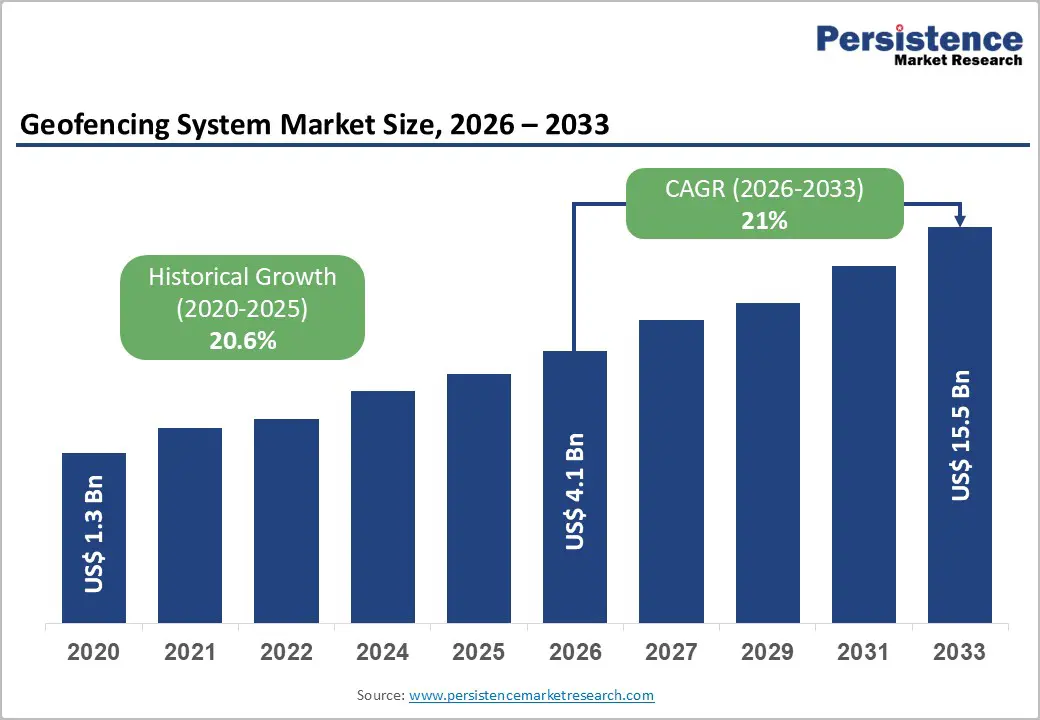
The global geofencing market is entering a transformative growth phase, driven by the rapid digitization of enterprises and the proliferation of connected devices. Valued at US$ 4.1 billion in 2026, the market is projected to surge to US$ 15.5 billion by 2033, expanding at an impressive CAGR of 21%. This remarkable growth reflects a shift in how organizations leverage location intelligence—from experimental pilot projects to large-scale, mission-critical deployments.
At its core, geofencing enables businesses to create virtual boundaries around physical locations and trigger automated actions when devices enter or exit those areas. What once served primarily as a marketing tool has now evolved into a foundational layer for logistics, security, urban planning, and digital engagement strategies.
The Expanding Role of Location Intelligence
Geofencing is no longer confined to simple proximity-based alerts. With advancements in GPS, Bluetooth Low Energy (BLE), Wi-Fi, and cellular networks, it has become a sophisticated system capable of delivering real-time insights and automation.
The widespread adoption of smartphones and IoT devices has dramatically expanded the addressable market. Today, geofencing is embedded across industries such as:
- Retail (customer engagement and in-store analytics)
- Logistics (fleet tracking and route optimization)
- BFSI (fraud prevention and compliance)
- Government (public safety and smart city initiatives)
This convergence of technologies is strengthening the geofencing ecosystem, enabling seamless integration with cloud platforms, analytics engines, and enterprise software systems.
Key Market Highlights
- North America leads with ~38% market share, driven by advanced digital infrastructure and early adoption.
- GPS-based geofencing dominates with ~48% share due to its reliability in outdoor applications.
- Fixed geofencing holds ~54% share, widely used in static environments like retail stores and warehouses.
These trends highlight the maturity of core technologies while also signaling opportunities for innovation in emerging segments.
Growth Drivers Shaping the Market
- Proliferation of Smartphones and IoT Devices
The exponential growth of connected devices is a primary catalyst for geofencing adoption. Smartphones, wearables, vehicles, and industrial sensors continuously generate location data, enabling real-time tracking and automation.
This expanding device ecosystem allows businesses to:
- Monitor assets with high precision
- Automate workflows based on location triggers
- Enhance customer engagement through contextual experiences
As geofencing integrates with enterprise platforms, it is transitioning from standalone applications to scalable, cloud-based solutions. This shift supports recurring revenue models and strengthens long-term market growth.
- Rising Demand in Logistics and Transportation
Geofencing has become indispensable in logistics and transportation. It plays a critical role in:
- Fleet management
- Last-mile delivery optimization
- Cold chain monitoring
- Route compliance and safety
By embedding geofencing into transportation management systems, companies can transform raw location data into actionable insights. For example, geofences around warehouses can automate check-ins, trigger alerts for delays, and ensure adherence to service-level agreements.
Regulatory requirements further accelerate adoption. Industries dealing with hazardous materials or sensitive goods rely on geofencing to enforce compliance and enhance accountability.
- Expansion into Security and Fraud Prevention
Beyond logistics, geofencing is gaining traction in security applications. Financial institutions, for instance, use location data to validate transactions and detect anomalies.
By comparing a user’s physical location with transaction data, organizations can:
- Reduce fraud
- Minimize false declines
- Improve customer trust
This growing reliance on geofencing for security underscores its importance as a digital risk management tool.
Challenges Limiting Market Adoption
Despite its rapid growth, the geofencing market faces several technical and operational barriers.
- Battery Consumption and Device Limitations
Continuous location tracking, especially via GPS, can drain device batteries quickly. This often leads to user opt-outs, particularly in consumer-facing applications.
- Accuracy Constraints
Geofencing accuracy can be inconsistent in urban environments or indoor settings due to:
- Signal interference
- Multipath effects
- Limited satellite visibility
While BLE and Wi-Fi-based solutions offer improvements, they introduce additional complexity and infrastructure requirements.
- Integration Complexity
Deploying geofencing at scale requires integration with multiple enterprise systems such as:
- CRM platforms
- ERP systems
- Marketing automation tools
- Transportation management systems
This increases implementation costs and technical complexity, particularly for small and mid-sized businesses.
- Data Privacy Regulations
Strict data privacy laws across regions add another layer of complexity. Organizations must ensure compliance with:
- Consent management frameworks
- Data localization requirements
- Cross-border data transfer regulations
These factors can slow down deployment and increase operational costs.
Emerging Opportunities in the Geofencing Market
- Integration with Autonomous Systems
The rise of autonomous vehicles and drone delivery systems is creating new opportunities for geofencing. In these applications, geofencing acts as a control mechanism to:
- Define no-fly zones
- Regulate movement within designated areas
- Ensure safety and compliance
As urban air mobility evolves, geofencing will become a critical component of regulatory frameworks.
- Smart Cities and Urban Mobility
Geofencing is playing a pivotal role in smart city initiatives. Municipalities are leveraging it for:
- Traffic management
- Public safety monitoring
- Electric vehicle charging zones
- Curbside access control
These applications transform geofencing into an orchestration layer for urban infrastructure, supporting long-term digitalization goals.
- AI and Advanced Analytics Integration
The convergence of geofencing with artificial intelligence and data analytics is unlocking new value. By feeding location data into machine learning models, organizations can:
- Predict customer behavior
- Optimize supply chains
- Detect anomalies in real time
- Enable dynamic pricing strategies
This evolution shifts geofencing from simple rule-based triggers to intelligent decision-making systems.
- Growth of Indoor Spatial Analytics
Indoor geofencing represents a significant untapped opportunity. Unlike outdoor environments, indoor spaces require alternative technologies such as:
- Wi-Fi triangulation
- BLE beacons
- RFID systems
These solutions enable granular tracking within:
- Retail stores
- Warehouses
- Hospitals
- Airports
Businesses can analyze customer movement, optimize layouts, and improve operational efficiency. As indoor positioning technologies mature, this segment is expected to witness rapid growth.
Category-Wise Insights
Technology Trends
GPS-based geofencing continues to dominate due to its global coverage and compatibility with existing devices. It remains essential for:
- Fleet tracking
- Asset monitoring
- Mobility services
However, BLE and Ultra-Wideband (UWB) technologies are emerging as high-growth segments. They offer:
- Higher accuracy (centimeter-level precision)
- Better indoor performance
- Lower energy consumption
These technologies are particularly valuable in environments where GPS is ineffective.
Geofencing Type Trends
Fixed geofencing remains the dominant segment, widely used in static environments such as:
- Retail outlets
- Warehouses
- Industrial zones
Its reliability and ease of implementation make it a preferred choice for large-scale deployments.
On the other hand, mobile geofencing is gaining momentum. It enables dynamic interactions between moving entities, making it ideal for:
- Ride-hailing services
- Delivery networks
- Workforce safety applications
The adoption of 5G and edge computing is further enhancing the capabilities of mobile geofencing.
Regional Market Insights
North America
North America leads the global market, driven by:
- High smartphone penetration
- Advanced digital advertising ecosystems
- Strong cloud infrastructure
The region is also home to major technology providers, fostering innovation and competition. While privacy regulations add complexity, they also promote the development of secure and compliant solutions.
Europe
Europe’s geofencing market is shaped by stringent data protection laws and strong industrial digitization. Key trends include:
- Integration with sustainable mobility initiatives
- Adoption in manufacturing and logistics
- Growth in smart city applications
Although regulatory requirements may slow deployment, they create a high-trust environment that benefits enterprise-grade solutions.
Asia Pacific
Asia Pacific is the fastest-growing region, fueled by:
- Rapid urbanization
- Expansion of e-commerce
- Growth of mobile-first platforms
Countries like China, Japan, and India are leading adoption across logistics, retail, and public sector applications. The region’s diverse regulatory landscape necessitates localized solutions, creating opportunities for both global and regional players.
Competitive Landscape
The geofencing market is moderately fragmented, with a mix of global technology giants and specialized solution providers.
- Platform leaders focus on ecosystem integration and scalability.
- Vertical specialists differentiate through industry-specific solutions and advanced analytics.
Competition is intensifying as companies invest in:
- AI-driven location intelligence
- Privacy-focused architectures
- Indoor positioning technologies
Mergers and acquisitions are also on the rise, signaling a trend toward ecosystem consolidation.
Future Outlook
The future of the geofencing market lies in its ability to evolve beyond basic location triggers into a comprehensive intelligence layer. As technologies such as AI, IoT, and 5G continue to advance, geofencing will become:
- More accurate
- More energy-efficient
- More deeply integrated into enterprise workflows
Its role will expand across industries, from enabling autonomous mobility to powering smart cities and enhancing customer experiences.
By 2033, geofencing will not just be a tool for location-based actions—it will serve as a strategic enabler of digital transformation, driving efficiency, security, and innovation across the global economy.
Conclusion
The geofencing market is on a high-growth trajectory, supported by technological advancements and expanding use cases. While challenges such as accuracy, battery consumption, and regulatory compliance persist, ongoing innovation is addressing these barriers.
As businesses increasingly rely on real-time location intelligence, geofencing is set to become a cornerstone of modern digital ecosystems. Organizations that invest in scalable, secure, and intelligent geofencing solutions will be well-positioned to capitalize on this rapidly evolving market.

 English
 Arabic
 French
 Spanish
 Portuguese
 Deutsch
 Turkish
 Dutch
Dutch
 Italiano
 Russian
 Romaian
 Greek
Greek