


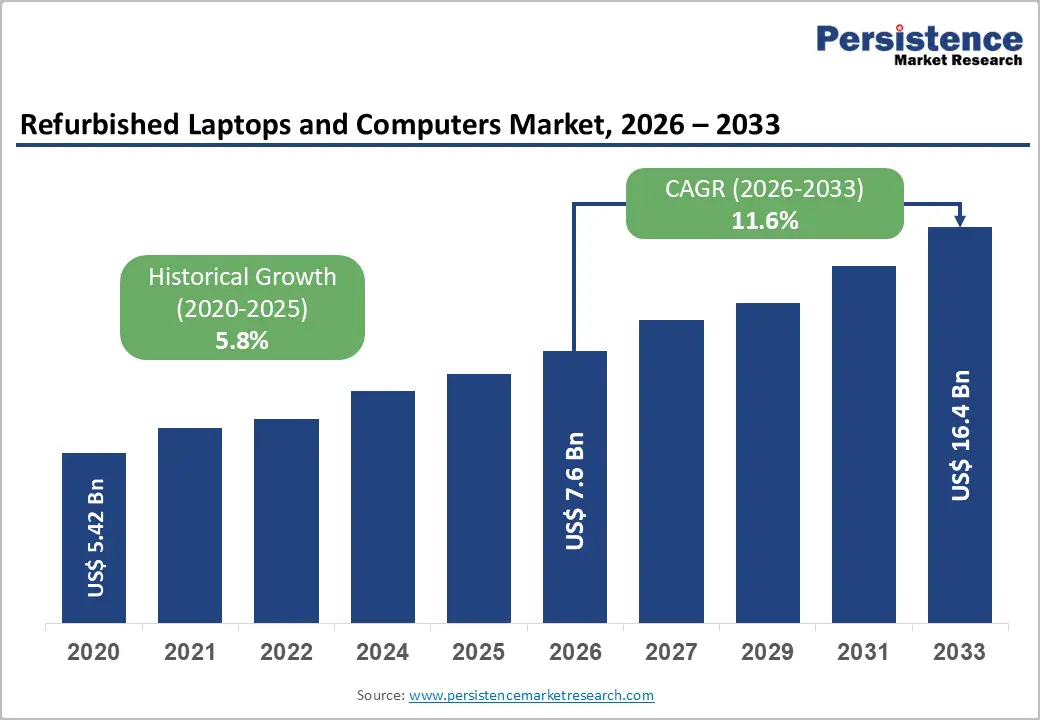
The global refurbished laptops and computers market is entering a period of accelerated expansion as affordability, sustainability, and digital accessibility reshape consumer and enterprise purchasing behavior. Valued at US$ 7.6 billion in 2026, the market is projected to reach US$ 16.4 billion by 2033, growing at a CAGR of 11.6% between 2026 and 2033.
Refurbished computing devices are no longer viewed merely as low-cost alternatives. They are increasingly recognized as practical, environmentally responsible, and technologically capable solutions for businesses, students, governments, and individual consumers. The growing adoption of circular economy principles, combined with rising IT hardware costs and corporate sustainability goals, is transforming the refurbished electronics ecosystem into a mainstream technology segment.
Market Overview
Refurbished laptops and computers refer to pre-owned devices that are professionally inspected, repaired, cleaned, tested, and restored to working condition for resale. These systems are commonly sourced from enterprise lease returns, corporate IT refresh cycles, retail returns, and surplus inventory.
The market is benefiting from a unique convergence of factors:
- Growing price sensitivity among consumers and organizations
- Increasing e-waste management regulations globally
- Corporate IT asset disposition (ITAD) programs
- Expanding digital education initiatives
- Rising remote and hybrid work adoption
- Improved trust in certified refurbished products
The transition away from Windows 10 before its end-of-life deadline in October 2025 has also accelerated enterprise device replacement cycles, significantly increasing the availability of high-quality off-lease laptops and desktops in refurbishment channels.
Cost Efficiency Continues to Drive Demand
One of the most powerful growth drivers for refurbished devices is their substantial cost advantage over new hardware. Refurbished laptops are typically priced 30% to 50% lower than comparable new systems, making them attractive for budget-conscious buyers.
Small and medium-sized businesses (SMBs), educational institutions, startups, and consumers in developing economies increasingly prefer refurbished systems to reduce capital expenditure while maintaining acceptable performance standards.
In emerging economies, refurbished devices are helping bridge the digital divide. Many students and first-time internet users can access computing technology only through affordable secondary-market hardware. Governments and NGOs are also integrating refurbished devices into digital literacy programs to improve technology accessibility.
Rising inflation and uncertain macroeconomic conditions globally have further strengthened value-oriented purchasing behavior. Organizations seeking to optimize IT budgets are now considering refurbished enterprise-grade devices as viable alternatives to expensive new hardware.
Sustainability Becomes a Core Market Catalyst
Environmental sustainability is becoming central to purchasing decisions across both corporate and consumer segments. The electronics industry remains one of the largest contributors to global e-waste generation, encouraging governments and corporations to embrace circular economy strategies.
Refurbished devices significantly extend product lifecycles, reduce landfill waste, and lower carbon emissions associated with manufacturing new electronics. This sustainability advantage is increasingly influencing procurement decisions.
Regulatory initiatives such as the EU WEEE Directive (2012/19/EU), Extended Producer Responsibility (EPR) frameworks, and the EU General Product Safety Regulation (GPSR) are formalizing refurbishment ecosystems across Europe and other regions.
Large enterprises are also aligning procurement strategies with ESG targets and sustainability reporting requirements. Refurbished hardware helps organizations reduce environmental impact while supporting corporate sustainability commitments.
OEMs such as HP, Dell, and Lenovo are strengthening their certified refurbishment programs as part of broader circular economy initiatives, further legitimizing the secondary electronics market.
Corporate PC Refresh Cycles Fuel Supply Growth
The global transition from Windows 10 to Windows 11 is creating a major supply-side opportunity for the refurbishment industry. As enterprises upgrade fleets to meet newer operating system requirements, millions of enterprise-grade devices are entering IT asset disposition channels.
This surge in off-lease inventory is significantly improving the availability of premium refurbished devices, especially business-class laptops such as:
- HP EliteBook
- Dell Latitude
- Lenovo ThinkPad
These systems are particularly attractive because they are built with durable enterprise-grade specifications and typically remain highly functional after corporate replacement cycles.
ITAD providers and certified refurbishers are benefiting from the increased flow of reusable devices into secondary markets. This creates a reinforcing supply-demand cycle that is expected to support market growth through the forecast period.
Online Platforms Reshape Market Distribution
The rapid expansion of e-commerce has transformed how refurbished electronics are marketed and sold globally. Online distribution channels now account for approximately 68% of market sales, making digital platforms the dominant route to market.
Dedicated refurbished marketplaces such as Back Market and Amazon Renewed have helped overcome long-standing consumer trust concerns by introducing:
- Standardized grading systems
- Warranty protection
- Easy return policies
- Verified seller networks
- Transparent product descriptions
These platforms allow consumers to compare products across multiple brands and price points while providing confidence in product quality.
The online model also enables refurbishers to scale globally without the limitations of traditional retail infrastructure. Consumers in smaller cities and underserved regions can now access certified refurbished devices through nationwide delivery networks.
At the same time, physical certified refurbish stores continue to serve enterprise buyers requiring bulk procurement, technical consultations, and after-sales support.
OEM-Certified Refurbishment Programs Gain Momentum
Original Equipment Manufacturers are increasingly entering the refurbishment ecosystem directly through certified programs that offer quality assurance and warranty-backed products.
HP expanded its Certified Refurbished PC portfolio in 2025 by adding EliteBook and EliteDesk models while extending program availability across multiple European countries. Dell Refurbished and Lenovo Renew have similarly expanded their offerings.
OEM-backed refurbishment programs provide several advantages:
- Standardized testing and certification
- Manufacturer warranties
- Authentic replacement parts
- Professional refurbishment processes
- Stronger consumer confidence
These programs are particularly important for enterprise and institutional buyers who require reliable after-sales support and predictable product quality.
As OEM participation increases, the market is becoming more formalized and professionally managed, helping reduce the perception that refurbished products are inherently risky or unreliable.
Consumer Trust Remains a Key Challenge
Despite rapid market growth, consumer skepticism continues to limit broader adoption in some segments.
Many buyers remain concerned about:
- Device reliability
- Battery degradation
- Data security risks
- Short warranty coverage
- Hidden hardware defects
- Lack of standard grading systems
Independent refurbishers often provide limited warranties, which can discourage premium buyers and corporate procurement teams.
Trust remains especially important in enterprise environments where data protection and operational continuity are critical. Inconsistent refurbishment standards across informal market participants also contribute to buyer hesitation.
To address these concerns, leading platforms and OEM-certified programs are emphasizing transparency, warranty coverage, and quality certification as differentiators.
Laptop Segment Dominates the Market
Laptops account for nearly 74% of the refurbished laptops and computers market, making them the dominant product category.
The shift toward hybrid work, remote learning, and mobile computing has significantly increased global demand for portable devices. Laptops offer greater flexibility and convenience than desktop systems, particularly for students, professionals, and remote workers.
Business-class laptops remain especially popular in secondary markets because they combine durability with enterprise-grade performance specifications.
While desktops represent a smaller market share, they continue to maintain relevance in educational institutions, offices, and fixed-location work environments where mobility is less important.
Windows Remains the Leading Operating Platform
Windows-based devices dominate the refurbished computing market with approximately 66% market share.
The dominance of Windows systems is driven by:
- Large global enterprise installed base
- Broad software compatibility
- Enterprise IT standardization
- Availability of off-lease Windows hardware
- Microsoft Authorized Refurbisher licensing programs
Refurbished macOS devices maintain strong demand among premium consumers due to Apple’s brand value and longer device lifecycles. However, their higher resale pricing limits broader affordability compared to Windows alternatives.
Linux-based refurbished systems are also gaining traction among developers, educational users, and open-source communities seeking low-cost computing solutions.
Regional Market Trends
North America Leads the Global Market
North America remains the largest regional market, accounting for approximately 34% of global share.
The region benefits from:
- Mature ITAD infrastructure
- Strong e-commerce adoption
- High enterprise device turnover
- Advanced logistics networks
- Strong OEM-certified refurbishment ecosystems
The United States alone generated more than US$ 2 billion in refurbished laptop revenues in 2024. Growing sustainability awareness and structured enterprise procurement practices continue to support regional growth.
Europe Advances Through Regulation
Europe is emerging as a highly formalized refurbishment market driven by strong environmental regulations and circular economy initiatives.
Policies such as the WEEE Directive, GPSR, and Waste Framework Directive are encouraging structured refurbishment ecosystems while improving product traceability and safety compliance.
Countries including Germany, France, the U.K., and Spain are witnessing rising adoption of certified refurbished electronics across both consumer and institutional segments.
Asia Pacific Becomes the Fastest-Growing Region
Asia Pacific is projected to record the highest growth rate during the forecast period.
The region benefits from:
- Rapidly growing middle-class populations
- Expanding internet penetration
- Cost-sensitive consumers
- Government digital education programs
- Growing SME sectors
India, China, and ASEAN countries are leading demand growth. India, in particular, represents a major opportunity due to increasing digital literacy initiatives and affordability challenges in non-metro regions.
China’s manufacturing and refurbishment ecosystem also enables highly competitive pricing and scalable supply capabilities.
Competitive Landscape
The refurbished laptops and computers market remains moderately fragmented, with a mix of OEM-certified programs, online marketplaces, and independent refurbishers competing globally.
Leading companies are differentiating themselves through:
- Certified quality standards
- Extended warranties
- Sustainability branding
- Global logistics capabilities
- AI-enabled device diagnostics
- Subscription-based device models
Some of the key companies operating in the market include:
- Apple Certified Refurbished
- Dell Refurbished
- Lenovo Renew
- HP Renew
- Amazon Renewed
- Best Buy Outlet
- Acer Recertified
- Back Market
- Refurb.io
- PC Liquidations
- Microsoft Authorized Refurbishers (MAR)
Subscription-based refurbished device programs and Device-as-a-Service (DaaS) models are expected to gain traction as enterprises seek flexible and sustainable IT procurement strategies.
Future Outlook
The future of the refurbished laptops and computers market appears highly promising as affordability and sustainability increasingly shape global technology consumption patterns.
Several long-term trends are expected to support sustained growth:
- Expansion of OEM-certified refurbishment ecosystems
- Rising corporate ESG commitments
- Increasing regulatory support for circular electronics
- Continued growth in hybrid work and digital education
- Greater acceptance of secondary-market electronics
- Improved quality assurance and warranty standards
As technology refresh cycles continue accelerating globally, the supply of high-quality reusable hardware is expected to expand substantially. Combined with rising consumer awareness and growing institutional adoption, refurbished laptops and computers are poised to become an integral component of the global computing ecosystem.
The market’s evolution from a price-driven secondary segment into a trusted, sustainability-focused technology channel highlights its increasing strategic importance within the broader electronics industry.

 English
 Arabic
 French
 Spanish
 Portuguese
 Deutsch
 Turkish
 Italiano
 Russian
 Romaian
 Portuguese (Brazil)
 Greek
Greek