


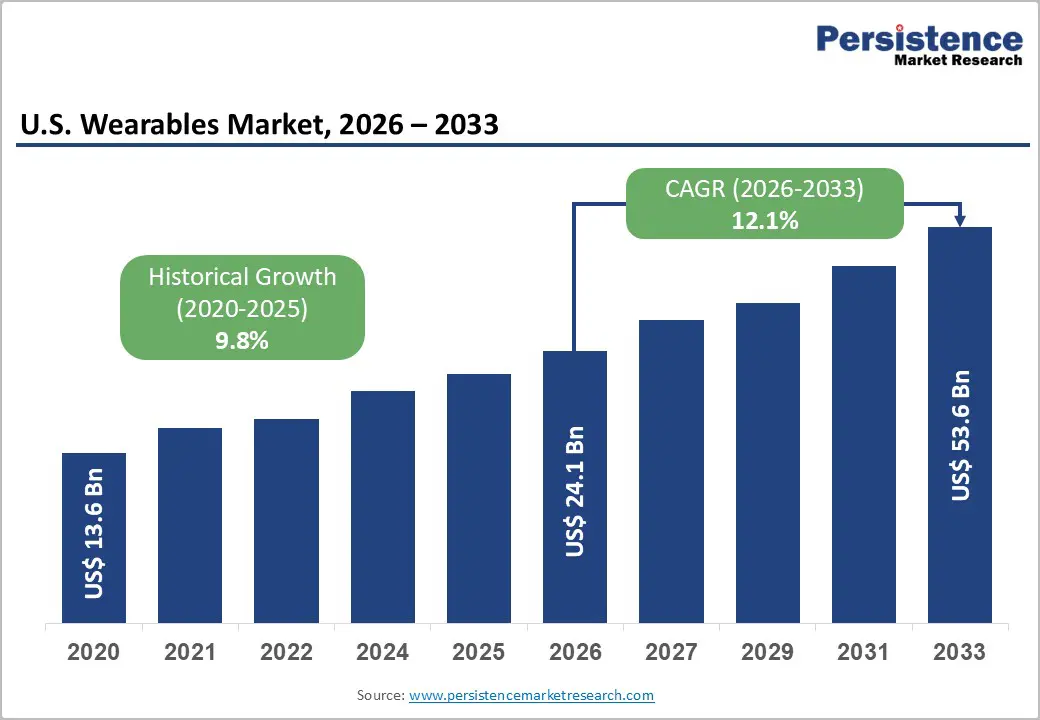
The U.S. wearables market is entering a high-growth phase driven by the convergence of healthcare digitization, consumer wellness awareness, and rapid advancements in sensor and AI technologies. Valued at US$24.1 billion in 2026, the market is projected to reach US$53.6 billion by 2033, expanding at a strong CAGR of 12.1% during the forecast period.
This growth reflects a broader shift in consumer behavior—wearables are no longer just fitness accessories; they are becoming essential tools for preventive healthcare, real-time monitoring, and personalized digital lifestyles.
Market Overview: From Fitness Gadgets to Health Ecosystems
The evolution of wearables in the United States has been significantly shaped by post-pandemic wellness priorities. Consumers increasingly rely on smart devices for continuous health tracking, including heart rate monitoring, sleep analysis, oxygen saturation (SpO2), and stress management.
Integration with smartphones and broader IoT ecosystems has further strengthened adoption. Devices now provide real-time insights that support lifestyle decisions, making wearables a core part of daily health management rather than optional accessories.
Government-backed initiatives, including preventive health campaigns by the U.S. Department of Health and Human Services, are also encouraging adoption by promoting digital health tools for early diagnosis and wellness tracking.
Key Market Highlights
Product Leadership
- Wrist-wear dominates the market, accounting for over 38% share in 2026, valued at more than US$9.1 billion.
- Its popularity is driven by multifunctionality—fitness tracking, notifications, health monitoring, and seamless smartphone integration.
- Meanwhile, headwear devices are emerging as the fastest-growing segment, expanding at a CAGR of 14.9%, supported by demand for hands-free communication and immersive audio experiences.
Connectivity Trends
- Bluetooth remains dominant, holding over 54% market share in 2026, valued at over US$13 billion, due to its low power consumption and universal compatibility.
- Cellular connectivity is the fastest-growing segment, with a CAGR of 15.6%, as users demand standalone functionality without smartphone dependency.
Application Insights
- Fitness & wellness leads the market, capturing more than 27% share in 2026 (over US$6.5 billion).
- Healthcare applications are expanding rapidly, projected to grow at a CAGR of 14.5%, driven by remote patient monitoring and chronic disease management.
Market Drivers
- Rising Digital Health Adoption and Preventive Care Awareness
A key growth driver is the increasing burden of chronic diseases in the U.S. According to public health data, nearly six in ten adults live with at least one chronic condition. This has created strong demand for continuous monitoring tools.
Wearables equipped with ECG, SpO2, and sleep-tracking capabilities are increasingly integrated into preventive care frameworks supported by Medicare and Medicaid programs. These devices help reduce hospital visits and improve early diagnosis through real-time health insights.
Additionally, integration with electronic health records (EHRs) has strengthened physician–patient connectivity, enabling better clinical decision-making.
- Advancements in Sensor Technology and Connectivity
Technological innovation is another major growth engine. Leading companies such as Apple Inc. and Samsung Electronics Co. Ltd. are heavily investing in advanced biosensors, AI algorithms, and low-power chipsets.
Key advancements include:
- Enhanced battery life (up to 50% improvement in wrist devices)
- More accurate health-grade sensors
- Improved water resistance and durability
- Seamless IoT interoperability
The rollout of 5G networks across the U.S. has further enabled real-time data transmission, especially for cellular-enabled wearables used in remote monitoring and emergency response systems.
Market Restraints
- Counterfeit Product Proliferation
One of the major challenges is the presence of counterfeit devices imitating premium brands such as Apple and Samsung. These products often fail to meet safety and accuracy standards, leading to consumer distrust.
Limited regulatory enforcement and fragmented global supply chains make it difficult to control fake product circulation. This impacts both revenue and brand reputation.
- Device Saturation and Long Replacement Cycles
Urban markets in the U.S. already show high penetration of smartwatches and fitness bands. As a result:
- Consumers upgrade devices less frequently
- New models often offer only incremental improvements
- Smartphones and fitness apps reduce dependency on wearables
This slows short-term revenue expansion despite long-term growth potential.
Emerging Opportunities
- AI-Driven Personalized Healthcare
Artificial intelligence is transforming wearables into predictive health platforms. Machine learning algorithms can now detect:
- Irregular heart rhythms
- Sleep disorders
- Stress patterns
- Early signs of chronic conditions
Companies are increasingly offering subscription-based digital health services that combine wearable data with clinical insights. Regulatory support from the U.S. Food and Drug Administration (FDA) for digital therapeutics is further accelerating innovation.
- Smart Clothing and Embedded Sensors
A rapidly emerging segment is smart textiles or smart clothing, which integrates sensors directly into fabrics. These garments enable:
- Continuous heart rate monitoring
- Temperature tracking
- Muscle activity analysis
- Posture correction
Sports and fitness brands are investing heavily in this segment, aiming to merge comfort with advanced biometric tracking. This innovation is expected to create entirely new revenue streams beyond traditional wearable devices.
Segment Analysis
Product Segment: Wrist-Wear Dominance
Wrist-worn devices remain the backbone of the wearables industry. Their popularity stems from convenience and multifunctionality, offering users a single device for:
- Fitness tracking
- Health monitoring
- Communication alerts
- App integration
Headwear devices, however, are gaining traction due to their hands-free usability and integration with audio-based experiences.
Connectivity Segment: Bluetooth vs. Cellular
Bluetooth continues to dominate due to its energy efficiency and compatibility across devices. However, cellular wearables are reshaping the market by enabling independence from smartphones.
This is particularly valuable for:
- Elderly care
- Child safety tracking
- Outdoor fitness enthusiasts
- Emergency response applications
Application Segment: Healthcare Transformation
While fitness remains the dominant use case, healthcare is the fastest-growing application area. Wearables are increasingly used for:
- Remote patient monitoring
- Chronic disease management
- Post-surgical recovery tracking
- Telehealth integration
This shift is transforming wearables from consumer gadgets into clinical-grade monitoring tools.
Competitive Landscape
The U.S. wearables market is moderately consolidated, with major global technology players leading innovation. Companies such as Garmin Ltd., Fitbit Inc., Meta Platforms Inc., and Sony Group Corporation are competing through ecosystem integration, AI-driven analytics, and subscription-based services.
Key competitive strategies include:
- Development of proprietary operating systems
- Expansion into healthcare partnerships
- AI-powered health insights
- Integration with telehealth platforms
- Premium design differentiation
Recent Industry Developments
Several notable developments are shaping the market:
- In 2026, Team USA partnered with wearable technology providers to equip athletes with advanced biometric tracking devices for performance optimization during major sporting events.
- The FDA introduced updated guidance clarifying that most fitness and wellness wearables will not require medical device classification unless making clinical claims. This has significantly reduced regulatory barriers for innovation.
Future Outlook
The U.S. wearables market is transitioning toward a fully integrated digital health ecosystem. Over the next decade, growth will be driven by:
- Expansion of AI-powered health analytics
- Increasing adoption of subscription health platforms
- Growth in remote patient monitoring
- Emergence of smart textiles
- Strong 5G-enabled device ecosystems
As healthcare, fitness, and consumer electronics continue to converge, wearables will become central to both personal wellness and clinical care delivery.
Conclusion
The U.S. wearables market is on a strong upward trajectory, supported by technological innovation, rising health awareness, and evolving digital ecosystems. With market size expected to more than double by 2033, the sector is shifting from simple fitness tracking devices to comprehensive health intelligence platforms.
Companies that successfully integrate AI, healthcare partnerships, and seamless connectivity will be best positioned to lead the next wave of wearable innovation in the United States.

 English
 French
 Spanish
 Portuguese
 Deutsch
 Turkish
 Dutch
Dutch
 Italiano
 Russian
 Romaian
 Portuguese (Brazil)
 Greek
Greek