


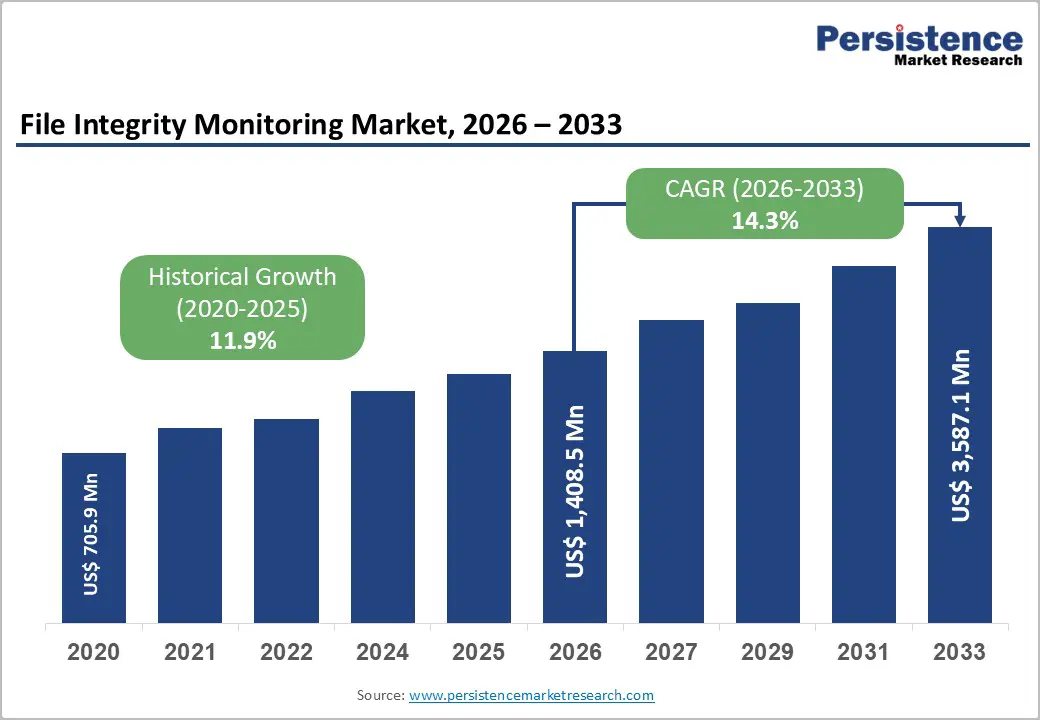
The global file integrity monitoring (FIM) market is undergoing a significant transformation as organizations increasingly prioritize cybersecurity resilience and regulatory compliance. Valued at US$1,408.5 million in 2026, the market is projected to reach US$3,587.1 million by 2033, expanding at a strong CAGR of 14.3% during the forecast period. This robust growth reflects the rising importance of continuous monitoring of critical files, configurations, and sensitive system data across complex IT environments.
As cyber threats become more sophisticated and widespread, enterprises are shifting from reactive security models to proactive, real-time integrity monitoring frameworks. FIM solutions are now essential components of modern cybersecurity architectures, particularly in hybrid cloud and multi-cloud infrastructures.
Market Overview
File Integrity Monitoring refers to security technology that detects and reports unauthorized changes to files, systems, and configurations. These tools continuously track file states and alert security teams when modifications deviate from established baselines.
The increasing reliance on digital systems, cloud computing, and remote operations has significantly expanded the attack surface for organizations. As a result, FIM solutions are being widely adopted to ensure:
- Real-time detection of unauthorized file changes
- Compliance with global data protection regulations
- Rapid forensic investigation capabilities
- Reduction in insider and external cyber threats
The shift toward automation, AI-driven analytics, and cloud-native architectures is further reshaping the competitive landscape of the FIM market.
Key Market Highlights
Offering Segment
The software segment dominates the market, accounting for over 68% share in 2026, valued at more than US$957.8 million. This dominance is driven by demand for scalable, automated, and AI-enabled monitoring platforms capable of handling distributed environments.
On the other hand, the services segment is the fastest growing, expanding at a CAGR of 15.6%, as organizations increasingly rely on managed services for deployment, tuning, and continuous monitoring.
Deployment Mode
- On-premises deployment holds over 43% share in 2026, valued at more than US$605.7 million, due to its suitability for regulated industries and legacy systems.
- Cloud-based FIM solutions are growing rapidly at a CAGR of 18.7%, driven by scalability, automation, and reduced infrastructure costs.
Cloud-native architectures, including containerized and serverless environments, are significantly boosting adoption of modern FIM tools.
Enterprise Size
- Large enterprises dominate the market, accounting for more than 70% share in 2026 (over US$986 million) due to strong cybersecurity budgets and complex IT ecosystems.
- SMEs represent the fastest-growing segment, expanding at a CAGR of 18.1%, as ransomware threats and compliance pressures push smaller organizations to adopt affordable security solutions.
Industry Vertical
- BFSI sector leads the market, with over 28% share in 2026 (US$394.4 million), driven by stringent regulatory compliance and high-value data protection needs.
- Healthcare is the fastest-growing vertical, expanding at a CAGR of 17.4%, due to rising ransomware attacks and increasing digitization of patient records.
Regional Insights
- North America leads the market, holding over 36% share in 2026 (US$507.1 million), supported by strong cybersecurity frameworks and high ransomware exposure.
- Europe accounts for over 24% share, driven by strict regulations such as GDPR, NIS 2 Directive, and DORA.
- Asia Pacific is the fastest-growing region, with a CAGR of 18.2%, fueled by rapid digital transformation in India, China, Japan, and ASEAN economies.
Market Dynamics
Key Driver: Rising Cybersecurity Threats
One of the primary drivers of the FIM market is the surge in cybersecurity incidents, including ransomware, malware, and insider threats. Traditional perimeter-based security models are no longer sufficient to protect modern IT environments.
Organizations are increasingly adopting FIM solutions to:
- Detect unauthorized file changes in real time
- Strengthen ransomware defense mechanisms
- Support forensic investigations
- Reduce financial losses from data breaches
According to IBM, the average cost of a data breach reached US$4.44 million in 2025, highlighting the financial urgency behind proactive cybersecurity investments.
Regulatory Compliance Pressure
Strict global regulations are significantly contributing to FIM adoption. Key frameworks include:
- PCI-DSS for payment security
- HIPAA for healthcare data protection
- GDPR for data privacy and accountability
- SOX and CCPA for corporate governance and consumer rights
These regulations require continuous monitoring, audit trails, and tamper detection mechanisms. FIM solutions help organizations meet these requirements through automated compliance reporting and real-time alerting systems.
Market Restraints
Despite strong growth prospects, the market faces several challenges:
Implementation Complexity
Deploying FIM systems requires careful configuration, baseline definition, and integration with SIEM and SOAR platforms. This complexity can delay adoption and increase costs.
False Positives and Alert Fatigue
High volumes of alerts often lead to security team fatigue, reducing operational efficiency and increasing risk of missed threats.
SME Adoption Barriers
Small and medium enterprises often struggle with budget constraints and lack of skilled cybersecurity professionals, limiting widespread adoption.
Growth Opportunities
Cloud-Native and Containerized FIM
The rapid adoption of Kubernetes and container-based architectures is creating new opportunities for modern FIM solutions. Traditional tools are being replaced by cloud-native systems capable of:
- Monitoring ephemeral workloads
- Securing container images
- Enforcing infrastructure-as-code policies
- Integrating with DevSecOps pipelines
This shift is critical as more than 60% of enterprises already use Kubernetes, with adoption expected to exceed 90% in the coming years.
AI and Machine Learning Integration
AI-driven FIM solutions are transforming the market by improving accuracy and reducing false positives. Machine learning models help establish behavioral baselines and detect anomalies in real time.
Key benefits include:
- Reduced alert fatigue
- Faster threat detection
- Automated incident response
- Improved correlation of system activity
Some advanced systems now reduce response times from hours to minutes, significantly improving cybersecurity resilience.
Segment Analysis
Software Segment
Software remains the backbone of the FIM market, offering:
- Real-time file monitoring
- Automated compliance reporting
- Integration with SIEM systems
- Machine learning-based anomaly detection
Organizations prefer software solutions due to their scalability and ability to operate across distributed environments.
Services Segment
The services segment is growing rapidly due to increasing demand for:
- Managed security services
- Deployment support
- Policy configuration
- Continuous monitoring and tuning
As cybersecurity environments become more complex, enterprises rely heavily on expert-driven services.
Industry Analysis
BFSI Sector
The banking and financial services sector remains the largest adopter of FIM solutions. Financial institutions handle sensitive transactional and customer data, making them prime targets for cyberattacks.
FIM is critical for:
- Regulatory compliance (PCI DSS, SOX)
- Fraud detection
- Transaction integrity verification
- Risk mitigation
Healthcare Sector
Healthcare is experiencing rapid adoption due to increasing digitization and ransomware threats. Hospitals and healthcare providers rely on FIM for:
- Protecting electronic health records (EHRs)
- Ensuring compliance with HIPAA
- Securing connected medical devices
- Preventing unauthorized data modification
Regional Analysis
North America
North America dominates due to advanced cybersecurity infrastructure and strict regulatory frameworks. The region experiences high ransomware activity, pushing organizations to invest heavily in proactive monitoring tools.
Europe
Europe’s strong regulatory environment, particularly GDPR and NIS 2 Directive, ensures continuous demand for compliance-driven security solutions. Financial services and government sectors are key adopters.
Asia Pacific
Asia Pacific is the fastest-growing region, driven by rapid digitalization, cloud adoption, and expanding IT infrastructure. Countries like India and China are major contributors to market growth.
Competitive Landscape
The FIM market is moderately fragmented, with both global cybersecurity leaders and niche players competing.
Key companies include:
- Trend Micro Incorporated
- Tripwire Inc.
- Qualys Inc.
- SolarWinds Worldwide LLC
- Splunk Inc.
- Netwrix Corporation
These companies focus on AI integration, cloud-native monitoring, and compliance automation to strengthen their market position.
Recent Developments
- Trend Micro introduced AI-powered FIM capabilities integrated with Kubernetes and eBPF for real-time cloud workload protection.
- Cimcor expanded its cybersecurity footprint in the Middle East through strategic partnerships, targeting government and financial institutions.
- Vendors are increasingly embedding FIM features into broader cybersecurity platforms, including XDR and SIEM ecosystems.
Conclusion
The file integrity monitoring market is positioned for strong and sustained growth through 2033, driven by escalating cyber threats, regulatory enforcement, and rapid digital transformation. As organizations transition toward cloud-native and hybrid infrastructures, demand for real-time, automated, and intelligent monitoring solutions will continue to rise.
With a projected market size of US$3.58 billion by 2033, FIM solutions are becoming indispensable components of modern cybersecurity strategies. The integration of AI, machine learning, and cloud-native capabilities will further redefine the competitive landscape, making FIM a core pillar of enterprise security architecture in the coming decade.

 Arabic
 French
 Spanish
 Portuguese
 Deutsch
 Turkish
 Dutch
Dutch
 Italiano
 Russian
 Romaian
 Portuguese (Brazil)
 Greek
Greek