


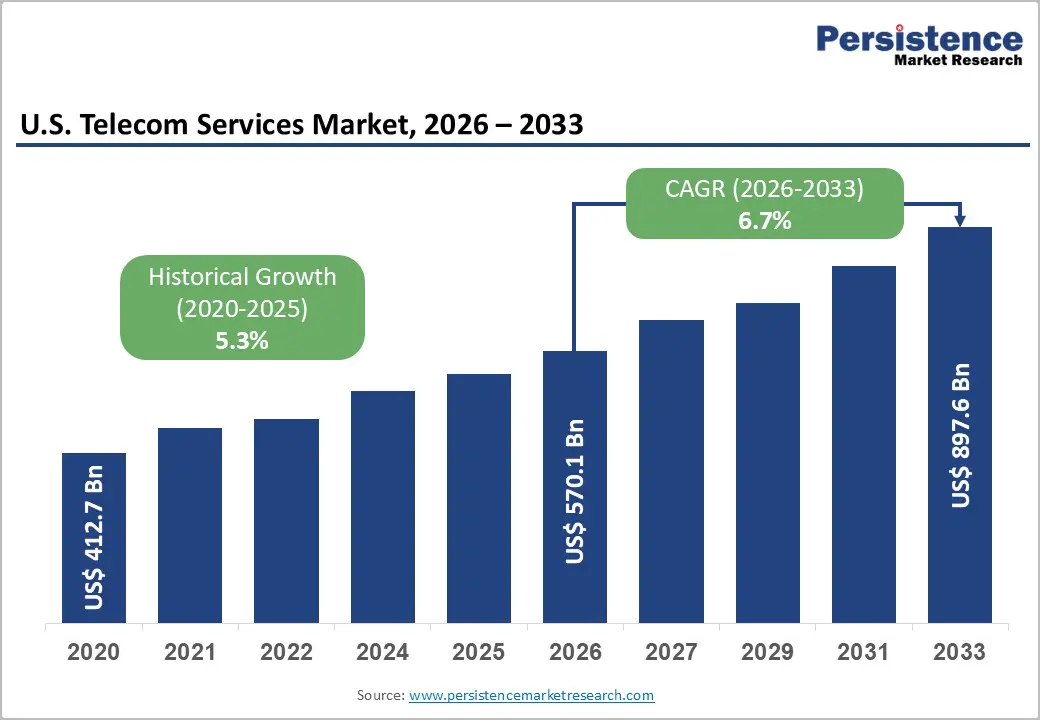
The U.S. telecom services industry is undergoing a profound transformation as next-generation digital infrastructure reshapes the way consumers, enterprises, and governments communicate, operate, and deliver services. The market is shifting from traditional voice-centric business models toward data-driven connectivity ecosystems powered by 5G, fiber-optic broadband, cloud computing, artificial intelligence (AI), edge computing, and Internet of Things (IoT) technologies.
The U.S. telecom services market size was valued at US$ 218.9 billion in 2026 and is projected to reach US$ 244.7 billion by 2033, expanding at a CAGR of 1.6% from 2026 to 2033. Historically, the market grew from US$ 190.5 billion in 2020 at a CAGR of 2.5%, reflecting the gradual migration away from legacy voice services toward advanced broadband and mobile data connectivity solutions.
Telecommunications providers across the United States are aggressively investing in fiber networks, standalone 5G infrastructure, satellite integration, and private enterprise connectivity to meet the growing demand for seamless digital experiences. The industry is also benefiting from rising adoption of telemedicine, smart manufacturing, connected vehicles, AI-driven business applications, and digital financial services that require low-latency, high-bandwidth communications infrastructure.
5G Deployment Accelerating Industry Transformation
One of the strongest growth drivers in the U.S. telecom services market is the rapid deployment of 5G infrastructure. Telecommunications operators are significantly expanding wireless capacity to support growing mobile data consumption and emerging machine-to-machine communication applications.
As of Q1 2025, North America recorded approximately 314 million 5G connections, representing nearly 83% population penetration. The region continues to experience exponential growth in mobile data traffic, driven by video streaming, cloud gaming, enterprise mobility, and AI-enabled applications.
The deployment of standalone 5G networks is enabling ultra-low latency communication, faster upload and download speeds, and improved network reliability. Telecom providers are increasingly leveraging mid-band spectrum to balance coverage and performance while supporting dense urban environments and enterprise workloads.
5G is also accelerating the adoption of Fixed Wireless Access (FWA) services, which use wireless infrastructure to provide home broadband connectivity. FWA has emerged as a viable alternative to traditional cable and DSL services, especially in suburban and rural regions where fiber deployment remains limited.
The continued expansion of 5G infrastructure is expected to unlock new revenue opportunities in industrial IoT, autonomous transportation, remote healthcare monitoring, augmented reality (AR), virtual reality (VR), and smart city deployments.
Fiber Broadband Expansion Strengthening Connectivity Infrastructure
Fiber-optic broadband infrastructure investments represent another major pillar supporting telecom market growth in the United States. Telecom operators are replacing aging copper-based networks with high-speed fiber architectures capable of supporting massive data transmission requirements.
Large telecom companies including AT&T, Frontier Communications, Comcast, and Charter Communications are rapidly expanding fiber coverage nationwide. Fiber deployment supports increasing consumer demand for streaming services, cloud computing, online gaming, remote work, and digital education platforms.
AT&T announced a US$ 250 billion multi-year investment strategy aimed at expanding fiber, 5G, and satellite infrastructure across urban, suburban, and rural regions. Similarly, Frontier and Spectrum have accelerated network expansion initiatives to improve broadband accessibility and service reliability.
Fiber infrastructure delivers multiple strategic advantages, including:
- Higher internet speeds
- Reduced latency
- Enhanced network reliability
- Greater scalability
- Lower maintenance costs over time
The growing adoption of smart homes, AI-powered applications, and connected enterprise systems is expected to further increase demand for fiber broadband services throughout the forecast period.
Federal Broadband Programs Expanding Rural Connectivity
Government-backed broadband expansion programs are significantly improving internet accessibility in underserved and rural regions across the United States.
The Broadband Equity, Access, and Deployment (BEAD) program, established under the Infrastructure Investment and Jobs Act, represents the largest federal broadband funding initiative in U.S. history. The program allocates billions of dollars to states and territories for broadband deployment projects targeting underserved communities.
These investments are structurally expanding the addressable market for telecom service providers by enabling infrastructure development in regions that were previously economically challenging to serve.
Federal broadband funding is helping accelerate:
- Rural fiber deployment
- Community broadband initiatives
- Public-private partnerships
- Digital inclusion programs
- Affordable internet access
Improved rural connectivity is expected to stimulate economic development, support remote learning, enable telemedicine services, and increase broadband adoption across residential and enterprise users.
Rising IoT Adoption Fueling Machine-to-Machine Connectivity
Machine-to-Machine (M2M) communication and Mobile IoT services are emerging as the fastest-growing segments within the U.S. telecom services market.
Industries including healthcare, manufacturing, automotive, logistics, agriculture, and utilities are increasingly adopting connected devices to improve operational efficiency, automate workflows, and enhance real-time monitoring capabilities.
The proliferation of connected devices is driving demand for:
- Cellular IoT connectivity
- Private wireless networks
- Edge computing infrastructure
- Real-time analytics platforms
- Low-latency communications
Advancements in 4G LTE and 5G networks are enabling faster data transmission and enhanced device management capabilities, making large-scale IoT deployments more feasible across industrial and commercial environments.
Connected vehicle technologies, smart factories, remote asset monitoring, and smart city initiatives are expected to remain key growth areas for telecom operators offering IoT connectivity solutions.
Consumer Demand Continues to Dominate Market Revenue
The consumer/residential segment accounts for the largest share of the U.S. telecom services market, representing approximately 40% of total industry revenue in 2026.
Consumers continue to demand high-speed broadband, mobile data services, streaming entertainment, and seamless digital experiences across multiple connected devices. The growth of remote work, online education, e-commerce, and digital content consumption has substantially increased household bandwidth requirements.
Video streaming platforms, gaming services, and cloud-based applications are contributing to sustained growth in broadband usage. Simultaneously, smartphone penetration and 5G adoption are driving higher mobile data consumption across the population.
Telecom providers are increasingly focusing on bundled service offerings that combine:
- Mobile services
- Broadband internet
- Streaming subscriptions
- Smart home services
- Security solutions
Bundling strategies help reduce customer churn while improving average revenue per user (ARPU).
Enterprise Digital Transformation Driving Business Connectivity Demand
Enterprise customers represent one of the fastest-growing telecom service segments due to rapid digital transformation initiatives across industries.
Businesses are increasingly investing in advanced communications infrastructure to support:
- Cloud computing
- AI workloads
- Hybrid work environments
- Data center connectivity
- Cybersecurity operations
- Edge computing deployments
The IT and telecom sector is witnessing particularly strong growth as enterprises require scalable, low-latency, and high-bandwidth connectivity solutions for mission-critical operations.
Telecom providers are responding by offering enterprise-focused services such as:
- Dedicated fiber connections
- MPLS networks
- SD-WAN solutions
- Private 5G networks
- Managed cloud connectivity
- Secure communications platforms
Demand for enterprise connectivity solutions is expected to rise further as AI adoption accelerates across industries.
Healthcare Industry Creating New Telecom Opportunities
The healthcare sector is emerging as a major opportunity area for telecom service providers due to the rapid expansion of telemedicine and remote healthcare delivery systems.
Modern healthcare increasingly relies on secure, high-speed communications infrastructure capable of supporting:
- Real-time video consultations
- Remote patient monitoring
- AI-assisted diagnostics
- Electronic health records
- Medical imaging transfers
- Connected healthcare devices
The rollout of advanced 5G and fiber networks is enabling more sophisticated telehealth applications, including real-time remote diagnostics and robotic-assisted procedures.
Healthcare organizations require telecom infrastructure that meets strict compliance and security standards, creating opportunities for telecom operators to develop industry-specific connectivity solutions.
Rural healthcare providers are especially benefiting from broadband expansion initiatives that improve access to telemedicine platforms and specialist consultations.
BFSI Sector Modernization Supporting Telecom Growth
The Banking, Financial Services, and Insurance (BFSI) sector is also driving significant demand for secure telecom infrastructure.
Financial institutions are rapidly modernizing operations through digital banking platforms, AI-powered analytics, fraud detection systems, and cloud-based financial services.
These applications require:
- High-bandwidth connectivity
- Low-latency communications
- Secure data transmission
- Redundant network architecture
- Reliable disaster recovery systems
Banks and financial institutions rely heavily on technologies such as MPLS, VPNs, Ethernet connectivity, leased lines, and satellite backup systems to maintain uninterrupted operations.
As digital banking adoption expands, telecom providers have growing opportunities to deliver highly secure and scalable network solutions tailored to the BFSI industry.
Fixed Voice Services Continue to Decline
Despite strong growth in broadband and mobile data services, the telecom industry continues to face structural challenges from the ongoing decline of fixed voice services.
Consumers and enterprises are increasingly abandoning traditional landline telephony in favor of mobile-first communication strategies and internet-based voice services.
Wireless-only households now represent the majority of U.S. homes, reflecting the long-term erosion of legacy voice infrastructure. Voice over Internet Protocol (VoIP), messaging apps, and unified communication platforms have significantly reduced reliance on traditional landline services.
This ongoing decline in fixed voice revenue partially offsets gains in broadband and wireless services, contributing to the relatively moderate overall market growth rate.
Competitive Landscape Remains Highly Consolidated
The U.S. telecom services market remains highly consolidated and oligopolistic, dominated by a small group of national operators including:
- AT&T
- Verizon Communications
- T-Mobile US
- Comcast
- Charter Communications
- Dish Network
These companies benefit from extensive infrastructure ownership, nationwide brand recognition, and large subscriber bases. Significant capital requirements and regulatory complexities create substantial barriers to entry for smaller competitors.
Regional providers including Lumen Technologies, Frontier Communications, and Altice USA continue to focus on specific geographic markets and underserved customer segments.
Competition is increasingly centered around:
- Fiber expansion
- 5G coverage
- Customer experience
- Bundled service offerings
- Enterprise solutions
- AI-enabled network optimization
As the market matures, telecom operators are prioritizing infrastructure modernization and service innovation to sustain long-term growth.
Future Outlook
The future of the U.S. telecom services market will be shaped by accelerating digital transformation, nationwide 5G expansion, AI-driven applications, and increasing reliance on cloud-based connectivity.
Fiber-optic broadband and advanced wireless infrastructure will remain critical enablers of economic activity, enterprise modernization, and consumer digital experiences. Emerging technologies such as edge computing, autonomous systems, connected healthcare, and industrial IoT will continue creating new monetization opportunities for telecom providers.
Although declining legacy voice revenues and intense competition may constrain growth, sustained investment in next-generation connectivity infrastructure is expected to support the long-term evolution of the U.S. telecom industry through 2033 and beyond.

 Arabic
 French
 Spanish
 Portuguese
 Deutsch
 Turkish
 Dutch
Dutch
 Italiano
 Russian
 Romaian
 Portuguese (Brazil)
 Greek
Greek