


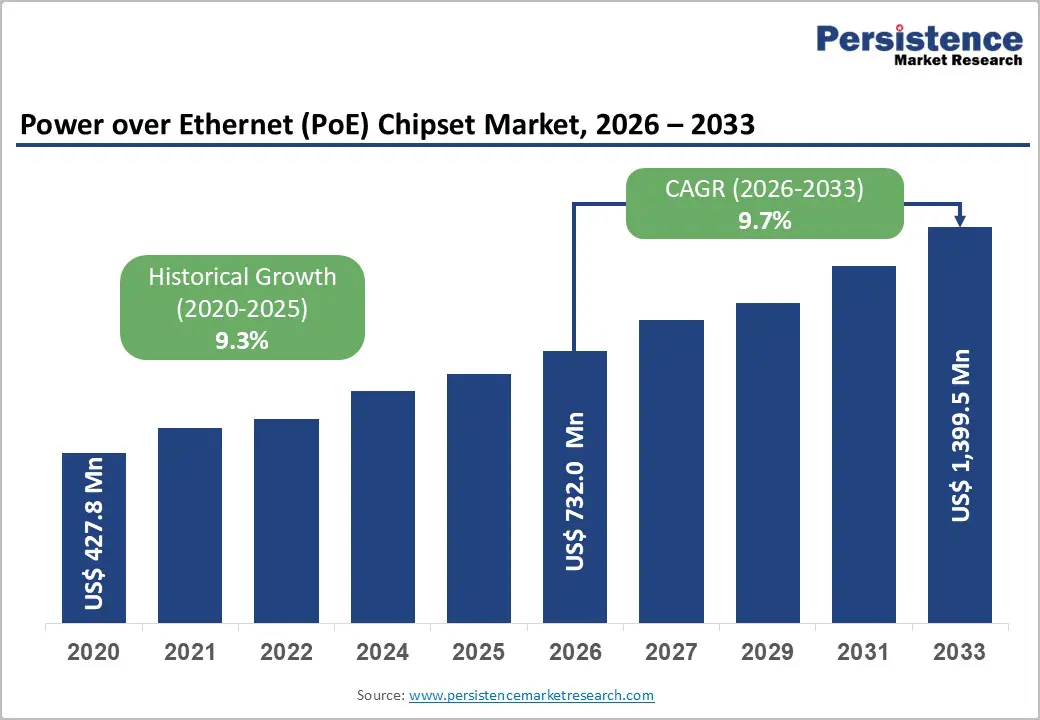
The Global Power over Ethernet (PoE) Chipset Market is entering a strong expansion phase, underpinned by rapid digital infrastructure development across enterprises, smart buildings, telecom networks, and industrial automation systems. Valued at US$ 732.0 Mn in 2026, the market is projected to reach US$ 1,399.5 Mn by 2033, growing at a CAGR of 9.7% during 2026–2033.
This sustained growth reflects a broader structural shift in how modern networks are powered and connected. PoE technology—delivering both data and electrical power over a single Ethernet cable—has become a foundational enabler for IoT ecosystems, wireless access points, IP surveillance systems, and smart lighting infrastructure.
From smart cities to 5G densification, PoE chipsets are increasingly central to next-generation digital infrastructure design.
Market Overview
The PoE chipset ecosystem has evolved from a niche enterprise networking solution into a mainstream power-delivery architecture across multiple industries. Historically, the market grew at a 9.3% CAGR (2020–2025), driven by early smart building adoption and enterprise network upgrades.
By 2026, more than 115 million smart buildings globally are expected to be operational, compared to approximately 45 million in 2022. This rapid expansion represents a 150% increase in smart infrastructure deployment, significantly boosting demand for PoE-enabled endpoints and chipsets.
At the same time, global internet usage reached 5.5 billion users in 2024 (68% of the world population), highlighting the massive scale of connected device ecosystems that depend on robust network infrastructure.
Key Market Highlights
- Market Size (2026): US$ 732.0 Mn
- Forecast (2033): US$ 1,399.5 Mn
- CAGR (2026–2033): 9.7%
- Historical CAGR (2020–2025): 9.3%
Regional Share Overview
- North America: ~37% (market leader)
- Asia Pacific: ~33% (fastest-growing)
- Europe: ~21%
- Rest of the World: Remaining share
Market Drivers
- Smart Building Expansion Driving Infrastructure Modernization
Smart buildings are the most powerful structural driver of the PoE chipset market. These environments integrate lighting systems, HVAC controls, security cameras, access systems, and energy monitoring into unified digital platforms.
With building operations accounting for approximately 30% of global energy consumption and 26% of energy-related emissions, governments are enforcing stricter energy efficiency mandates. Policies requiring zero-carbon-ready buildings by 2030 are accelerating adoption of PoE-powered systems.
PoE technology eliminates the need for separate electrical wiring, making it ideal for:
- Smart LED lighting systems
- Occupancy sensors
- IP surveillance cameras
- Access control systems
This convergence of sustainability and digitization is significantly expanding PoE chipset demand.
- 5G Rollout and Wireless Network Densification
The global rollout of 5G networks is accelerating deployment of high-density wireless access points. These devices require flexible, cost-efficient power delivery, making PoE the preferred solution.
Modern enterprise networks increasingly rely on IEEE 802.3bt standards, which support up to 90 watts per port, enabling high-performance devices such as:
- Wi-Fi 6/6E access points
- 5G small cells
- High-definition security cameras
India’s telecom sector highlights this trend, with 1.21 billion subscribers and broadband expansion from 149 million (2016) to 979 million (2025).
This massive connectivity growth directly translates into higher PoE chipset consumption across telecom and enterprise networks.
- Digital Economy Expansion and Enterprise IT Investment
The global shift toward digital-first business models is reinforcing enterprise demand for advanced networking infrastructure.
In Europe alone, the ICT sector includes:
- 1.4 million enterprises
- 7.2 million employees
- €667 billion in value added
High-productivity segments such as cloud computing, cybersecurity, and enterprise software are driving widespread deployment of:
- PoE-enabled IP phones
- Security cameras
- Wireless access infrastructure
- Smart office lighting systems
As enterprises modernize their IT estates, PoE chipsets become a core component of network design.
Market Restraints
- Semiconductor Supply Chain Vulnerability
The PoE chipset market depends heavily on advanced semiconductor fabrication processes. Any disruption in foundry capacity, geopolitical trade tensions, or material shortages can delay production.
Complex mixed-signal chipset designs also limit flexibility in sourcing alternatives. For example, advanced PSE controllers integrate multiple functions such as power detection, DC-DC conversion, and fault protection into a single die, making replacements difficult during shortages.
- Power Budget Constraints in Legacy Infrastructure
While IEEE 802.3bt enables up to 90W per port, many legacy buildings lack sufficient electrical capacity to support large-scale PoE deployments.
Retrofitting older infrastructure requires:
- Electrical upgrades
- Network switch replacement
- Cooling enhancements
These additional costs can slow adoption in mature commercial real estate markets.
Market Opportunities
- IoT Expansion Across Industrial and Commercial Sectors
The rapid proliferation of IoT devices is creating massive opportunities for PoE chipset suppliers. Applications include:
- Smart factories
- Healthcare monitoring systems
- Logistics tracking networks
- Smart retail infrastructure
In China alone, internet users reached 1.108 billion in 2024, with 249 million users engaging in emerging digital applications such as AI services, smart mobility, and telemedicine.
Each connected endpoint represents a potential PoE-powered device, expanding chipset demand significantly.
- Next-Generation PoE Standards
The evolution of IEEE 802.3bt and emerging single-pair PoE standards is expanding application scope across higher-power devices.
Capabilities include:
- Up to 90W power delivery
- Support for industrial automation systems
- High-performance wireless access points
- Large-format digital displays
These advancements are enabling entirely new categories of PoE-powered devices, increasing chipset content per deployment.
Segment Analysis
Product Type Insights
PSE Chipsets – Market Leader (54% Share)
PoE Power Sourcing Equipment (PSE) chipsets dominate the market due to their role in Ethernet switches and injectors. These chipsets manage:
- Power allocation
- Device detection
- Fault protection
- Load balancing
Companies such as Texas Instruments are advancing integrated PSE solutions that combine multiple functions into single-chip architectures, improving efficiency and scalability.
PD Chipsets – Fastest Growing Segment
Powered Device (PD) chipsets are growing rapidly due to the explosion of endpoint devices like:
- IP cameras
- LED lighting systems
- VoIP phones
- Wireless access points
Each connected device requires a dedicated PD chipset, making this segment highly scalable.
Device Type Insights
Network Cameras – Largest Share (34%)
Network cameras remain the largest application segment due to widespread adoption of IP surveillance systems in smart buildings, cities, and industrial facilities.
High-end surveillance systems now require PoE+ and PoE++ (802.3bt) for power-hungry features like:
- 4K video processing
- PTZ functionality
- AI-based analytics
Wireless Access Points – Fastest Growing Segment
The rise of Wi-Fi 6/6E and 5G small cells is driving rapid growth in PoE-powered access points. Each deployment requires both PSE and PD chipset integration, increasing overall market volume.
Regional Insights
North America – Market Leader (37%)
North America leads the global PoE chipset market due to advanced enterprise infrastructure and early adoption of high-power PoE standards.
Strong participation from companies like Analog Devices and Broadcom reinforces the region’s leadership in innovation and commercialization.
Asia Pacific – Fastest Growing Region (33%)
Asia Pacific is the fastest-growing region, driven by:
- Large-scale 5G deployment
- Smart city initiatives
- Massive internet user base
- Industrial automation growth
China, Japan, and South Korea are leading adopters of PoE-powered surveillance, connectivity, and smart infrastructure systems.
Europe – Regulated Growth Market (21%)
Europe’s PoE demand is driven by:
- Energy efficiency regulations
- Smart building mandates
- Industrial automation investments
Germany remains the key demand hub due to its advanced manufacturing ecosystem and ICT sector strength.
Competitive Landscape
The PoE chipset market is moderately consolidated, dominated by global semiconductor leaders including:
- Texas Instruments
- Analog Devices
- Microchip Technology
- Broadcom
- STMicroelectronics
- onsemi
These companies compete on:
- IEEE standard compliance (802.3af/at/bt)
- Power efficiency improvements
- Integration of multi-port controllers
- Support for AI-driven networking infrastructure
Recent developments highlight continued innovation. For example, Broadcom’s enterprise networking solutions are integrating advanced Ethernet switching with PoE power sourcing to support next-generation AI workloads and high-bandwidth enterprise networks.
Conclusion
The Power over Ethernet (PoE) Chipset Market is positioned for strong long-term expansion, driven by the convergence of smart infrastructure, 5G deployment, IoT proliferation, and enterprise digital transformation.
With market value expected to nearly double from US$ 732.0 Mn in 2026 to US$ 1,399.5 Mn by 2033, PoE technology is transitioning from a networking convenience into a foundational power architecture for modern digital ecosystems.
As smart buildings, industrial automation, and connected devices continue to scale globally, PoE chipsets will remain a critical enabler of efficient, scalable, and sustainable network infrastructure.

 English
 Arabic
 French
 Spanish
 Deutsch
 Turkish
 Dutch
Dutch
 Italiano
 Russian
 Romaian
 Portuguese (Brazil)
 Greek
Greek