


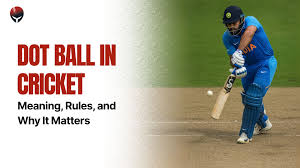
The Indian Premier League (IPL) is known for explosive batting, towering sixes, and thrilling run chases. However, amid all the excitement, one of the most important aspects of T20 cricket often goes unnoticed—the dot ball. While a dot ball may not appear as dramatic as a wicket or a boundary, it can significantly influence the outcome of a match.
In this article, we'll explain what a dot ball is in IPL, its meaning, the rules surrounding it, and the impact it has on teams and players.
What Is a Dot Ball in IPL?
A dot ball is a delivery from which the batting team scores zero runs. On the scorecard, it is represented by a simple dot (•), which is why it is called a "dot ball."
For example:
-
Batter defends the ball and does not run.
-
Batter misses the ball completely.
-
Batter plays a shot but cannot score.
-
A fielder prevents any run from being taken.
In all these situations, the delivery is recorded as a dot ball.
How Is a Dot Ball Recorded?
In cricket scoring, every legal delivery is noted on the scorecard. When no run is scored from a ball, a dot is placed against that delivery.
Example over:
1, •, 4, •, 2, •
In this over:
-
Three deliveries produced runs.
-
Three deliveries were dot balls.
The bowler successfully prevented scoring on half the deliveries.
Rules Related to Dot Balls in IPL
A dot ball follows the standard Laws of Cricket and IPL playing conditions.
Legal Delivery Required
For a delivery to count as a dot ball, it must be a legal delivery.
If the bowler bowls:
-
A no-ball
-
A wide ball
The batting team automatically receives an extra run, meaning the delivery cannot be counted as a dot ball.
Also Read: what is fairplay award in ipl
No Runs Scored
A ball is considered a dot ball only if no runs are added to the batting team's total from that delivery.
This includes:
-
No runs off the bat
-
No byes
-
No leg byes
-
No extras
If even a single run is scored through any method, it is no longer a dot ball.
Why Are Dot Balls Important in IPL?
In T20 cricket, teams have only 120 legal deliveries to score as many runs as possible. Every ball is valuable, which makes dot balls extremely important.
1. Creates Pressure on Batters
A sequence of dot balls increases pressure on the batting side.
When batters struggle to score, they often attempt risky shots to accelerate the run rate, increasing the chances of getting out.
2. Controls the Run Rate
The IPL is a high-scoring tournament where teams regularly score over 180 runs.
Bowlers who consistently deliver dot balls help keep the required run rate under control and limit the opposition's scoring opportunities.
3. Builds Momentum for the Bowling Team
Several dot balls in an over can shift momentum toward the fielding side.
A maiden over in T20 cricket is rare and can dramatically change the direction of a match.
4. Leads to Wickets
Many wickets in T20 cricket come after pressure created by dot balls.
A batter facing multiple scoreless deliveries may attempt an aggressive shot and lose their wicket.
Which Bowlers Excel at Bowling Dot Balls?
Some of the IPL's greatest bowlers are known for their ability to bowl dot balls consistently.
Examples include:
-
Bhuvneshwar Kumar
-
Jasprit Bumrah
-
Sunil Narine
-
Ravichandran Ashwin
-
Lasith Malinga
These bowlers combine accuracy, discipline, and tactical awareness to restrict scoring opportunities.
Dot Ball Percentage: A Key Bowling Statistic
Modern cricket analytics often tracks a bowler's dot ball percentage.
Formula:
Dot Ball Percentage = (Dot Balls ÷ Total Balls Bowled) × 100
A high dot-ball percentage indicates that a bowler is consistently preventing batters from scoring.
In T20 cricket, this metric is often considered just as important as wickets and economy rate.
How Teams Use Dot Balls Strategically
IPL teams analyze dot-ball data extensively to:
-
Identify effective bowlers.
-
Plan match strategies.
-
Apply pressure during crucial overs.
-
Control powerplay and death-over scoring.
Teams understand that winning T20 matches is not only about taking wickets but also about limiting scoring opportunities.
Conclusion
A dot ball in IPL may seem like a small event, but its impact on the game is enormous. It represents a delivery from which no runs are scored and serves as one of the most effective tools for bowlers to create pressure and control the flow of a match.
In a tournament where every run matters, dot balls often become the foundation of successful bowling performances. Whether you're a new cricket fan or an experienced follower of the IPL, understanding the value of dot balls provides deeper insight into the tactical side of T20 cricket.

 English
 Arabic
 French
 Spanish
 Portuguese
 Deutsch
 Turkish
 Italiano
 Russian
 Romaian
 Portuguese (Brazil)
 Greek
Greek