


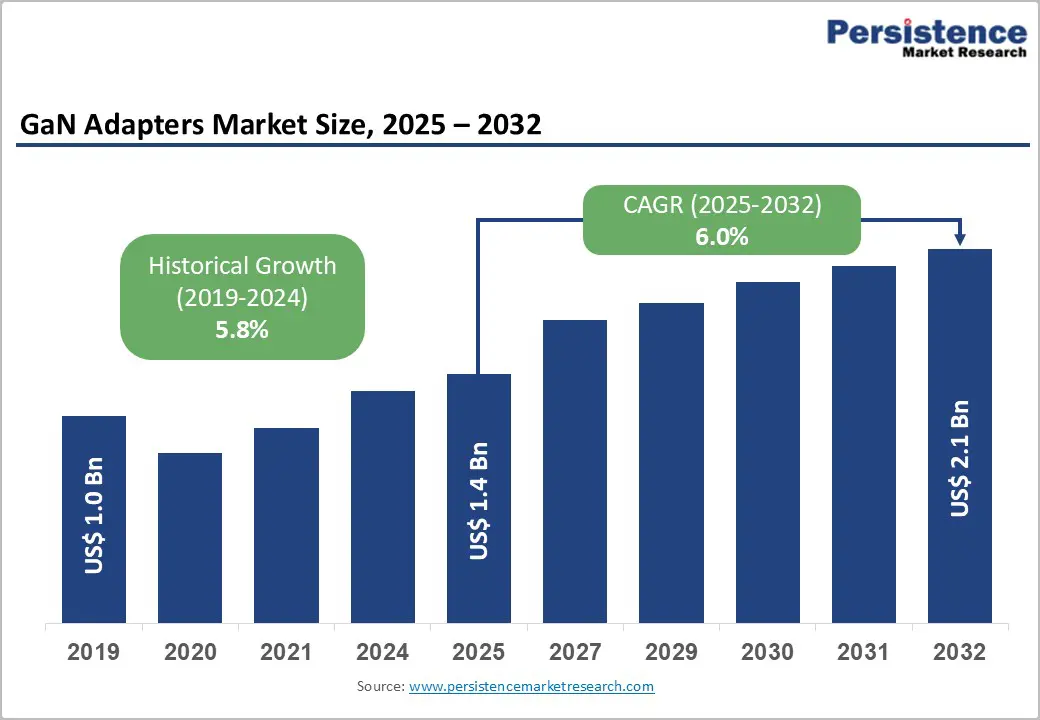
The global GaN adapters market is entering a transformative growth phase as consumers and businesses increasingly demand compact, energy-efficient, and high-performance charging solutions. The market is projected to grow from US$1.5 billion in 2026 to US$2.3 billion by 2033, registering a CAGR of 6.0% during the forecast period. The transition toward USB-C power delivery, rapid charging technologies, and multi-device ecosystems is creating significant opportunities for Gallium Nitride (GaN)-based power adapters worldwide.
GaN technology has emerged as one of the most significant innovations in power electronics over the past decade. Unlike conventional silicon-based semiconductors, GaN components offer higher efficiency, reduced heat generation, and faster switching capabilities. These advantages enable manufacturers to produce chargers that are smaller, lighter, and more powerful than traditional alternatives.
As smartphones, tablets, laptops, gaming devices, and electric vehicles increasingly rely on advanced charging technologies, GaN adapters are becoming an essential component of the modern digital lifestyle.
Why GaN Technology is Transforming the Charging Industry
Gallium Nitride is a semiconductor material that offers superior electrical performance compared to traditional silicon. GaN transistors can operate at higher voltages, frequencies, and temperatures, making them ideal for power conversion applications.
One of the primary advantages of GaN technology is its ability to significantly reduce energy losses during charging. Traditional silicon chargers generate considerable heat, requiring larger components and cooling systems. GaN chargers, by contrast, maintain high efficiency while remaining compact and lightweight.
These characteristics are especially valuable in today's consumer electronics market, where portability and convenience are key purchasing factors. Consumers increasingly expect chargers that can deliver high power output without occupying significant space in bags, workstations, or travel kits.
The shift toward remote work, hybrid workplaces, and mobile lifestyles has further increased the demand for versatile charging solutions capable of powering multiple devices efficiently.
Rising Demand for Fast Charging Drives Market Growth
Fast charging has become one of the most influential trends in consumer electronics. Modern smartphones, laptops, tablets, and wearable devices require significantly more power than previous generations, leading manufacturers to adopt advanced charging standards such as USB-C Power Delivery (PD) and Programmable Power Supply (PPS).
GaN adapters support these high-performance charging protocols while maintaining compact form factors. As premium smartphones and laptops increasingly support charging speeds above 45W and 65W, the demand for GaN-based chargers continues to rise.
Another major growth driver is the decision by many smartphone manufacturers to stop including charging adapters in device packaging. This shift has created a thriving aftermarket for standalone chargers, encouraging consumers to invest in premium GaN chargers that offer better performance and compatibility.
The growing popularity of multi-device ecosystems is also contributing to market expansion. Consumers often carry smartphones, tablets, wireless earbuds, smartwatches, and laptops simultaneously, increasing the need for versatile charging solutions capable of powering multiple devices from a single adapter.
Sustainability and Energy Efficiency Supporting Adoption
Environmental sustainability has become an important purchasing criterion for both consumers and enterprises. Governments worldwide are introducing regulations aimed at reducing energy consumption and improving electronic device efficiency.
GaN adapters align closely with these objectives by minimizing power losses and reducing heat generation during charging. Their improved efficiency translates into lower electricity consumption over time, helping users reduce energy costs while supporting sustainability goals.
Manufacturers are also emphasizing the environmental benefits of compact charger designs. Smaller chargers require fewer raw materials and generate lower transportation emissions due to reduced weight and packaging requirements.
As awareness of environmental responsibility grows, energy-efficient charging solutions are expected to become increasingly attractive to consumers and businesses alike.
Market Challenges: Higher Costs Limit Wider Adoption
Despite their technological advantages, GaN adapters continue to face challenges related to production costs. Manufacturing GaN semiconductors requires sophisticated fabrication processes and specialized materials, resulting in higher costs compared to traditional silicon components.
The complexity of epitaxial growth techniques and substrate preparation contributes to increased manufacturing expenses. Additionally, production yields for GaN devices remain lower than those of mature silicon technologies, further impacting pricing.
As a result, GaN chargers often carry premium price tags that may discourage adoption among budget-conscious consumers.
Consumer awareness remains another challenge. While technology enthusiasts understand the advantages of GaN chargers, many mainstream consumers remain unfamiliar with the benefits of the technology. Without clear understanding of improved efficiency, portability, and performance, some consumers may choose lower-cost silicon chargers instead.
Industry participants are addressing this issue through educational marketing campaigns and product demonstrations that highlight the long-term value proposition of GaN technology.
Electric Vehicle Infrastructure Creates New Opportunities
Beyond consumer electronics, electric vehicle (EV) charging infrastructure represents a significant growth opportunity for GaN technology.
As governments and private organizations invest heavily in EV adoption, the demand for efficient power conversion systems continues to increase. GaN semiconductors are increasingly being incorporated into onboard chargers, DC-DC converters, and charging stations due to their ability to deliver higher power density and improved efficiency.
GaN-powered charging systems offer several advantages for electric vehicles, including reduced weight, smaller component sizes, and enhanced thermal performance. These benefits contribute to improved vehicle efficiency and more compact charging architectures.
The expansion of public fast-charging networks worldwide is expected to create substantial demand for GaN-based power electronics. As manufacturing costs decline and technological advancements continue, GaN solutions are likely to become increasingly prevalent throughout the EV charging ecosystem.
Product Type Analysis: Single-Port Adapters Lead the Market
Among product categories, 1-port GaN adapters are expected to maintain market leadership, accounting for approximately 50% of total revenue in 2026.
The popularity of single-port chargers stems from their simplicity, affordability, and compatibility with individual devices such as smartphones, tablets, and laptops. Consumers appreciate their compact design and portability, making them ideal for everyday use and travel.
Many leading device manufacturers recommend or bundle single-port USB-C chargers with their products, further supporting market demand.
However, multi-port GaN adapters are emerging as the fastest-growing segment. Consumers increasingly seek charging solutions capable of powering multiple devices simultaneously. Two-port and four-port chargers offer significant convenience while reducing cable clutter and minimizing the number of adapters users need to carry.
As remote work and digital lifestyles continue to expand, demand for multi-device charging solutions is expected to accelerate substantially.
Power Type Analysis: 65W Chargers Dominate Demand
The 65W GaN adapter segment is projected to account for more than 30% of market revenue in 2026, making it the leading power category.
This wattage level represents an ideal balance between performance, portability, and compatibility. A 65W charger can efficiently power most ultrabooks, tablets, smartphones, and various portable electronics, making it highly attractive to consumers.
Manufacturers have increasingly standardized around 65W power delivery solutions, contributing to widespread adoption across both personal and professional applications.
Meanwhile, the 100W+ segment is expected to experience the fastest growth during the forecast period. High-performance laptops, gaming systems, mobile workstations, and advanced computing devices require greater power capacity, creating strong demand for higher-wattage GaN chargers.
GaN technology allows manufacturers to deliver these elevated power levels without the excessive size and heat associated with conventional chargers.
Consumer Electronics Remain the Largest Application Segment
Consumer electronics are expected to account for approximately 40% of total market revenue in 2026, maintaining their position as the largest application category.
The widespread adoption of smartphones, tablets, smartwatches, wireless earbuds, and portable computing devices continues to drive demand for efficient charging solutions. Consumers increasingly prioritize charging speed, portability, and reliability, all of which are strengths of GaN technology.
Flagship smartphones and premium tablets are frequently optimized for fast-charging protocols that benefit significantly from GaN-based adapters.
While consumer electronics dominate current demand, the automotive segment is poised to become the fastest-growing application area. Rapid EV adoption and charging infrastructure development are generating substantial opportunities for GaN-powered charging systems and power conversion technologies.
Regional Outlook
North America Leads Global Revenue
North America is expected to account for approximately 35% of global market revenue in 2026. The region benefits from high disposable incomes, strong consumer electronics adoption, and early acceptance of advanced charging technologies.
Consumers in the United States and Canada are particularly receptive to premium charging accessories, supporting demand for high-performance GaN products.
Additionally, growing EV adoption and investments in charging infrastructure are expanding opportunities for GaN technology beyond consumer electronics.
Europe Benefits from Sustainability Initiatives
Europe remains a significant market due to strong regulatory support for energy efficiency and environmental sustainability.
The region's emphasis on reducing energy consumption aligns closely with the advantages offered by GaN technology. Increasing standardization around USB-C charging further supports market growth across both consumer and commercial sectors.
Europe's expanding electric mobility ecosystem also creates opportunities for GaN integration into automotive charging systems and power electronics.
Asia Pacific Emerges as the Fastest-Growing Region
Asia Pacific is projected to be the fastest-growing regional market through 2033. Countries such as China, Japan, South Korea, and India play a central role due to their extensive electronics manufacturing capabilities and large consumer populations.
Government initiatives supporting semiconductor development, domestic manufacturing, and clean energy technologies are accelerating GaN adoption throughout the region.
Rising disposable incomes, increasing smartphone penetration, and growing demand for premium electronics are further strengthening market growth prospects.
Competitive Landscape
The global GaN adapters market remains moderately fragmented, characterized by continuous innovation and intense competition.
Leading companies include Anker Innovations, Belkin International, GaN Systems, Navitas Semiconductor, Xiaomi, Baseus, RAVPower, Infineon Technologies, Delta Electronics, Lenovo Group, Texas Instruments, CUI Inc., Digi-Key Electronics, and IOGEAR.
Market participants are focusing on product innovation, strategic partnerships, and expanded distribution networks to strengthen their competitive positions. Multi-port chargers, high-wattage adapters, and travel-friendly charging solutions remain key areas of innovation.
As GaN technology continues to mature and manufacturing costs decline, competition is expected to intensify, resulting in broader adoption and expanded product offerings.
Conclusion
The GaN adapters market is positioned for sustained growth as consumers and businesses increasingly prioritize fast charging, energy efficiency, and portability. With the market expected to reach US$2.3 billion by 2033, advancements in consumer electronics, USB-C adoption, and electric vehicle infrastructure will continue to drive demand.
Although higher manufacturing costs currently present challenges, ongoing technological improvements and economies of scale are expected to make GaN solutions more affordable and accessible. As awareness grows and charging requirements become increasingly sophisticated, GaN adapters are set to become a cornerstone of the next generation of power delivery technologies.

 English
 Arabic
 French
 Portuguese
 Deutsch
 Turkish
 Dutch
Dutch
 Italiano
 Russian
 Romaian
 Portuguese (Brazil)
 Greek
Greek