


The rapid pace of digital transformation is creating unprecedented volumes of retired IT equipment across enterprises, government organizations, data centers, and cloud service providers. As businesses continuously upgrade hardware to support cloud computing, artificial intelligence (AI), cybersecurity requirements, and high-performance workloads, managing obsolete technology assets has become a critical operational and compliance challenge.
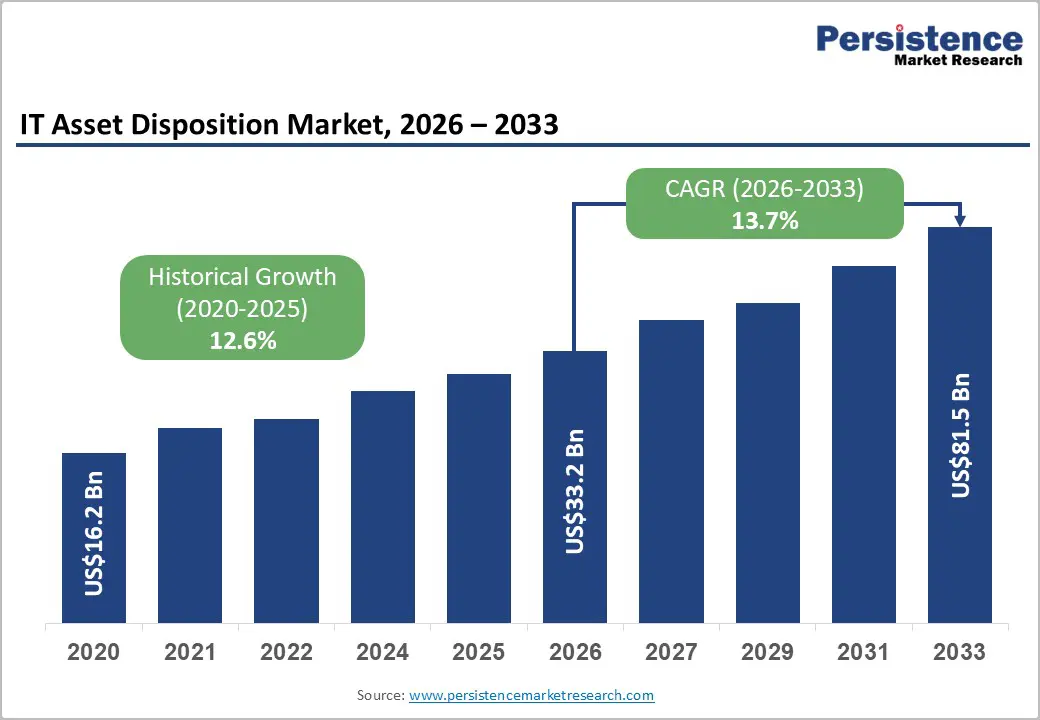
This growing need has significantly boosted the IT Asset Disposition (ITAD) market. According to industry estimates, the global IT asset disposition market is expected to grow from US$33.2 billion in 2026 to approximately US$81.5 billion by 2033, registering a robust CAGR of 13.7% during the forecast period.
Organizations are increasingly turning to professional ITAD providers to securely dispose of retired assets, recover residual value, comply with environmental regulations, and minimize cybersecurity risks. The convergence of data protection requirements, sustainability initiatives, and circular economy principles is transforming IT asset disposition from a compliance function into a strategic business activity.
Why IT Asset Disposition Has Become a Business Priority
Modern organizations generate vast quantities of electronic waste through regular hardware refresh cycles. Laptops, desktops, servers, networking equipment, storage devices, smartphones, and tablets all have finite operational lifespans.
As enterprises migrate to cloud infrastructure and adopt AI-powered systems, older hardware is retired at a much faster rate than before. Data centers, telecommunications companies, and technology firms frequently replace equipment to improve efficiency, security, and processing capabilities.
However, simply discarding retired devices is no longer an option. These assets often contain sensitive corporate, customer, financial, and intellectual property data. Improper disposal can expose organizations to data breaches, legal liabilities, and reputational damage.
As a result, ITAD services have become essential for ensuring secure data destruction, regulatory compliance, environmental responsibility, and asset value recovery.
Growing Cybersecurity Concerns Driving ITAD Adoption
One of the strongest growth drivers in the ITAD market is the increasing focus on cybersecurity.
Retired devices frequently contain confidential information that may remain accessible even after conventional deletion methods. Hard drives, solid-state drives, servers, and mobile devices can store recoverable data if proper sanitization procedures are not followed.
The growing frequency of cyberattacks and data breach incidents has encouraged organizations to adopt certified disposal methods such as:
- Data wiping
- Degaussing
- Physical destruction
- Secure shredding
- Certified data erasure
Companies increasingly demand audit trails and certificates of destruction from ITAD vendors to demonstrate compliance and reduce legal risks.
The expansion of hybrid and remote work environments has further intensified this challenge. Organizations must now manage thousands of distributed devices that eventually require secure retirement, making professional ITAD services more important than ever.
Regulatory Compliance Strengthening Market Growth
Governments worldwide are introducing stricter regulations governing electronic waste management and data protection.
Regulatory frameworks require organizations to properly manage retired electronic equipment while maintaining documented disposal procedures. Failure to comply can result in penalties, lawsuits, and operational disruptions.
Several regulatory developments are influencing the market:
- Extended Producer Responsibility (EPR) programs
- Electronic waste recycling mandates
- Data protection regulations
- Environmental sustainability requirements
- Secure information destruction standards
In regions such as Europe, organizations must comply with comprehensive electronic waste directives that emphasize recycling and responsible disposal. Similarly, emerging economies are implementing digital tracking systems to monitor e-waste movement and ensure accountability throughout the disposal process.
These evolving regulations are encouraging organizations to partner with certified ITAD providers capable of managing complex compliance requirements across multiple jurisdictions.
Circular Economy Creating New Growth Opportunities
The ITAD industry is evolving beyond traditional disposal services toward value recovery and circular economy models.
Instead of simply destroying obsolete equipment, many organizations now seek to maximize the residual value of retired assets through refurbishment, redeployment, and resale programs.
This shift offers several benefits:
Cost Reduction
Refurbished equipment can be resold or redeployed internally, helping organizations reduce technology procurement costs.
Sustainability Improvements
Extending the lifespan of electronic devices reduces landfill waste and minimizes environmental impact.
ESG Compliance
Environmental, Social, and Governance (ESG) reporting requirements are encouraging organizations to demonstrate measurable progress in waste reduction and resource optimization.
Resource Conservation
Reusing devices reduces demand for raw materials and supports sustainable manufacturing practices.
As sustainability becomes a key corporate objective, ITAD providers that offer refurbishment and remarketing services are gaining a competitive advantage.
AI and Automation Transforming Asset Lifecycle Management
Artificial intelligence and automation technologies are reshaping the IT asset disposition landscape.
Advanced asset management platforms now enable organizations to monitor equipment throughout its entire lifecycle, from deployment to retirement.
AI-powered solutions can:
- Assess device condition automatically
- Estimate resale values
- Determine optimal recovery strategies
- Streamline refurbishment processes
- Generate compliance reports
- Improve inventory tracking
Automation also enhances operational efficiency by reducing manual intervention and minimizing human error.
For hyperscale data centers and large enterprises managing thousands of assets, automated lifecycle management solutions provide significant cost and time savings while ensuring regulatory compliance.
Computers and Laptops Continue to Dominate Asset Disposition Volumes
Among asset categories, computers and laptops are expected to maintain the largest market share, accounting for approximately 45.3% of the market in 2026.
Several factors contribute to their dominance:
- Widespread use across industries
- Frequent replacement cycles
- Large volumes of sensitive stored data
- Increased remote work adoption
- Growing cybersecurity concerns
Most organizations replace employee laptops every three to five years to maintain performance, security, and software compatibility.
The continued growth of hybrid work models has expanded enterprise device inventories, creating a steady stream of retired equipment requiring secure disposal or refurbishment.
Meanwhile, smartphones and tablets are emerging as the fastest-growing segment due to shorter upgrade cycles and increasing enterprise mobility adoption.
IT and Telecom Sector Leads Market Demand
The IT and telecommunications sector remains the largest end-user segment, representing nearly 33.8% of market revenue in 2026.
This dominance stems from the industry's extensive hardware infrastructure, including:
- Servers
- Network equipment
- Storage systems
- Data center assets
- Telecommunications hardware
The rapid deployment of cloud computing, AI applications, and 5G networks requires continuous hardware upgrades, generating substantial volumes of retired equipment.
Because telecom operators and technology firms handle vast amounts of customer data, they place a strong emphasis on secure asset disposal and regulatory compliance.
The media and entertainment industry also represents a significant market segment due to increasing investments in high-performance computing infrastructure required for streaming, content production, gaming, and digital media workflows.
Asia Pacific Emerges as the Largest Regional Market
Asia Pacific is projected to account for approximately 35.2% of the global IT asset disposition market in 2026, making it the leading regional market.
Several factors support regional dominance:
Massive Electronics Consumption
Countries such as China, India, Japan, and South Korea collectively represent one of the world's largest electronics markets.
Growing E-Waste Volumes
Rapid technology adoption generates substantial quantities of electronic waste requiring responsible management.
Expanding Data Center Infrastructure
Cloud service providers and technology companies continue investing heavily in regional data center expansion.
Strong Government Support
Governments across the region are strengthening e-waste regulations and promoting circular economy initiatives.
China remains a major growth contributor due to its extensive electronics manufacturing ecosystem and large-scale cloud infrastructure investments.
India is also emerging as an important market as policymakers strengthen e-waste management frameworks and encourage responsible recycling practices.
North America Expected to Deliver the Fastest Growth
North America is forecast to be the fastest-growing regional market through 2033.
The region benefits from:
- Advanced cybersecurity awareness
- Strict data protection requirements
- Large-scale cloud adoption
- Rapid AI infrastructure deployment
- Frequent technology refresh cycles
The United States continues to represent the largest individual market worldwide.
The AI boom has accelerated server replacement cycles significantly, as organizations upgrade hardware to support increasingly demanding machine learning workloads.
Additionally, operating system transitions and stricter privacy regulations are encouraging enterprises to replace outdated devices and engage certified ITAD providers for secure retirement.
As data centers continue expanding across the region, the volume of retired servers and storage systems is expected to rise substantially.
Europe Strengthens Focus on Sustainable IT Asset Management
Europe continues to experience steady growth, supported by comprehensive environmental and recycling regulations.
Organizations throughout the region increasingly prioritize:
- E-waste reduction
- Resource recovery
- Refurbishment programs
- Carbon footprint reduction
- Circular economy initiatives
Countries such as Germany and the United Kingdom maintain highly developed recycling infrastructures and strong regulatory oversight.
Many European enterprises view IT asset disposition not only as a compliance requirement but also as an essential component of broader sustainability strategies.
This trend is encouraging greater adoption of refurbishment, remarketing, and responsible recycling services across the region.
Competitive Landscape and Industry Developments
The global IT asset disposition market remains moderately fragmented, with multinational providers competing alongside specialized regional vendors.
Leading companies are increasingly differentiating themselves through comprehensive lifecycle management services rather than basic recycling and destruction offerings.
Modern ITAD providers now offer:
- Asset tracking
- Secure logistics
- Certified data sanitization
- Refurbishment
- Remarketing
- ESG reporting
- Circular economy consulting
Recent industry developments highlight ongoing market consolidation and innovation.
Strategic acquisitions are enabling providers to expand geographic coverage and strengthen service capabilities. At the same time, new software solutions are improving device reimaging, data sanitization, and asset recovery processes.
Industry associations are also emerging to establish best practices, improve standardization, and promote professionalism across the rapidly growing ITAD sector.
Conclusion
The global IT asset disposition market is entering a period of significant expansion as organizations seek secure, compliant, and sustainable methods for managing retired technology assets.
Rising cybersecurity threats, stricter regulations, increasing e-waste volumes, and accelerating hardware refresh cycles are creating strong demand for professional ITAD services worldwide.
At the same time, the industry's evolution toward refurbishment, reuse, and circular economy models is opening new revenue opportunities while supporting corporate sustainability goals.
With AI-driven asset management, expanding cloud infrastructure, and growing ESG commitments shaping the future of technology lifecycle management, the IT asset disposition market is poised to become an increasingly critical component of enterprise IT strategy through 2033.

 Arabic
 French
 Spanish
 Portuguese
 Deutsch
 Turkish
 Dutch
Dutch
 Italiano
 Russian
 Romaian
 Portuguese (Brazil)
 Greek
Greek