


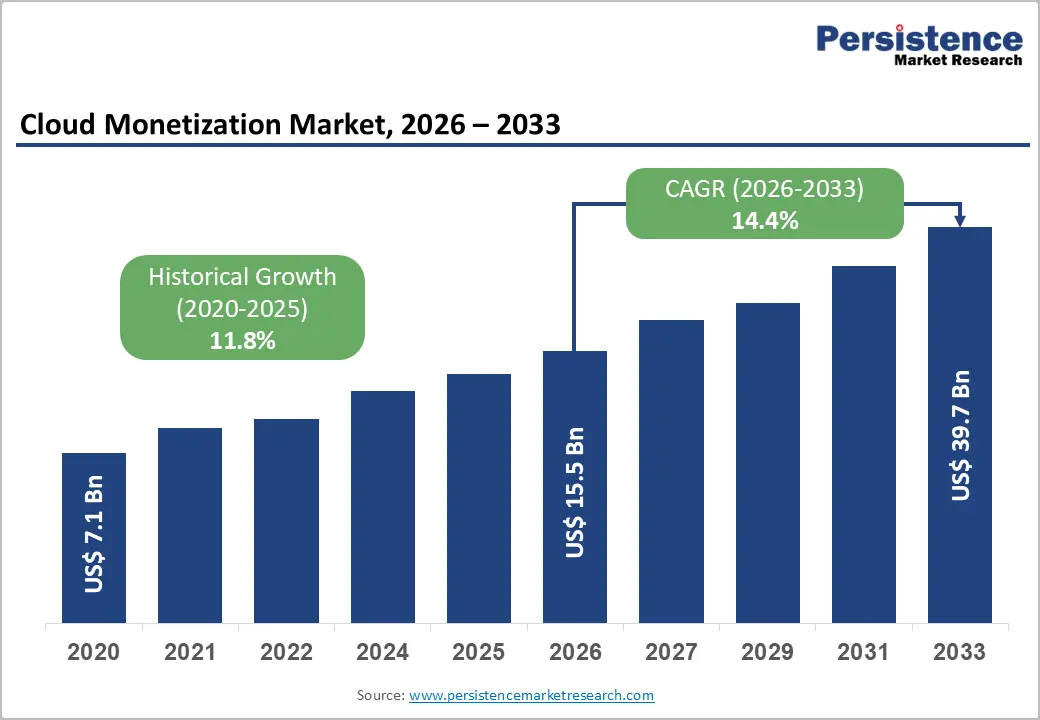
The global cloud monetization market is entering a high-growth phase as enterprises increasingly shift toward subscription-driven, usage-based, and outcome-oriented digital business models. Valued at approximately US$ 15.5 billion in 2026, the market is projected to reach US$ 39.7 billion by 2033, expanding at a strong CAGR of 14.4% during the forecast period. This rapid expansion reflects a fundamental transformation in how digital services are priced, consumed, and commercialized across industries.
Cloud monetization platforms have evolved from simple billing tools into strategic revenue-enablement systems. They now sit at the center of digital ecosystems, managing pricing logic, subscription lifecycles, usage tracking, revenue recognition, and customer analytics. As enterprises scale across multi-cloud and hybrid environments, the need for intelligent monetization infrastructure becomes critical to prevent revenue leakage and ensure pricing accuracy.
Market Overview: Shift Toward Intelligent Revenue Systems
The cloud monetization landscape is being reshaped by the rise of cloud-native applications, API-driven services, and recurring revenue models. Organizations are moving away from one-time licensing toward continuous engagement models such as SaaS subscriptions, pay-as-you-go services, and consumption-based pricing.
This shift is not only financial but architectural. Modern digital ecosystems require real-time billing engines capable of processing millions of transactions across distributed systems. As services become more modular and interconnected, monetization platforms are increasingly responsible for stitching together pricing logic across multiple service layers.
Industries such as software, telecom, media, healthcare, and financial services are leading adoption, driven by the need for flexible pricing, automated billing, and dynamic revenue optimization.
Key Market Drivers
- Expansion of Subscription-Based Digital Economy
Subscription models have become the dominant revenue structure for digital businesses. They enable predictable cash flows, stronger customer retention, and higher lifetime value. However, they also introduce complexity in billing cycles, tiered pricing, and usage tracking.
Enterprises now rely on cloud monetization platforms to manage recurring billing, automate invoicing, and deliver personalized pricing. The growing volume of digital transactions across mobile apps, streaming services, and enterprise SaaS platforms continues to fuel demand.
- Cloud-Native and Digital Transformation Acceleration
Cloud-native architecture is fundamentally reshaping enterprise IT environments. Microservices, containers, and APIs allow companies to launch and scale services rapidly, but also require flexible monetization layers.
According to industry trends, over half of medium-sized enterprises in developed markets now use cloud infrastructure as a core operational foundation. This widespread adoption creates a continuous demand for real-time billing and adaptive pricing systems.
- AI-Driven Pricing and Revenue Optimization
Artificial intelligence is becoming a core enabler of cloud monetization. AI-powered platforms can analyze usage patterns, detect anomalies, and optimize pricing strategies dynamically. This reduces revenue leakage and improves profitability.
Automation also minimizes manual intervention in billing processes, ensuring accuracy in complex multi-service environments.
- Growth of Connected Digital Ecosystems
The rise of IoT, APIs, and platform-based business models has significantly increased the number of billable events. Every API call, data transaction, or device interaction can become a monetizable unit, further increasing the need for scalable monetization infrastructure.
Key Market Trends
Usage-Based and Consumption Pricing Models
Enterprises are rapidly transitioning to usage-based pricing structures. Instead of fixed subscription fees, customers are charged based on actual consumption. This model improves transparency and aligns cost with value delivery.
This trend is especially strong in cloud computing, AI services, and developer platforms, where usage can fluctuate significantly.
Integration of Real-Time Analytics
Modern monetization platforms increasingly incorporate real-time analytics to track usage patterns, predict revenue trends, and optimize pricing decisions. This enables businesses to respond dynamically to customer behavior and market demand.
Rise of Platform Ecosystems
Cloud providers are expanding beyond infrastructure into full ecosystem platforms that include billing, marketplaces, and subscription management. This ecosystem approach strengthens vendor lock-in and enhances monetization efficiency.
Convergence of Billing and Customer Experience
Billing is no longer a back-office function. It is now directly tied to customer experience. Transparent pricing, flexible billing cycles, and self-service dashboards are becoming standard expectations in digital-first industries.
Market Challenges
Data Security and Privacy Risks
Cloud monetization systems handle sensitive financial and customer usage data. This makes them prime targets for cyberattacks. Organizations must invest heavily in encryption, identity management, and compliance frameworks to mitigate risks.
Regulatory Complexity
Different regions enforce varying rules on taxation, data storage, and cross-border billing. Compliance with frameworks such as GDPR and financial reporting standards increases operational complexity and slows deployment.
Legacy System Integration
Many enterprises still rely on outdated billing systems that lack API compatibility or real-time processing capabilities. Integrating modern monetization platforms with legacy infrastructure remains a significant barrier, often increasing cost and implementation timelines.
Market Opportunities
Emergence of Outcome-Based Pricing
A major opportunity lies in outcome-based pricing models, where customers pay based on achieved results rather than usage alone. This model is gaining traction in enterprise SaaS, AI services, and managed cloud solutions.
It aligns vendor incentives with customer success, improving long-term retention and revenue predictability.
Expansion in Emerging Economies
Rapid digitalization in Asia Pacific, Latin America, and parts of Africa is creating strong demand for cloud monetization systems. Mobile-first economies and startup ecosystems are particularly driving adoption of subscription and pay-per-use models.
Hybrid Cloud Monetization
As enterprises adopt hybrid cloud environments, there is growing demand for unified monetization platforms that can manage revenue across both on-premise and cloud systems. This creates opportunities for integration-focused solutions.
Segment Analysis
By Service Model
Software-as-a-Service (SaaS) remains the dominant segment, accounting for nearly 45% of market share in 2026. SaaS platforms depend heavily on recurring billing, subscription management, and customer lifecycle tracking. The need for scalable monetization infrastructure is therefore deeply embedded in SaaS growth.
Platform-as-a-Service (PaaS) is expected to be the fastest-growing segment through 2033. Developer ecosystems, API-driven applications, and microservices architectures generate highly variable usage patterns, requiring advanced billing and real-time monetization systems.
By End User
IT and Telecom leads the market with approximately 30% share due to complex billing structures, bundled services, and high transaction volumes. Telecom operators require real-time charging systems to manage data usage, roaming services, and digital subscriptions.
Healthcare is emerging as the fastest-growing segment, driven by telemedicine, digital diagnostics, and remote care platforms. Cloud monetization systems enable accurate billing for virtual consultations and subscription-based healthcare services.
Regional Insights
North America
North America dominates the global market with around 38% share. The region benefits from advanced cloud infrastructure, strong enterprise adoption, and the presence of major technology providers. Businesses in this region are early adopters of AI-driven monetization and subscription-based ecosystems.
Europe
Europe shows steady growth supported by strong regulatory frameworks and GDPR-driven data governance requirements. Enterprises prioritize secure, transparent, and compliant billing systems, especially across cross-border operations.
Asia Pacific
Asia Pacific is the fastest-growing region due to rapid digital transformation, mobile-first consumption, and expanding cloud adoption. Countries such as India, China, Japan, and South Korea are driving innovation in subscription-based platforms, gaming ecosystems, and digital services.
Competitive Landscape
The cloud monetization market is moderately consolidated, with several global technology leaders shaping the competitive environment.
Key players include:
- Microsoft Corporation
- Oracle Corporation
- SAP SE
- Salesforce Inc.
- IBM Corporation
- Amazon Web Services
- Zuora Inc.
- Ericsson
- Huawei Technologies
- Amdocs
- Netcracker Technology
- Aria Systems
- Chargebee
- Recurly Inc.
These companies compete on the basis of scalability, real-time billing capabilities, AI integration, and ecosystem breadth. Large hyperscalers integrate monetization directly into cloud ecosystems, while specialized vendors focus on subscription billing, pricing flexibility, and analytics-driven revenue optimization.
Conclusion
The cloud monetization market is transitioning from a supporting IT function into a core strategic revenue engine for digital enterprises. As businesses increasingly rely on subscription-based and usage-driven models, the importance of intelligent monetization systems continues to grow.
Between 2026 and 2033, growth will be driven by AI-powered pricing, expansion of cloud-native ecosystems, and increasing demand for real-time billing infrastructure. While challenges such as integration complexity, regulatory pressure, and security risks remain, the long-term trajectory of the market is strongly upward.
Cloud monetization will ultimately define how value is captured in the digital economy—linking consumption, pricing, and customer experience into a unified revenue framework.
Related Reports:

 English
 Arabic
 French
 Spanish
 Portuguese
 Deutsch
 Turkish
 Dutch
Dutch
 Italiano
 Russian
 Romaian
 Greek
Greek