


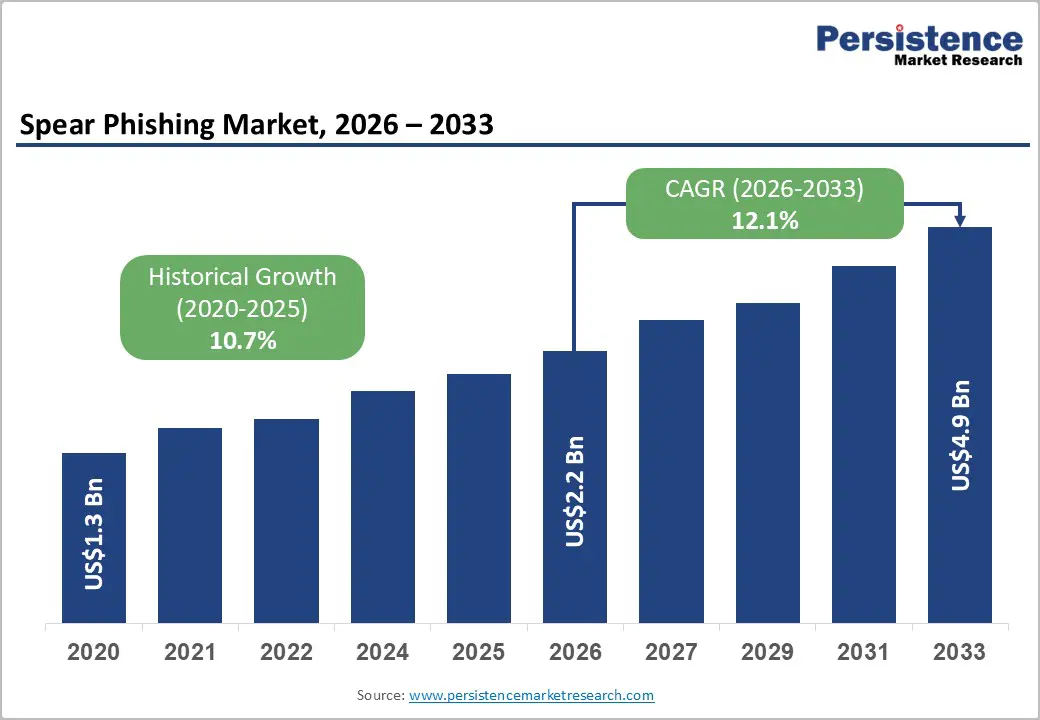
The global spear phishing market is entering a period of sustained and accelerated expansion, driven by the growing sophistication of cyberattacks and the rising financial impact of targeted email-based fraud. Valued at approximately US$2.2 billion in 2026, the market is projected to reach US$4.9 billion by 2033, expanding at a CAGR of 12.1% during the forecast period. This strong growth trajectory reflects the increasing recognition of spear phishing as one of the most damaging cyber threats facing modern enterprises.
Unlike generic phishing, spear phishing is highly targeted, often involving detailed reconnaissance, impersonation of trusted contacts, and carefully crafted messages designed to exploit human behavior. As organizations digitize operations and adopt cloud-first strategies, the attack surface continues to expand, making identity-centric threats more prevalent and harder to detect.
Market Overview and Key Growth Drivers
The spear phishing market is being shaped by a convergence of financial, technological, and regulatory forces. One of the most significant drivers is the rising incidence of Business Email Compromise (BEC) attacks, which continue to generate substantial global financial losses. These attacks often rely on impersonation of executives or vendors, tricking employees into transferring funds or sharing sensitive data.
As a result, enterprises are increasingly investing in advanced cybersecurity solutions such as:
- AI-powered email security gateways
- Identity verification and authentication systems
- Threat intelligence and behavioral analytics platforms
- Zero-trust security architectures
Another major factor accelerating market growth is the rapid evolution of AI-driven cyberattacks. Threat actors are now using artificial intelligence to generate highly convincing phishing emails that replicate writing styles, communication tone, and contextual relevance. This has significantly increased the success rate of spear phishing campaigns compared to traditional methods.
In parallel, regulatory pressure is intensifying globally, with stricter cybersecurity disclosure requirements and data protection laws. Industries such as banking, healthcare, and critical infrastructure are under heightened scrutiny, forcing organizations to adopt proactive threat detection and incident response systems.
Key Market Highlights
- Market Size (2026E): US$2.2 Billion
- Forecast (2033F): US$4.9 Billion
- CAGR (2026–2033): 12.1%
- Historical CAGR (2020–2025): 10.7%
- Leading Region: North America (37.9% share)
- Fastest-Growing Region: Asia Pacific
- Dominant Component: Solutions (71.3% share)
- Leading Deployment Model: On-premises (53.5% share)
The market structure indicates strong dominance by solution-based offerings, while services and cloud-based deployments are emerging as high-growth segments.
Driver Analysis
- Escalating Business Email Compromise (BEC) Losses
BEC remains one of the most financially damaging forms of cybercrime, and spear phishing is its primary entry point. Attackers typically impersonate executives, finance departments, or trusted vendors to manipulate employees into transferring funds or sharing sensitive credentials.
Organizations are responding with increased spending on:
- Secure email gateways
- Domain spoofing detection tools
- AI-based fraud detection systems
- Multi-layer identity verification
This shift reflects a broader realization that traditional perimeter-based defenses are insufficient against modern social engineering attacks.
- AI-Driven Attack Sophistication
Artificial intelligence has significantly enhanced the precision and scalability of spear phishing campaigns. Attackers can now:
- Generate personalized email content at scale
- Mimic writing styles of executives
- Automate reconnaissance using publicly available data
- Adapt messages based on user behavior
In response, enterprises are deploying behavioral analytics and anomaly detection systems that monitor identity activity patterns rather than relying solely on static signatures. This transition toward AI-powered defense systems is reshaping the cybersecurity landscape.
- Regulatory Compliance Requirements
Governments and regulatory bodies are enforcing stricter cybersecurity mandates across industries. Organizations are now required to:
- Report breaches within defined timelines
- Maintain continuous monitoring systems
- Implement risk-based security frameworks
- Demonstrate compliance with data protection standards
These requirements are accelerating investments in integrated cybersecurity platforms, particularly in regulated sectors such as BFSI, healthcare, and government.
Restraint Analysis
- Budget Constraints in SMEs
Small and medium enterprises face significant challenges in adopting advanced spear phishing protection tools due to:
- Limited cybersecurity budgets
- Lack of in-house expertise
- Dependence on basic security solutions
While managed security services are helping bridge this gap, adoption remains uneven, limiting overall market penetration.
- Operational Complexity and Alert Fatigue
Modern security systems generate large volumes of alerts, many of which require manual investigation. This leads to:
- Alert fatigue among security teams
- Delayed incident response
- Reduced operational efficiency
The fragmentation of cybersecurity tools further complicates threat visibility, pushing organizations toward integrated platforms that unify detection and response capabilities.
Opportunity Analysis
- Identity-Centric and Browser-Level Security
As cyberattacks increasingly target identities rather than infrastructure, demand is rising for:
- Identity-based access controls
- Continuous authentication systems
- Browser-level security monitoring
- Zero-trust frameworks
Vendors such as Microsoft and Zscaler are leading the shift toward identity-aware security ecosystems that protect users across applications and devices.
- Growth of Managed Security Services
Managed Security Service Providers (MSSPs) are gaining strong traction due to rising complexity and skill shortages. These services include:
- 24/7 threat monitoring
- Phishing simulation programs
- Incident response support
- Employee awareness training
Companies like Cofense and CrowdStrike are expanding their managed detection and response offerings to support enterprises of all sizes.
- Phishing-Resistant Authentication
Traditional MFA systems are increasingly vulnerable to social engineering attacks. This has driven adoption of:
- FIDO2 security keys
- Passwordless authentication
- Biometric identity verification
These technologies strengthen identity assurance and reduce reliance on credentials that can be stolen or intercepted.
Segment Analysis
By Component
Solutions Segment (Dominant – 71.3%)
Solutions dominate the market due to strong demand for integrated platforms combining email security, identity protection, and threat intelligence. Tools such as Microsoft Defender for Office 365 and Proofpoint Targeted Attack Protection are widely used to prevent impersonation and BEC attacks.
Services Segment (Fastest Growing)
Services are expanding rapidly as organizations increasingly outsource cybersecurity functions. Managed detection, phishing simulations, and employee training programs are becoming essential, especially for SMEs and regulated industries.
By Deployment
On-Premises (53.5% Share)
On-premises deployment remains dominant due to strict compliance requirements, data control needs, and integration with legacy systems. Sectors like banking and government continue to prefer internal infrastructure for sensitive communications.
Cloud-Based (Fastest Growing)
Cloud deployment is expanding rapidly due to scalability, flexibility, and compatibility with remote work environments. Hybrid models are also gaining popularity, offering a balance between control and agility.
Regional Analysis
North America
North America leads the global market with a 37.9% share, driven by high cyberattack frequency, advanced digital infrastructure, and strong cybersecurity investment. The United States remains the primary growth engine, supported by major vendors such as Microsoft, Cisco, and Proofpoint.
Regulatory enforcement and federal cybersecurity initiatives are pushing enterprises toward AI-driven and identity-centric security frameworks. The region continues to lead in innovation, particularly in zero-trust and automated threat detection technologies.
Europe
Europe holds a significant share due to strict data protection laws and strong cybersecurity governance frameworks. Countries such as Germany, the UK, and France are investing heavily in email security and identity protection systems.
Regulations like GDPR and sector-specific compliance requirements are accelerating adoption of integrated security platforms. Vendors such as Mimecast and Check Point are actively expanding their presence in the region.
Asia Pacific
Asia Pacific is the fastest-growing region, fueled by rapid digital transformation, expanding cloud adoption, and rising cyber threats. Countries such as China, India, Japan, and Southeast Asian economies are experiencing increasing demand for cybersecurity solutions.
However, the region faces challenges such as uneven regulatory maturity and varying cybersecurity readiness. Despite this, government initiatives and enterprise digitalization are expected to sustain strong growth momentum.
Competitive Landscape
The spear phishing market is moderately consolidated, with a mix of global technology giants and specialized cybersecurity firms. Key competitive strategies include:
- AI-driven threat detection innovation
- Expansion of cloud-native security platforms
- Integration of identity protection capabilities
- Growth in managed security services
Leading companies are focusing on unified cybersecurity ecosystems that combine email security, endpoint protection, and identity management.
Key Industry Developments
- March 2025: Proofpoint expanded its strategic alliance with Microsoft to enhance AI-powered phishing detection on Azure.
- September 2025: Proofpoint introduced protections for AI-driven “agentic workspaces” against phishing and prompt injection attacks.
- February 2025: CrowdStrike highlighted the rapid rise of AI-enabled spear phishing in its Global Threat Report, emphasizing identity-centric defense strategies.
Key Companies Covered
Microsoft, Cisco Systems, Proofpoint, Broadcom, Trend Micro, Mimecast, Barracuda Networks, Fortinet, Check Point Software Technologies, CrowdStrike, Zscaler, Abnormal Security, Cofense, OpenText, IRONSCALES, and GreatHorn.
Conclusion
The spear phishing market is undergoing a structural transformation driven by AI-powered attacks, increasing financial fraud losses, and evolving regulatory requirements. As cybercriminals adopt more sophisticated identity-based attack techniques, organizations are shifting toward advanced, integrated, and proactive cybersecurity models.
Between 2026 and 2033, the market will continue transitioning from traditional email security solutions to identity-centric, AI-driven, and zero-trust security ecosystems. Vendors that can unify detection, response, and user awareness into a single platform are expected to lead the next phase of growth in this rapidly evolving cybersecurity segment.
Related Reports:

 English
 Arabic
 French
 Spanish
 Portuguese
 Turkish
 Dutch
Dutch
 Italiano
 Russian
 Romaian
 Portuguese (Brazil)
 Greek
Greek