


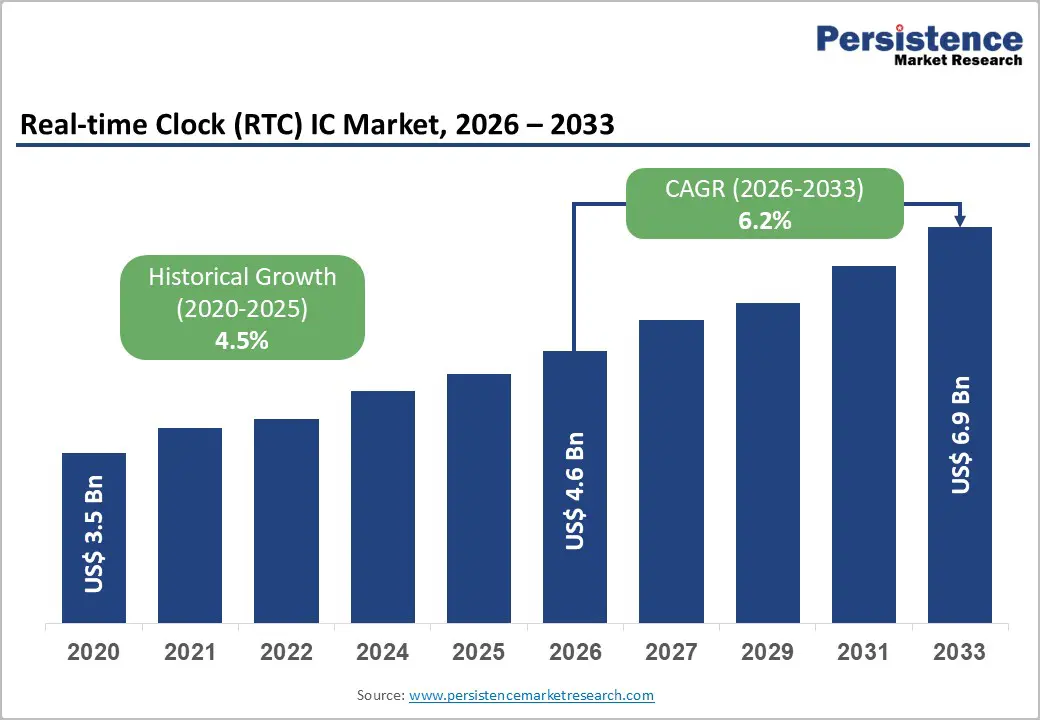
The global Real-time Clock (RTC) IC market is entering a phase of steady yet structurally important growth, driven by the rapid expansion of connected devices across consumer electronics, automotive systems, industrial automation, healthcare equipment, and telecom infrastructure. Valued at US$4.6 billion in 2026, the market is projected to reach US$6.9 billion by 2033, registering a CAGR of 6.2% during the forecast period.
Unlike many semiconductor segments that experience cyclical volatility, RTC ICs maintain consistent demand because they perform a fundamental function—accurate timekeeping even during power loss or sleep states. As digital ecosystems become more synchronized and data-driven, RTC ICs are evolving from passive components into critical timing infrastructure for modern electronics.
Market Overview
RTC ICs are widely used to maintain real-world time in electronic devices, ensuring continuity of timekeeping even when the main system power is off. These chips are essential in systems requiring scheduling, timestamping, event logging, and power-efficient operation.
The market growth is strongly influenced by:
- Rapid expansion of IoT-enabled devices
- Increasing integration in automotive electronics and EV platforms
- Rising adoption in healthcare monitoring devices
- Growth of telecom infrastructure and 5G networks
- Demand for ultra-low-power semiconductor components
The combination of miniaturization trends and increasing system complexity is pushing manufacturers to develop highly efficient, compact, and multifunctional RTC ICs.
Key Market Trends
- Shift Toward Ultra-Low-Power RTC ICs
One of the most significant trends is the growing demand for ultra-low-power RTC ICs in battery-operated devices. Modern RTCs often consume microamp-level currents, allowing them to operate continuously in smartphones, wearables, and IoT sensors without significantly draining battery life.
Over 80% of smartphones, wearables, and portable health devices now integrate RTC functionality. This is essential for maintaining time during deep sleep modes, enabling alarms, scheduled tasks, and sensor synchronization.
As IoT device deployment is expected to reach tens of billions globally by the early 2030s, RTC ICs are becoming indispensable components in always-on architectures.
- Automotive Electrification and ADAS Integration
The automotive industry is emerging as one of the fastest-growing application segments for RTC ICs. Modern vehicles rely on precise time synchronization for:
- Advanced Driver Assistance Systems (ADAS)
- Infotainment and navigation systems
- Telematics and remote diagnostics
- Battery management systems in EVs
- Event data recorders
Electric vehicles (EVs) and connected cars require multiple RTC ICs to ensure system-level coordination. Regulatory frameworks in North America, Europe, and Asia are also pushing for improved data logging accuracy, further strengthening RTC adoption.
The automotive segment is expected to grow at a CAGR of 10.8%, making it a major growth engine for the market.
- Integration of RTCs into MCUs and SoCs
A key restraint affecting the market is the increasing integration of RTC functionality into microcontrollers (MCUs) and System-on-Chips (SoCs). This reduces the need for discrete RTC ICs in many applications.
In fact, more than 60% of wearable devices launched in 2025 included embedded RTC functionality within MCUs. This trend improves cost efficiency and reduces board space but limits standalone RTC IC demand in entry-level devices.
However, high-precision and mission-critical applications still rely on dedicated RTC ICs due to reliability and accuracy requirements.
- Accuracy Limitations of Quartz-Based RTCs
Traditional RTC ICs depend on quartz crystal oscillators, which are susceptible to:
- Temperature drift
- Aging effects
- Frequency instability in harsh environments
These limitations affect nearly 40% of industrial RTC applications, especially in environments requiring high-precision timekeeping. As a result, industries such as aerospace, utilities, and industrial automation are increasingly exploring advanced alternatives like TCXO and MEMS-based timing systems.
- Emergence of MEMS-Based Timing Solutions
MEMS-based RTC and clock systems represent a major technological shift. Companies like SiTime are pioneering silicon-based timing solutions that replace traditional quartz crystals.
Key advantages include:
- Higher thermal stability
- Greater resistance to vibration and shock
- Smaller form factor
- Improved long-term reliability
The introduction of integrated Clock-System-on-Chip (ClkSoC) solutions is expanding RTC applications into AI data centers, edge computing, and high-performance networking systems.
- Smart Grid and EV Charging Infrastructure Expansion
Another emerging opportunity lies in energy infrastructure modernization. Smart grids and EV charging stations require RTC ICs for:
- Time-of-use (TOU) billing
- Load balancing
- Off-peak charging coordination
- Grid synchronization
- Offline data logging
EV chargers may remain idle for up to 70–80% of their operational lifetime, making ultra-low-power RTCs essential for efficient energy management.
Market Segmentation Analysis
By Product Type
Standalone RTC ICs
Standalone RTC ICs dominate the market with over 60% share in 2026, valued at more than US$2.8 billion. Their popularity is driven by:
- Dedicated timekeeping functionality
- High reliability
- Easy integration with multiple systems
- Low power consumption
These ICs are widely used in industrial systems, consumer electronics, and automotive applications where precision timing is essential.
Integrated RTC ICs
Integrated RTC ICs are the fastest-growing segment. They are increasingly embedded in MCUs and SoCs, offering:
- Reduced board space
- Lower system cost
- Improved power efficiency
- Simplified design architecture
Their adoption is especially strong in IoT devices, wearables, and compact automotive electronics.
By Interface Type
I2C Interface
The I2C interface dominates with over 65% market share, valued at more than US$3.0 billion. Its advantages include:
- Low pin count
- Simple architecture
- Broad compatibility
- Ease of implementation
It remains the standard for most consumer and embedded applications.
SPI Interface
SPI is the fastest-growing interface type due to:
- High-speed data transfer
- Full-duplex communication
- Better performance in complex systems
It is increasingly used in industrial automation and advanced automotive electronics.
By Mounting Type
Surface Mount Devices (SMD)
Surface-mount RTC ICs account for more than 75% market share, valued at over US$3.5 billion. They are preferred because of:
- Compact size
- Automated assembly compatibility
- High production efficiency
Through-Hole Devices
Through-hole RTC ICs remain relevant in applications requiring:
- High mechanical strength
- Resistance to vibration
- Reliability in harsh environments
These are widely used in industrial and aerospace systems.
By Application
Consumer Electronics
Consumer electronics dominate the market with over 35% share, valued at more than US$1.6 billion. RTC ICs are essential in:
- Smartphones
- Tablets
- Laptops
- Wearables
- Smart home devices
Automotive
The automotive segment is the fastest-growing application area. RTC ICs are critical in EVs and connected vehicles for system coordination and data logging.
Other Applications
- Industrial automation
- Healthcare devices
- Telecom infrastructure
- Smart grid systems
Regional Analysis
Asia Pacific
Asia Pacific leads the global market with over 40% share, valued at approximately US$1.8 billion in 2026. Growth is driven by:
- Large-scale electronics manufacturing
- Strong semiconductor ecosystem in China, Japan, South Korea, and Taiwan
- Government-backed smart city initiatives
- Rapid IoT adoption in India and ASEAN countries
North America
North America holds over 24% share, valued at US$1.1 billion, supported by:
- Strong semiconductor R&D ecosystem
- Automotive innovation in EV and autonomous vehicles
- Government initiatives like the CHIPS Act
- Expanding telecom and defense applications
Europe
Europe accounts for over 21% market share, driven by:
- Strong automotive manufacturing base in Germany
- EU Chips Act and semiconductor expansion initiatives
- Industry 4.0 automation adoption
- Regulatory emphasis on security and reliability
Competitive Landscape
The RTC IC market is moderately consolidated, with major semiconductor companies competing on:
- Power efficiency
- Precision timing accuracy
- Integration capabilities
- Automotive-grade compliance
Key Players Include:
- Texas Instruments
- STMicroelectronics
- Microchip Technology
- NXP Semiconductors
- Analog Devices
- Renesas Electronics
- Seiko Epson Corporation
- ROHM Semiconductor
- Silicon Laboratories
- Diodes Incorporated
Strategic Developments
- SiTime expanded its timing portfolio through acquisitions and MEMS-based innovation.
- New product launches focus on AI data centers and high-reliability systems.
- Automotive-grade RTC ICs are increasingly designed with AEC-Q100 compliance.
Future Outlook
The RTC IC market is expected to evolve along three key trajectories:
- Miniaturization and integration into system-on-chip architectures
- Shift toward MEMS-based timing solutions replacing quartz crystals
- Expansion into automotive, AI, and energy infrastructure ecosystems
Despite integration pressures from MCUs, standalone RTC ICs will continue to hold strong demand in applications requiring precision, reliability, and low-power autonomous operation.
Conclusion
The global Real-time Clock (RTC) IC market is transitioning from a traditional embedded component space into a strategic enabling technology for modern digital systems. With growing demand from IoT, automotive electrification, smart infrastructure, and consumer electronics, RTC ICs are becoming essential for ensuring synchronization, reliability, and energy efficiency across devices.
As the market expands from US$4.6 billion in 2026 to US$6.9 billion in 2033, innovation in low-power design, MEMS-based solutions, and system integration will define the next phase of competition and growth.

 English
 Arabic
 French
 Spanish
 Portuguese
 Deutsch
 Turkish
 Dutch
Dutch
 Russian
 Romaian
 Portuguese (Brazil)
 Greek
Greek