


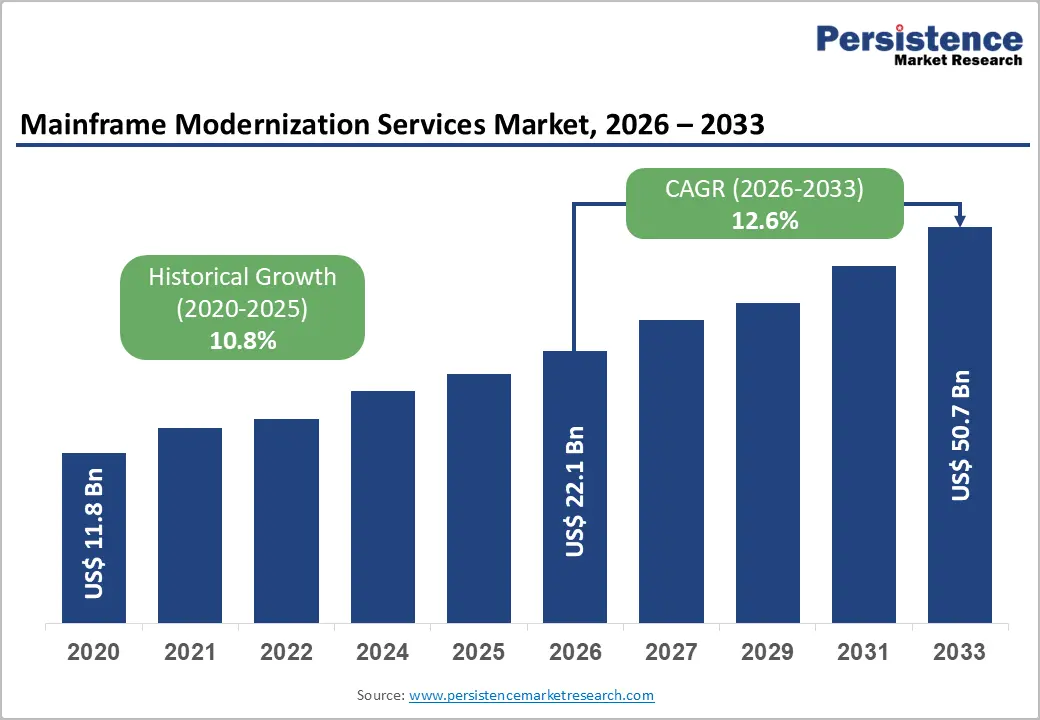
The global mainframe modernization services market is entering a period of accelerated expansion, driven by enterprises seeking to replace or upgrade legacy mainframe systems with agile, cloud-ready, and AI-enabled architectures. Valued at US$22.1 billion in 2026, the market is projected to reach US$50.7 billion by 2033, reflecting a robust CAGR of 12.6% during the forecast period. This growth reflects a structural shift in enterprise IT strategy, where organizations are prioritizing digital transformation, operational efficiency, and cost optimization over maintaining aging, high-cost mainframe environments.
At the core of this transition is the increasing realization that traditional mainframes, while reliable, are no longer sufficient to support the speed, scalability, and intelligence required by modern digital businesses. As industries adopt cloud computing, AI, DevOps, and real-time analytics, mainframe modernization has evolved from a technical upgrade into a strategic necessity.
Market Overview: From Legacy Dependence to Modern Enterprise Architecture
Mainframes continue to play a critical role in industries such as banking, insurance, government, and telecom due to their reliability and processing power. However, maintaining these systems often consumes 25–30% of total IT budgets, primarily due to hardware upkeep, licensing costs, and the scarcity of skilled mainframe professionals.
This cost burden, combined with increasing pressure for digital agility, is prompting enterprises to transition toward hybrid and cloud-native environments. Modernization services enable organizations to transform legacy applications, migrate data, and re-architect systems without disrupting mission-critical operations.
The evolution of AI-powered modernization tools is further accelerating this shift. Automated code refactoring, predictive analytics, and intelligent testing frameworks are reducing modernization timelines and improving accuracy, making large-scale transformation projects more feasible than ever before.
Key Market Highlights
Several key trends define the structure of the global mainframe modernization services market:
Service Type Leadership
Application modernization dominates the market with over 34% share in 2026, valued at more than US$7.5 billion. Enterprises are prioritizing the refactoring of legacy applications to improve efficiency, reduce costs, and enable integration with cloud platforms, AI tools, and analytics ecosystems. Meanwhile, data modernization is emerging as the fastest-growing segment due to rising demand for real-time analytics and regulatory compliance.
Deployment Trends
On-premises deployment retains a strong position with over 30% market share in 2026, valued at approximately US$6.6 billion, driven by security, compliance, and latency-sensitive workloads. However, cloud-based deployment is expanding rapidly as organizations shift toward scalable, flexible, and cost-efficient modernization models.
Industry Vertical Leadership
The BFSI sector leads with more than 28% market share in 2026, valued at over US$6.2 billion, due to its reliance on secure, high-volume transaction processing systems. The IT & telecom sector is growing at the fastest rate, with a projected CAGR of 15.7%, driven by network automation and digital service expansion.
Regional Leadership
North America dominates the global market with over 38% share in 2026, valued at US$8.4 billion, while Asia Pacific is the fastest-growing region with a CAGR of 17.5%, supported by rapid digital transformation across India, China, Japan, and ASEAN economies.
Market Drivers
Rising Cost Burden and Cloud Migration Mandates
One of the strongest forces driving modernization is the rising cost of maintaining legacy mainframe systems. Enterprises are increasingly spending a disproportionate share of IT budgets on outdated infrastructure. This includes maintenance of hardware, proprietary software licensing, and reliance on specialized mainframe talent, which is becoming increasingly scarce and expensive.
At the same time, enterprises are under pressure to migrate to cloud-first strategies. Governments and regulators in many regions are encouraging digital transformation initiatives, further accelerating adoption. Cloud-based modernization reduces capital expenditure while improving scalability and flexibility. Leading providers such as IBM, AWS, Accenture, and TCS are enabling hybrid modernization models that balance legacy stability with modern agility.
Increasing Adoption of AI, Automation, and DevOps
The integration of AI and automation into modernization workflows is transforming how enterprises approach legacy transformation. AI-powered tools now assist in code analysis, refactoring, and testing, significantly reducing manual effort.
Organizations adopting AI-driven modernization frameworks report 40–50% faster application update cycles and improved operational accuracy. DevOps integration further streamlines deployment pipelines, enabling continuous integration and continuous delivery (CI/CD) across previously rigid mainframe environments.
These advancements are making modernization more predictable, scalable, and cost-effective, expanding adoption across BFSI, healthcare, and retail industries.
Market Restraints
Modernization Risk and Operational Sensitivity
Despite strong demand, modernization projects carry inherent risks due to the mission-critical nature of mainframe systems. Even minor disruptions in systems handling banking transactions, healthcare records, or government services can have significant consequences.
As a result, enterprises often adopt phased or incremental modernization approaches rather than full-scale migrations. This cautious approach slows project timelines and delays revenue realization for service providers.
Talent Shortages and Integration Complexity
Another major challenge is the scarcity of professionals skilled in both legacy mainframe systems and modern cloud-native technologies. Modernization requires expertise across COBOL, Java, cloud architecture, DevOps, and cybersecurity—skills that rarely exist within a single workforce segment.
Additionally, integrating legacy systems with modern architectures introduces complexity, increasing project costs and dependency on specialized consulting firms and ecosystem partners.
Market Opportunities
AI-Powered Modernization Platforms
Generative AI and large language models (LLMs) are creating transformative opportunities in automated modernization. Tools such as AWS Mainframe Modernization and IBM WatsonX Code Assistant for Z are enabling automated translation of COBOL and other legacy code into modern programming languages.
These tools reduce code comprehension time by up to 30–40%, significantly accelerating migration timelines. As these technologies mature, service providers that embed AI into modernization frameworks are expected to gain a strong competitive advantage.
Rising Demand for Digital Customer Experiences
Modern enterprises are increasingly focused on delivering seamless, real-time digital experiences. Legacy mainframes often limit the ability to deploy personalized services, real-time analytics, and API-driven platforms.
Modernization enables organizations to break monolithic systems into modular, cloud-native architectures. This improves scalability, reduces deployment cycles, and enhances integration with digital ecosystems. Industries such as retail, BFSI, and healthcare are especially benefiting from these capabilities.
Segment Analysis
Service Type
Application modernization remains the dominant segment due to its direct impact on operational efficiency and system agility. Enterprises are modernizing legacy applications to transition toward microservices and containerized environments.
Data modernization is growing rapidly as organizations prioritize real-time analytics and AI-driven decision-making. Legacy databases are increasingly inadequate for handling modern data workloads, prompting large-scale upgrades.
Deployment
On-premises solutions continue to be widely used in regulated industries where data sovereignty and compliance are critical. However, cloud-based deployment is rapidly gaining traction due to its scalability, automation capabilities, and cost efficiency.
Hybrid models are emerging as a preferred approach, allowing enterprises to gradually transition workloads while maintaining operational continuity.
Industry Vertical
The BFSI sector leads the market due to its dependence on secure, high-volume transaction systems and regulatory compliance requirements. Modernization helps financial institutions improve scalability, reduce downtime, and enhance digital banking services.
IT & telecom is the fastest-growing vertical, driven by network virtualization, cloud adoption, and the need for agile service delivery models.
Regional Analysis
North America
North America remains the global leader due to early adoption of digital transformation strategies and strong government support for IT modernization. Federal agencies such as the IRS and Department of Defense are actively investing in mainframe modernization programs supported by initiatives like the Technology Modernization Fund.
Asia Pacific
Asia Pacific is witnessing the fastest growth, driven by rapid digitalization, expanding IT services ecosystems, and strong demand from BFSI and manufacturing sectors. India, in particular, has emerged as a global hub for modernization services due to its skilled workforce and presence of major IT service providers.
Europe
Europe is experiencing steady growth, driven by strict regulatory frameworks such as the NIS2 Directive, which emphasizes cybersecurity and operational resilience. Enterprises across Germany, France, and the UK are investing heavily in API-driven modernization and cloud integration.
Competitive Landscape
The market is moderately consolidated, with leading players such as IBM, Accenture, TCS, AWS, Wipro, and Cognizant holding significant share. These firms are investing in AI-powered modernization platforms, hyperscaler partnerships, and industry-specific solutions.
Recent developments highlight the increasing role of AI in modernization strategies. For instance, Kyndryl and AWS have launched enhanced AI-driven modernization services aimed at reducing migration timelines and improving automation across transformation workflows.
Conclusion
The mainframe modernization services market is undergoing a fundamental transformation driven by cloud adoption, AI innovation, and increasing pressure for digital agility. As enterprises move away from legacy infrastructure, modernization is becoming a strategic imperative rather than a technical upgrade.
With strong growth expected through 2033, the market will continue to evolve toward AI-assisted, automation-driven, and platform-based modernization models. Organizations that successfully navigate this transition will be better positioned to achieve operational efficiency, regulatory compliance, and long-term digital competitiveness.

 English
 French
 Spanish
 Portuguese
 Deutsch
 Turkish
 Dutch
Dutch
 Italiano
 Russian
 Romaian
 Portuguese (Brazil)
 Greek
Greek