


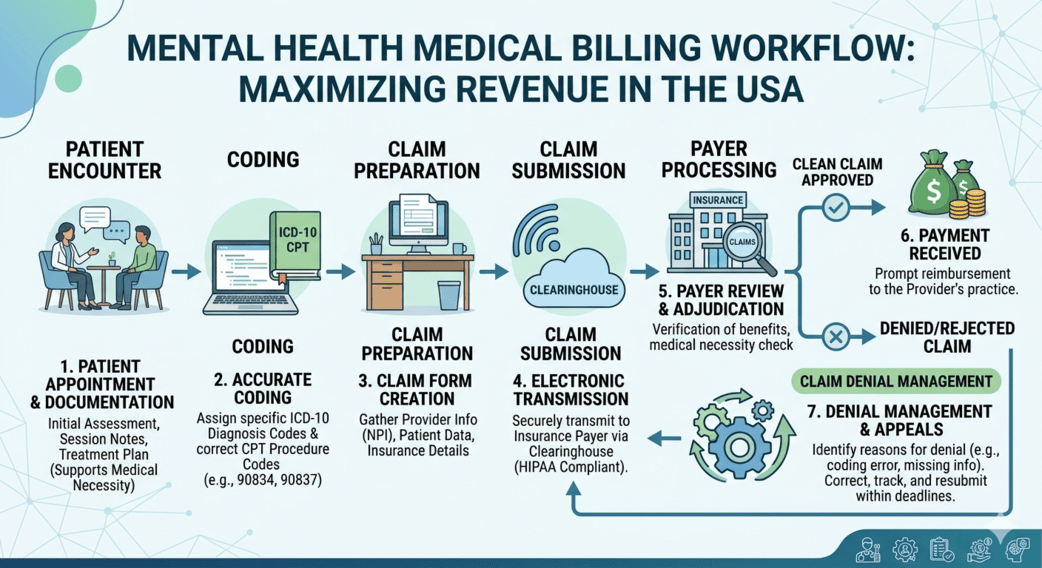
Mental health providers across the USA are seeing a growing demand for counseling, psychiatry, psychology, behavioral therapy, and telehealth services. While helping patients remains the top priority, many practices face another challenge behind the scenes—getting paid accurately and on time. This is where a reliable mental health medical billing solution becomes essential.
Billing for behavioral health services is different from many other medical specialties. Frequent coding updates, payer-specific documentation requirements, prior authorizations, and claim denials can slow down reimbursements if not managed correctly. Whether you run a private practice or a multi-provider behavioral health clinic, understanding how an effective billing solution works can improve both patient care and financial stability.
Why Mental Health Billing Is More Complex Than Other Specialties
Mental health billing involves more than simply submitting insurance claims. Providers must carefully document treatment sessions, use accurate diagnosis and procedure codes, and comply with insurance guidelines that often vary between payers.
Some of the common challenges include:
- Time-based psychotherapy coding
- Telehealth billing regulations
- Prior authorization requirements
- Frequent insurance policy updates
- Coordination of benefits
- Claim denials due to documentation errors
- Compliance with federal and state regulations
Unlike many medical specialties, behavioral health services often require detailed clinical documentation to justify medical necessity. Even a small documentation error can delay reimbursement.
What Is a Mental Health Medical Billing Solution?
A mental health medical billing solution is a structured approach that combines experienced billing professionals, technology, compliance practices, and workflow management to handle the financial side of behavioral healthcare.
Instead of focusing only on claim submission, a complete solution supports every stage of the billing process, from patient registration to final payment collection.
Typical services include:
- Insurance verification
- Patient eligibility checks
- Charge entry
- Accurate coding
- Claim submission
- Payment posting
- Denial management
- Appeals processing
- Financial reporting
- Compliance monitoring
The goal is to reduce administrative work while improving reimbursement accuracy.
Key Features Every Billing Solution Should Include
Choosing the right billing process involves looking beyond basic claim submission.
Accurate Coding Practices
Behavioral health coding changes regularly. Using correct CPT, ICD-10, and HCPCS codes helps reduce claim rejections and supports proper reimbursement.
Practices that also utilize professional medical coding services often experience fewer coding-related denials because documentation and coding remain aligned.
Insurance Eligibility Verification
Verifying insurance before appointments helps identify:
- Active coverage
- Copay amounts
- Deductibles
- Referral requirements
- Authorization needs
This simple step can prevent unexpected billing issues for both providers and patients.
Denial Prevention
An effective billing solution identifies errors before claims are submitted.
Common denial reasons include:
- Missing documentation
- Incorrect patient information
- Coding mismatches
- Duplicate claims
- Expired authorizations
Preventing these issues is usually more efficient than correcting them later.
Real-Time Financial Reporting
Modern billing systems provide reports that help practices monitor:
- Collection rates
- Outstanding claims
- Aging accounts receivable
- Payment trends
- Denial percentages
These insights support better business decisions without affecting patient care.
The Role of Revenue Cycle Management in Behavioral Health
Successful billing extends beyond filing insurance claims. Every financial interaction contributes to the overall health of a practice.
This is where revenue cycle management plays an important role.
The revenue cycle includes:
- Scheduling appointments
- Insurance verification
- Patient registration
- Clinical documentation
- Medical coding
- Claim submission
- Payment posting
- Denial resolution
- Patient billing
- Final account reconciliation
When each step works efficiently, providers spend less time managing administrative tasks and more time caring for patients.
How Credentialing Supports Faster Payments
Many payment delays begin before a patient is ever seen.
Proper credentialing ensures providers are enrolled with insurance companies and authorized to receive reimbursement for covered services.
Without updated credentialing records, claims may be delayed, rejected, or denied entirely.
Maintaining current provider enrollment also supports:
- Faster claim processing
- Network participation
- Compliance with payer requirements
- Fewer administrative complications
Regular monitoring helps avoid interruptions caused by expired credentials or outdated information.
Technology Is Changing Mental Health Billing
Healthcare technology continues to improve billing efficiency.
Many modern billing platforms now support:
- Electronic claim submission
- Automated eligibility verification
- Integrated electronic health records
- Secure patient payment portals
- Automated claim tracking
- Digital payment posting
- Analytics dashboards
Automation reduces repetitive manual work while helping staff identify issues before they affect reimbursement.
However, technology alone is not enough. Experienced billing professionals remain essential for handling complex payer rules and appeals.
Benefits of Outsourcing Mental Health Billing
Some behavioral health practices choose to outsource billing rather than manage it internally.
Potential advantages include:
Reduced Administrative Burden
Providers and office staff can focus more on patient care instead of paperwork.
Improved Claim Accuracy
Experienced billing specialists stay updated with payer policies and coding changes.
Faster Cash Flow
Clean claims often lead to quicker reimbursements and fewer payment delays.
Better Compliance
Billing professionals monitor regulatory updates that affect behavioral health reimbursement.
Lower Operational Costs
Practices may reduce expenses associated with hiring, training, and managing in-house billing teams.
Many organizations combine outsourced medical billing services with coding and compliance support to improve overall operational efficiency.
Common Mistakes That Reduce Reimbursement
Even well-managed practices occasionally experience billing issues.
Some of the most common mistakes include:
- Incomplete documentation
- Incorrect psychotherapy time selection
- Missing modifiers
- Outdated diagnosis codes
- Late claim submission
- Inadequate follow-up on unpaid claims
- Incorrect patient demographics
- Failure to verify insurance benefits
Regular internal audits can help identify these issues before they become recurring problems.
Selecting the Right Billing Partner
Every behavioral health practice has different needs.
When evaluating a billing solution, consider factors such as:
- Experience with mental health specialties
- Knowledge of behavioral health regulations
- Transparent reporting
- Strong denial management processes
- HIPAA compliance
- Responsive customer support
- Scalable billing services
- Integration with existing practice management software
Choosing a partner that understands behavioral health workflows can contribute to smoother financial operations over time.
Organizations like 247 Medical Billing Services provide support across multiple areas of healthcare administration, including medical billing services, medical coding services, credentialing, and revenue cycle management. Selecting a provider with experience in behavioral health can help practices navigate changing payer requirements while maintaining operational efficiency.
Looking Ahead: The Future of Mental Health Billing
The demand for behavioral health services continues to grow throughout the USA. At the same time, insurance regulations, telehealth policies, and coding requirements continue to evolve.
A modern mental health medical billing solution is no longer just about processing claims. It combines skilled professionals, technology, compliance, and financial oversight to create a smoother reimbursement process.
Practices that invest in accurate documentation, proactive denial prevention, efficient workflows, and ongoing compliance are better positioned to improve financial performance while continuing to deliver quality mental healthcare.
Frequently Asked Questions
1. What is a mental health medical billing solution?
A mental health medical billing solution is a comprehensive system that manages insurance verification, coding, claim submission, payment posting, denial management, and reimbursement for behavioral health providers.
2. Why is mental health billing different from general medical billing?
Behavioral health services often involve time-based psychotherapy codes, specialized documentation requirements, telehealth regulations, and payer-specific billing guidelines that make the process more complex.
3. How can practices reduce claim denials?
Practices can lower denials by verifying insurance eligibility, using accurate diagnosis and procedure codes, maintaining complete documentation, and reviewing claims before submission.
4. Does credentialing affect insurance payments?
Yes. Proper credentialing ensures providers are enrolled with insurance companies, allowing claims to be processed and reimbursed according to payer requirements.
5. What is the role of revenue cycle management in mental health practices?
Revenue cycle management oversees every financial step, from patient registration and insurance verification to claim submission, payment collection, and account reconciliation, helping improve overall financial performance.
6. Should small mental health practices outsource billing?
Many smaller practices outsource billing to reduce administrative work, improve claim accuracy, stay compliant with changing regulations, and focus more on patient care.
7. How do medical coding services improve reimbursement?
Professional medical coding services help ensure diagnoses and procedures are coded accurately, reducing claim rejections, supporting compliance, and increasing the likelihood of timely reimbursement.

 English
 Arabic
 French
 Spanish
 Portuguese
 Turkish
 Dutch
Dutch
 Italiano
 Russian
 Romaian
 Portuguese (Brazil)
 Greek
Greek