


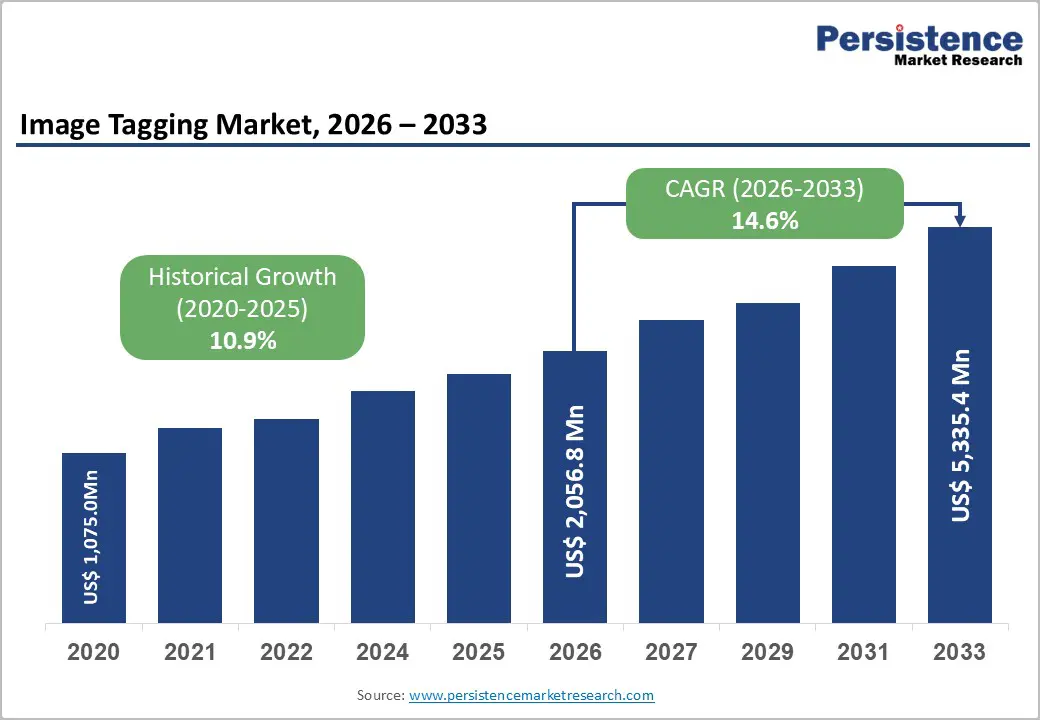
The global image tagging market is entering a period of rapid expansion as artificial intelligence (AI) and machine learning (ML) technologies continue to reshape how visual data is processed, labeled, and utilized across industries. Valued at US$2,056.8 million in 2026, the market is projected to reach US$5,335.4 million by 2033, registering a strong CAGR of 14.6% during the forecast period. This growth reflects the accelerating dependence on high-quality annotated visual datasets that power computer vision systems across sectors such as automotive, healthcare, retail, security, and industrial automation.
At its core, image tagging—also known as image annotation—enables machines to interpret visual content by assigning labels to objects, actions, and contexts within images. As deep learning models such as Convolutional Neural Networks (CNNs) and transformer-based vision architectures become more sophisticated, the demand for accurate and scalable tagging solutions has increased dramatically.
Market Overview and Key Growth Drivers
One of the most significant drivers of the image tagging market is the explosive growth of AI model training requirements. Modern AI systems rely heavily on large volumes of labeled data to achieve accuracy and reliability. With global data creation expected to surpass 230–240 zettabytes by 2026, a substantial portion of which is unstructured visual content, the need for structured annotation is becoming unavoidable.
Autonomous vehicles, for instance, require millions of labeled images to train perception systems capable of identifying pedestrians, traffic signals, and road conditions in real time. Similarly, healthcare AI applications depend on precisely tagged medical images for diagnosing diseases such as cancer, neurological disorders, and cardiovascular conditions.
Another major driver is the widespread adoption of computer vision across industries. Retailers are using image tagging to enable visual search engines and automated product categorization, while improving customer personalization. In fact, AI-driven personalization strategies have been shown to increase retail revenues by 10–15%, reinforcing the business value of visual intelligence systems.
In IT and telecom, image tagging supports content moderation, network monitoring, and smart infrastructure management, further broadening its application base.
Market Restraints and Challenges
Despite strong growth prospects, the market faces several challenges that may restrain expansion.
- Data Privacy and Regulatory Compliance
Strict data protection regulations such as the EU GDPR, the upcoming EU AI Act (2026), and India’s Digital Personal Data Protection Act are creating compliance complexities for companies handling visual and biometric data. GDPR enforcement alone has resulted in fines exceeding €5.65 billion, highlighting the financial risks associated with non-compliance.
These regulations impact cross-border data sharing, especially for cloud-based tagging platforms, increasing operational costs and limiting flexibility.
- High Cost of Annotation
Image tagging remains a labor-intensive and expensive process, particularly for specialized industries like medical imaging and autonomous driving. High-quality annotation often requires domain experts, which significantly increases costs. For small and medium enterprises, this creates a substantial barrier to entry.
- Quality Consistency Issues
Inconsistent labeling quality can directly impact AI model performance. Ensuring accuracy across large datasets remains a persistent operational challenge for many providers.
Emerging Opportunities
Generative AI and Multimodal Models
One of the most transformative opportunities lies in the integration of generative AI and multimodal foundation models. Technologies such as Meta’s Segment Anything Model (SAM) are enabling prompt-based image segmentation, significantly reducing manual effort in annotation workflows.
Similarly, AI-assisted platforms like Sama Multimodal are combining human oversight with automation, improving accuracy by over 35% while reducing operational inefficiencies.
The increasing investment in this space further highlights its potential. Meta’s acquisition of a 49% stake in Scale AI for US$14.3 billion reflects growing confidence in automated data labeling ecosystems.
Healthcare AI Expansion
Healthcare represents one of the most promising verticals for image tagging. AI-powered radiology, pathology, and ophthalmology systems require highly accurate labeled datasets for diagnostics. Companies like Qure.ai and iMerit are already demonstrating significant efficiency gains, including faster workflows and improved diagnostic accuracy through AI-assisted annotation tools.
Segment Analysis
By Tagging Method
Object Detection remains the dominant segment, accounting for over 30% market share in 2026, driven by demand for precise object-level identification in automotive, retail, and surveillance applications.
Meanwhile, Activity and Action Recognition is the fastest-growing segment, fueled by increasing use cases in behavioral analytics, smart surveillance systems, healthcare monitoring, and sports performance analysis.
By Technology
Fully automated tagging leads the market with more than 54% share, driven by scalability, speed, and cost efficiency. Automation is increasingly preferred for handling large-scale datasets in real time.
However, semi-automated tagging is gaining traction, particularly in industries requiring high accuracy such as healthcare and legal services. This hybrid approach combines machine efficiency with human validation.
By Deployment
Cloud-based solutions dominate the market with over 57% share, supported by scalability, accessibility, and seamless integration with AI workflows.
On the other hand, hybrid deployment models are the fastest growing, expanding at a CAGR of 20.1%, as enterprises balance data security, compliance, and performance optimization.
By Industry
The automotive sector leads the market with over 20% share, driven by increasing adoption of ADAS (Advanced Driver-Assistance Systems) and autonomous driving technologies. Image tagging plays a crucial role in training AI perception systems.
Meanwhile, retail and e-commerce is the fastest-growing segment due to rising demand for visual search, AI-driven recommendations, and automated product cataloging.
Regional Analysis
North America
North America dominates the global market with over 40% share in 2026, valued at approximately US$822.7 million. The region benefits from strong AI infrastructure, hyperscale cloud providers, and early enterprise adoption across industries such as healthcare, retail, and defense.
Government initiatives like the American AI Initiative and large-scale investments in AI research further strengthen the region’s leadership.
Asia Pacific
Asia Pacific is the fastest-growing region, with a CAGR of 19.8%. China leads with its national AI development strategy, while India’s Digital India initiative is accelerating AI adoption in public services. Japan and South Korea contribute advanced robotics and industrial automation capabilities, further expanding market opportunities.
Europe
Europe holds over 21% market share, driven by strong demand from automotive and healthcare sectors. However, strict regulatory frameworks such as GDPR and the EU AI Act influence adoption patterns. Despite compliance challenges, Europe continues to invest in privacy-preserving and ethical AI systems.
Competitive Landscape
The image tagging market is semi-consolidated, with major technology players such as Google, Microsoft, Amazon Web Services (AWS), IBM, and Oracle dominating through advanced cloud-based AI ecosystems.
These companies compete on the basis of model accuracy, scalability, integration capabilities, and developer tools. At the same time, specialized firms like Clarifai, Roboflow, V7, and Imagga focus on domain-specific solutions and customizable annotation workflows.
The market is also witnessing active consolidation and investment in generative AI, automation, and multimodal intelligence, reshaping the competitive landscape.
Recent Developments
- In 2026, the Government of India introduced regulations mandating AI-generated labeling for digital content, improving transparency in synthetic media identification.
- In 2025, Meta acquired a 49% stake in Scale AI, significantly boosting its position in the automated data annotation ecosystem.
Conclusion
The global image tagging market is poised for substantial expansion through 2033, driven by the increasing integration of AI across industries and the rising need for structured visual data. While challenges such as regulatory compliance and high annotation costs persist, advancements in generative AI, multimodal models, and automation are expected to redefine the efficiency and scalability of image tagging systems.
As industries continue to adopt computer vision at scale, image tagging will remain a foundational layer of the AI ecosystem—enabling machines to see, interpret, and act on visual information with increasing precision and intelligence.

 English
 Arabic
 French
 Spanish
 Portuguese
 Deutsch
 Turkish
 Dutch
Dutch
 Russian
 Romaian
 Portuguese (Brazil)
 Greek
Greek