


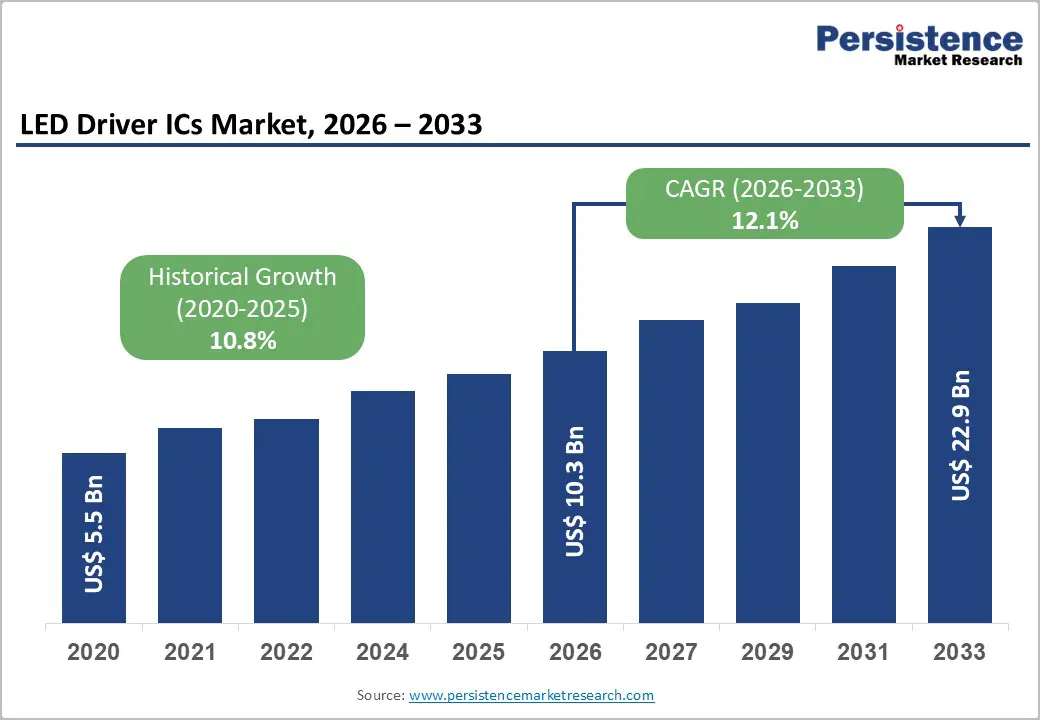
The global LED Driver ICs market is entering a period of strong structural expansion, supported by accelerating adoption of energy-efficient lighting systems, rapid urban infrastructure development, and the global shift toward intelligent, connected lighting ecosystems. Valued at US$10.3 billion in 2026, the market is projected to reach US$22.9 billion by 2033, reflecting a robust CAGR of 12.1% during the forecast period.
This growth trajectory is not merely cyclical—it is fundamentally driven by regulatory transformation, electrification trends in automotive systems, and the increasing integration of LED technology across commercial, residential, industrial, and display applications.
Market Overview
LED Driver ICs are critical semiconductor components responsible for regulating current and voltage supplied to LED lighting systems. Their function ensures optimal brightness, energy efficiency, dimming control, and long operational lifespan of LED assemblies.
As governments worldwide enforce strict energy efficiency standards and phase out incandescent and halogen lighting systems, LED driver ICs have become indispensable in modern lighting architectures. The transition from traditional lighting to solid-state lighting has created a sustained demand pipeline for advanced driver ICs capable of supporting smart and adaptive lighting environments.
Key regulatory frameworks such as the European Union Ecodesign Directive, U.S. Department of Energy (DOE) standards, Energy Star certifications, and IEC 61347 safety norms are reinforcing the adoption of high-performance driver ICs globally.
Key Market Highlights
- The AC-DC segment dominates with 54%+ share in 2026, driven by grid-connected lighting and smart city infrastructure.
- DC-DC drivers are the fastest-growing segment, fueled by EVs, portable electronics, and solar lighting systems.
- Buck converters lead topology adoption with 28%+ share, owing to efficiency and cost advantages.
- Buck-Boost topology is expanding rapidly due to its versatility in fluctuating power environments.
- The commercial sector holds the largest end-user share at 35%+, driven by smart buildings and retrofitting projects.
- Automotive applications are growing fastest at CAGR of 15.6%, driven by EV adoption and ADAS integration.
- Asia Pacific leads globally with 43%+ market share, followed by North America at 27%+.
Market Dynamics
Drivers
- Rising Demand for Energy-Efficient Lighting and Regulatory Push
One of the strongest forces driving the LED Driver ICs market is the global emphasis on reducing electricity consumption. Lighting accounts for approximately 10–15% of global electricity usage, and LED adoption can reduce energy consumption by 40–50% compared to conventional lighting systems.
Governments across major economies—including the EU, U.S., China, and India—are actively phasing out inefficient lighting technologies. This regulatory pressure is creating sustained demand for advanced LED driver ICs that offer:
- Power-factor correction
- Pulse-width modulation (PWM) dimming
- High efficiency and thermal stability
- Compliance with safety and electromagnetic standards
As of 2025, over half of global smart streetlight deployments incorporate digital LED driver ICs, highlighting the regulatory-driven transformation of lighting infrastructure.
- Automotive Electrification and Smart Lighting Integration
The automotive sector is emerging as a high-growth application area for LED driver ICs. With global vehicle production rising steadily, LED adoption in automotive lighting systems is expanding rapidly.
Modern vehicles increasingly use LED driver ICs in:
- Adaptive headlights and matrix beam systems
- Tail and brake lighting
- Interior ambient lighting
- LiDAR-adjacent optical systems
Electric vehicles (EVs) further intensify demand due to the need for energy-efficient power management systems that extend battery life. Advanced driver ICs with diagnostic capabilities, thermal protection, and precision dimming are becoming standard requirements in automotive design.
- Smart Lighting and IoT Integration
The emergence of smart buildings and IoT-enabled infrastructure is reshaping lighting systems into intelligent networks. LED driver ICs are increasingly integrated with:
- Bluetooth and Wi-Fi modules
- NB-IoT connectivity
- AI-based lighting controls
This enables dynamic brightness adjustment, remote monitoring, and human-centric lighting (HCL), enhancing both energy efficiency and user experience.
Restraints
- Semiconductor Supply Chain Volatility
The LED driver IC market remains vulnerable to global semiconductor supply disruptions. Past shortages have affected wafer fabrication cycles and extended lead times for IC production.
Additionally, price fluctuations in materials such as GaN (Gallium Nitride) and SiC (Silicon Carbide) continue to pressure manufacturing margins. Geopolitical tensions and export restrictions further complicate supply chain stability.
- High Compliance and Thermal Design Complexity
LED driver ICs must operate under strict regulatory standards such as:
- AEC-Q100 (automotive-grade reliability)
- EN 61347 (lighting safety)
- EN 55015 (electromagnetic compatibility)
At the same time, thermal management remains a significant engineering challenge. Ensuring consistent current output across varying temperatures increases design complexity and development costs, especially for compact and high-density applications.
Opportunities
- Smart City Infrastructure Expansion
Smart city initiatives represent one of the most significant growth opportunities for LED driver IC manufacturers. Governments are investing heavily in intelligent street lighting systems that integrate IoT-based monitoring and control.
For example, large-scale deployments in the United States and Asia Pacific are incorporating:
- Adaptive dimming systems
- Motion-sensing controls
- Remote energy monitoring
These systems rely heavily on advanced driver ICs capable of wireless communication and programmable control.
- Mini-LED and Micro-LED Display Growth
The rapid adoption of Mini-LED and Micro-LED technologies in TVs, AR/VR devices, and wearables is creating a high-value niche for precision driver ICs.
These applications require:
- Ultra-high channel density
- Sub-microsecond dimming precision
- Extremely low power consumption
- Thermal stability in compact form factors
As display technologies evolve toward higher resolution and immersive experiences, demand for advanced LED driver ICs is expected to surge significantly.
Segment Analysis
By Power Conversion Type
AC-DC Drivers (Dominant Segment)
AC-DC LED drivers hold more than 54% market share in 2026, driven by widespread adoption in grid-connected lighting systems. Their ability to convert alternating current into stable direct current makes them essential for:
- Commercial lighting
- Street lighting
- Smart city infrastructure
Their efficiency, safety compliance, and reliability ensure continued dominance.
DC-DC Drivers (Fastest Growing Segment)
DC-DC drivers are gaining momentum in EVs, solar lighting, and portable electronics. Their precise voltage regulation capabilities make them ideal for energy-sensitive applications requiring flexible power control.
By Topology
Buck Converters (Leading Segment)
Buck converters dominate with over 28% share, primarily due to their simplicity and efficiency in stepping down voltage. They are widely used in:
- Commercial lighting systems
- Automotive interiors
- Smart bulbs and appliances
Buck-Boost Converters (Fastest Growing)
Buck-Boost topology is expanding rapidly due to its ability to maintain stable LED performance under fluctuating input conditions. This makes it particularly valuable in EVs, solar systems, and adaptive lighting environments.
By End-User
Commercial Segment (Largest Market Share)
The commercial segment accounts for over 35% share, driven by:
- Office buildings
- Retail stores
- Hospitality infrastructure
- Public lighting systems
Energy efficiency mandates and smart building adoption continue to drive LED driver IC deployment in this segment.
Automotive Segment (Fastest Growing)
With a CAGR of 15.6%, automotive applications represent the fastest-growing segment. The transition toward EVs and advanced lighting systems is accelerating adoption across global automotive platforms.
Regional Analysis
Asia Pacific (Dominant Region)
Asia Pacific leads with over 43% market share, driven by strong semiconductor manufacturing ecosystems in China, South Korea, Japan, and Taiwan. Rapid urbanization and government-led smart city initiatives further strengthen demand.
India’s LED deployment programs and China’s large-scale manufacturing base make the region the global hub for LED driver IC production and exports.
North America
North America holds around 27% market share, supported by smart infrastructure investments and automotive innovation. Government efficiency programs and large-scale LED retrofit projects continue to expand demand for advanced driver ICs.
Europe
Europe accounts for more than 20% of the market, driven by strict sustainability regulations and Net Zero commitments. Countries such as Germany, the UK, and France are leading adopters of energy-efficient lighting systems and IoT-enabled infrastructure.
Competitive Landscape
The LED Driver IC market is moderately consolidated, with top companies controlling over 40% of global share. Competition is driven by:
- High-efficiency power conversion designs
- Integration of wide-bandgap materials (GaN, SiC)
- Automotive-grade certification compliance
- Advanced dimming and control features
Key strategies include partnerships with lighting OEMs, silicon IP licensing, and expansion into emerging Asia Pacific markets.
Recent Developments
- March 2025: Lumissil Microsystems launched IS31FL3758, a 48-channel LED driver IC designed for high-density display applications.
- February 2025: Macroblock introduced DaVinci Series LED Driver ICs, featuring advanced grayscale control and improved energy efficiency for high-end display systems.
Key Companies Covered
- Texas Instruments
- Analog Devices
- Infineon Technologies
- ON Semiconductor
- STMicroelectronics
- NXP Semiconductors
- ROHM Semiconductor
- Renesas Electronics
- Microchip Technology
- Toshiba
- Skyworks Solutions
- Diodes Incorporated
- Others
Conclusion
The LED Driver ICs market is positioned for sustained high-growth through 2033, underpinned by structural shifts toward energy efficiency, electrification, and intelligent infrastructure. As lighting evolves into a digitally controlled ecosystem, LED driver ICs will become increasingly central to enabling smart cities, advanced automotive systems, and next-generation display technologies.
With strong regulatory backing, expanding application diversity, and rapid technological innovation, the market is expected to remain one of the most dynamic segments within the global semiconductor and lighting industries.

 English
 Arabic
 French
 Spanish
 Portuguese
 Deutsch
 Turkish
 Dutch
Dutch
 Italiano
 Romaian
 Portuguese (Brazil)
 Greek
Greek