


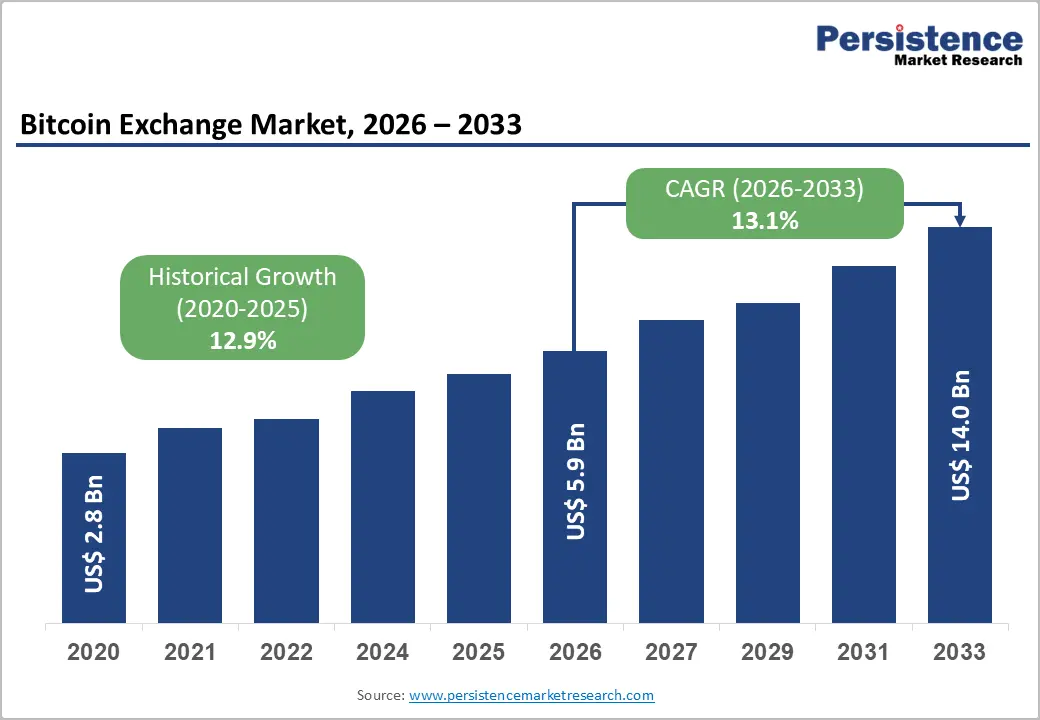
The global Bitcoin exchange market is projected to be valued at US$5.9 billion in 2026 and is expected to reach US$14.0 billion by 2033, expanding at a CAGR of 13.1% during the forecast period from 2026 to 2033. Market growth is primarily driven by increasing adoption of digital assets, strengthening regulatory frameworks, and growing participation from institutional investors.
Bitcoin exchanges have evolved from simple cryptocurrency trading platforms into comprehensive digital asset ecosystems that offer spot trading, derivatives, custody services, staking, institutional brokerage, and compliance solutions. As governments continue to introduce clearer cryptocurrency regulations and financial institutions expand their involvement in digital assets, exchanges are investing heavily in security, trading infrastructure, and customer experience to meet rising market expectations.
According to the International Monetary Fund (IMF, 2023), digital assets are becoming increasingly integrated into the global financial system, while the Bank for International Settlements (BIS, 2024) highlights growing experimentation with regulated digital asset infrastructures. These developments are strengthening confidence among both retail and institutional participants and creating long-term opportunities for Bitcoin exchange providers.
Key Industry Highlights
- Asia Pacific is expected to dominate the global market, accounting for 42% of revenue in 2026.
- North America is projected to be the fastest-growing regional market throughout the forecast period.
- Centralized Exchanges (CEXs) are expected to account for nearly 88% of total market revenue in 2026.
- Trading applications will contribute more than 72% of market revenue, supported by rising cryptocurrency trading volumes.
- Growing adoption of hybrid exchange models combining centralized liquidity with decentralized asset custody presents significant future opportunities.
Market Dynamics
Driver: Rising Institutional Adoption and Corporate Treasury Investments
Institutional participation has become one of the strongest growth drivers for the Bitcoin exchange market. Asset managers, hedge funds, pension funds, corporations, and family offices are increasingly allocating portions of their portfolios to Bitcoin through regulated exchanges.
According to CoinShares (2024), digital asset investment products have witnessed consistent capital inflows driven largely by institutional investors seeking portfolio diversification and inflation hedging opportunities.
To serve institutional clients, exchanges are expanding services including:
- Institutional-grade custody
- Prime brokerage
- OTC trading desks
- Advanced derivatives
- Regulatory compliance solutions
- Risk management platforms
The IMF has also emphasized the increasing integration of cryptocurrencies into traditional finance, encouraging regulated exchange development and improved market stability.
Partnerships between cryptocurrency exchanges and established financial institutions continue to improve market credibility while expanding access to digital asset trading.
Restraint: Market Volatility and Counterparty Risks
Despite growing adoption, Bitcoin exchange platforms continue to face challenges arising from cryptocurrency price volatility.
Sharp price fluctuations can lead to:
- Margin liquidations
- Significant trading losses
- Reduced investor confidence
- Lower participation among conservative investors
Counterparty risk remains another major concern, particularly for centralized exchanges where users rely on platform security and financial stability.
Past incidents involving exchange insolvencies, hacking attacks, liquidity shortages, and withdrawal suspensions have highlighted the importance of robust governance and transparent reserve management.
Although many exchanges now publish Proof-of-Reserves reports and strengthen compliance standards, concerns regarding custodial risks continue encouraging some investors to explore decentralized alternatives.
Opportunity: Growth of Hybrid and Decentralized Exchange Models
The increasing popularity of decentralized finance (DeFi) is creating substantial opportunities for Bitcoin exchange providers.
Modern investors increasingly seek:
- Self-custody
- Greater transparency
- Reduced intermediary dependence
- Enhanced asset security
Hybrid exchange models combine the strengths of centralized exchanges—including deep liquidity and fast execution—with decentralized custody that enables users to retain ownership of their assets.
According to Chainalysis (2024), decentralized trading platforms continue experiencing strong user adoption as investors prioritize transparency and security.
Meanwhile, the BIS notes increasing experimentation with blockchain-based financial infrastructures supporting innovations such as:
- Cross-chain interoperability
- Automated market makers
- Decentralized liquidity pools
- Smart contract-based settlements
These developments are expected to redefine cryptocurrency trading over the next decade.
Category-wise Market Analysis
Product Type Analysis
Centralized Exchanges (CEX)
Centralized exchanges are expected to remain the dominant market segment, accounting for approximately 88% of global revenue in 2026.
Their leadership is supported by:
- High liquidity
- Fast transaction execution
- Regulatory compliance
- Fiat currency integration
- Institutional custody
- Advanced trading features
Major platforms including Coinbase, Binance, and Kraken continue attracting both retail and institutional investors through secure trading environments and comprehensive service portfolios.
Decentralized Exchanges (DEX)
DEX platforms represent the fastest-growing product category.
Unlike centralized platforms, decentralized exchanges allow users to trade directly through blockchain smart contracts without transferring custody of their assets.
Benefits include:
- Enhanced privacy
- Improved transparency
- Self-custody
- Lower dependence on intermediaries
Platforms such as Uniswap demonstrate growing demand for decentralized trading solutions despite ongoing challenges related to scalability and liquidity.
Component Type Analysis
Software
Software solutions are projected to account for nearly 70% of market revenue in 2026.
Core software infrastructure includes:
- Trading engines
- Order matching systems
- Wallet management
- Security protocols
- Risk monitoring
- Mobile applications
- User interface development
Leading exchanges continuously upgrade software to improve transaction speeds, reduce latency, and strengthen cybersecurity.
For example, Binance operates sophisticated matching engines capable of processing millions of transactions daily.
Services
Services are expected to witness the fastest growth during the forecast period.
Growing institutional participation increases demand for:
- Custody services
- Compliance consulting
- Blockchain analytics
- Cybersecurity
- Risk management
- AML and KYC implementation
Kraken and Coinbase have significantly expanded institutional service offerings to address these evolving customer requirements.
Application Analysis
Trading
Trading remains the largest application segment, accounting for approximately 72% of market revenue in 2026.
Demand continues rising across:
- Spot trading
- Margin trading
- Futures
- Options
- Perpetual contracts
Increasing retail participation combined with institutional investment activity supports consistently high trading volumes across global exchanges.
Leading exchanges such as Binance process billions of dollars in daily trading activity across multiple digital assets.
Remittance
Remittance represents the fastest-growing application segment.
Bitcoin exchanges enable:
- Faster international transfers
- Lower transaction fees
- Improved financial inclusion
- Cross-border payments
These advantages are especially valuable in developing economies where traditional remittance services remain costly and time-consuming.
Platforms including Bitstamp continue expanding services supporting efficient international payment solutions.
Regional Market Analysis
Asia Pacific
Asia Pacific is expected to remain the largest Bitcoin exchange market, representing approximately 42% of global revenue in 2026.
The region benefits from:
- Strong retail investor participation
- Rapid digital transformation
- Expanding fintech ecosystems
- Regulatory modernization
Japan continues strengthening its regulatory environment while encouraging innovation in stablecoins and digital asset trading.
India is witnessing rapid cryptocurrency adoption driven by its growing technology-savvy population and expanding fintech sector.
Although China maintains strict cryptocurrency trading restrictions, its continued investment in blockchain technology and digital yuan initiatives reflects broader interest in digital financial infrastructure.
Companies such as bitFlyer have successfully established highly regulated exchange operations supporting investor confidence.
North America
North America is projected to record the fastest market growth during the forecast period.
Growth is supported by:
- Institutional investment
- Regulatory clarity
- Bitcoin ETF expansion
- Mature financial markets
- Advanced fintech infrastructure
The United States remains the regional leader as asset managers, investment firms, and financial institutions continue increasing exposure to digital assets.
Growing collaboration between traditional financial institutions and cryptocurrency exchanges further strengthens market development.
Canada also continues expanding digital asset adoption through strategic investments and industry consolidation.
Europe
Europe represents a major Bitcoin exchange market supported by harmonized regulatory frameworks and institutional participation.
Key markets include:
- Germany
- United Kingdom
- France
Germany's BaFin licensing framework provides strong regulatory certainty for exchange operators.
The United Kingdom continues refining cryptocurrency regulations under the Financial Conduct Authority (FCA), improving investor protection while encouraging innovation.
France is promoting tokenized financial systems and euro-backed stablecoins to strengthen regional payment infrastructure.
Institutional investments such as Deutsche Börse's strategic involvement in digital asset markets demonstrate growing confidence in regulated cryptocurrency trading.
Competitive Landscape
The global Bitcoin exchange market remains moderately fragmented, with several leading exchanges controlling significant trading volumes while numerous regional platforms compete across niche markets.
Competition primarily focuses on:
- Trading liquidity
- Transaction fees
- Security
- Regulatory compliance
- Product innovation
- Institutional services
- Customer experience
Leading companies continue investing heavily in artificial intelligence, cybersecurity, cloud infrastructure, and blockchain technology to strengthen operational efficiency and expand global market share.
Major exchanges also increasingly diversify revenues through staking services, lending, derivatives, token listings, and institutional custody.
Recent Industry Developments
Several major developments continue shaping the Bitcoin exchange market:
- April 2026: Charles Schwab announced plans to introduce direct Bitcoin and Ethereum trading, marking one of the largest traditional financial institutions entering cryptocurrency exchange services.
- April 2026: Goldman Sachs filed its first Bitcoin ETF with the U.S. Securities and Exchange Commission, expanding institutional investment opportunities through options-based Bitcoin exposure.
- March 2025: BlackRock launched the iShares Bitcoin Exchange-Traded Product (ETP) across major European exchanges in Paris, Amsterdam, and Frankfurt, significantly expanding regulated cryptocurrency investment products beyond the U.S.
These developments illustrate the accelerating convergence of traditional finance and cryptocurrency markets.
Key Companies in the Bitcoin Exchange Market
Prominent companies operating in the global Bitcoin exchange market include:
- Coinbase
- Binance
- Kraken
- Bitfinex
- Bittrex
- Gemini
- Huobi
- OKEx
- Bitstamp
- KuCoin
- Poloniex
- Coincheck
- bitFlyer
These organizations continue competing through technological innovation, regulatory compliance, institutional partnerships, global expansion, and diversified digital asset services.
Conclusion
The global Bitcoin exchange market is entering a new phase of maturity characterized by institutional participation, stronger regulatory oversight, and continuous technological innovation. As digital assets become increasingly integrated into traditional financial systems, exchanges are evolving into sophisticated financial platforms offering comprehensive trading, custody, compliance, and investment services.
Although market volatility and counterparty risks remain important challenges, ongoing improvements in security, transparency, and regulatory compliance are strengthening investor confidence. The emergence of hybrid exchange models, decentralized finance integration, and institutional-grade infrastructure is expected to create significant long-term growth opportunities.
With Asia Pacific maintaining market leadership, North America emerging as the fastest-growing region, and global financial institutions increasingly embracing digital assets, the Bitcoin exchange market is well-positioned for sustained expansion through 2033.

 English
 Arabic
 French
 Spanish
 Deutsch
 Turkish
 Dutch
Dutch
 Italiano
 Russian
 Romaian
 Portuguese (Brazil)
 Greek
Greek