


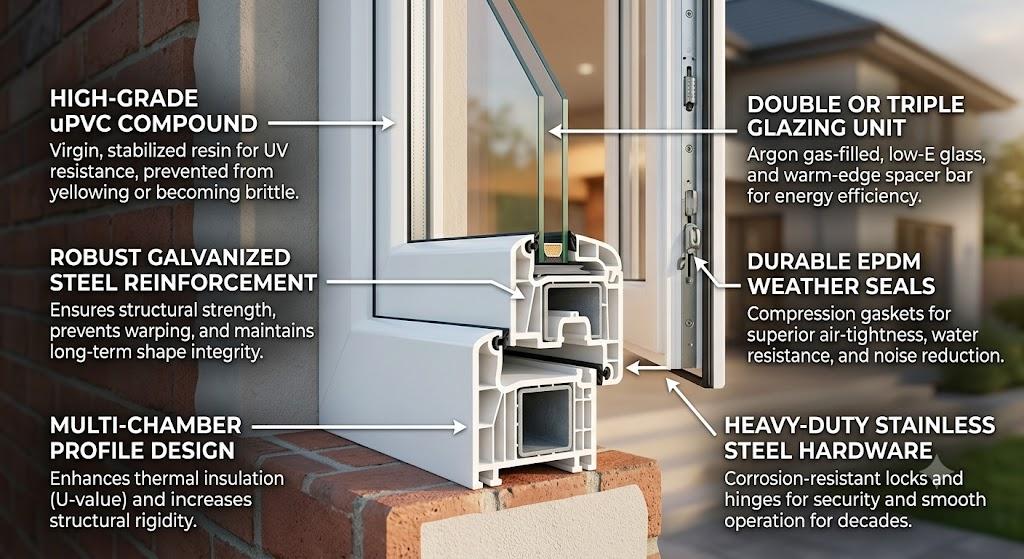
Ever noticed how one neighbour's windows still look brand new after 25 years, while another's have turned yellow and cranky in just five? Same material, wildly different results. The truth is, "uPVC" on a label means almost nothing on its own. It's what goes into the frame and around it that decides everything.
Some windows are built to survive you; others barely survive the warranty period. So let's cut through the sales talk and get honest about what actually keeps a uPVC window standing strong for 20 or 30 years.
uPVC Profile
If the raw material is bad, nothing else can save the window. Simple as that.
-
Lead-free uPVC stays tough and doesn't crack. Recycled or lead-based frames go brittle and yellow fast.
-
UV stabilisers are what stop the sun from bleaching your white frames into a sad cream colour.
-
Thick outer walls (around 2.8mm) keep the shape. Thin, flimsy frames bend, sag, and lose their seal.
Honestly, this one factor separates a ₹5,000 window from a ₹500 one that only looks the same.
Galvanised Steel
Here's a secret most sellers won't mention: good uPVC frames have galvanised steel hidden inside them. Because plastic alone can't hold up a big, heavy window forever. Over time it starts to droop, and once it droops, it stops closing properly.
The steel is like a spine. It keeps everything straight and stops that sagging. If you use no steel or cheap, rusty steel, your window won't last long.
Hollow Chambers
Slice a quality frame in half and you'll see little hollow sections inside. That's not the company saving plastic, it's a part of the design.
-
Those air pockets block heat and cold, so your AC works less.
-
More chambers mean a stronger, stiffer frame that won't flex.
-
Tiny built-in channels drain rainwater out instead of letting it sit and rot things.
Three to five chambers is the sweet spot. The more chambers it has, the tough the window will be.
Rubber Seals
You'll never think about the seals until they fail; then you'll notice every leak, draft, and street noise.
Good windows use EPDM rubber gaskets. This stuff stays soft and springy for years, hugging the frame tightly so nothing gets in. Cheap seals harden, crack, and shrink, and suddenly rainwater is creeping in during the monsoon, and dust is coating your sills. It's a small part that decides how comfortable your home stays.
Handles, Locks, and Hinges
Think about how many times you'll open a window in 20 years. Thousands. Weak hardware is usually the first thing to give up.
-
Stainless steel parts don't rust, even in humid or coastal areas.
-
Multi-point locks pull the window shut tight for better security and a better seal.
-
Smooth rollers and hinges mean it still glides easily years later, not sticking and screeching.
Good brands test their hardware for tens of thousands of open-close cycles. Cheap ones don't test at all.
Glass and Glazing
The glass isn't just there to see through. It does have another function.
-
Double glazing (two panes with a gap) keeps heat out and noise down.
-
Low-E coating reflects heat, so rooms stay cooler and your furniture doesn't fade.
-
Proper glazing beads hold the glass firm so it never rattles in the wind.
Get this right and a noisy main road can turn into a surprisingly peaceful bedroom.
Craftsmanship and Installation
You can buy the best window in the country, and a lazy installation will ruin it. Really.
-
Welded corners (fused with heat) are far stronger than screwed or glued ones.
-
Level, straight fittings stop gaps, jamming, and water sneaking behind the frame.
-
Proper sealing around the edges keeps the walls dry and keeps mould at bay
A window is a system. Every part has to be done right, or the weakest link drags the rest down.
Why People Pick uPVC Over Wood and Aluminium
There's a reason uPVC keeps winning:
-
No need for maintenance, no painting, no polishing, ever.
-
Termites and rust don't touch it, unlike wood and metal.
-
It doesn't rot, warp, or conduct heat the way its rivals do.
That's exactly why folks searching for the best uPVC windows in Mohali care more about what's inside the frame than the sticker price.
What's the Actual Secret?
There isn't one single magic feature. A window that lasts decades is the result of everything being just right at once: solid virgin plastic, hidden steel, smart chambers, real rubber seals, strong hardware, decent glass, and a careful install.
Nail all of them, and you've got a window your grandkids might still be using. Skip even one, and the clock starts ticking early.
To Wrap Up
A uPVC window is a long-game purchase, so the maker matters just as much as the material. If you want windows that genuinely go the distance, ArcEye Windoors is one of the top uPVC door and window manufacturers in Mohali, built for our tropical weather with zero maintenance, termite and storm resistance, and tight sealing against rain and noise.
Their formulation is accredited by top European and UK testing labs (weather-tested up to 25,000 hours) and backed by a solid warranty. For the best uPVC doors in Mohali for homes, offices, or hotels. ArcEye is a name worth trusting.
FAQs
1. How long do good uPVC windows really last?
Ans: A well-made uPVC window easily lasts 20 to 30 years with barely any upkeep. The trick is virgin material, hidden steel reinforcement, and a proper installation working together.
2. Why do some uPVC windows turn yellow?
Ans: Cheap frames without UV protection fade and yellow under strong sun. Quality uPVC with UV stabilisers stays white for decades, so always check it's lead-free and UV-treated.
3. Can uPVC handle India's heat?
Ans: Yes, easily. Good uPVC takes temperatures up to 60°C without warping, and its air chambers plus Low-E glass keeps your rooms noticeably cool inside.
4. Do uPVC windows actually block noise?
Ans: They really do. With double glazing and proper EPDM seals, a quality uPVC window cuts a big chunk of street noise, great for busy roads and city homes.
5. Is steel reinforcement really necessary?
Ans: For larger windows, absolutely. That hidden galvanised steel stops the frame from sagging over time, keeping it strong and sealing properly for years.
6. Is uPVC better than aluminium or wood?
Ans: For most homes, yes. It needs no maintenance, resists termites and rust, insulates better than metal, and never rots like wood, so it simply lasts longer.

 English
 French
 Spanish
 Portuguese
 Deutsch
 Turkish
 Dutch
Dutch
 Italiano
 Russian
 Romaian
 Portuguese (Brazil)
 Greek
Greek