


Wholesale Telecom Market Overview
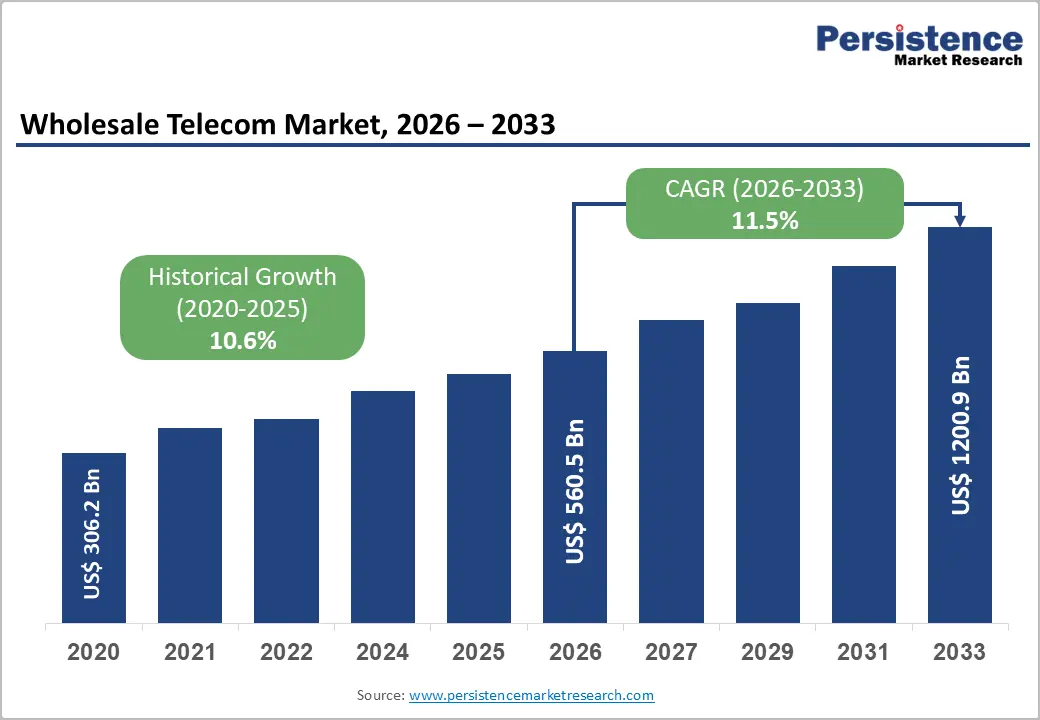
The global wholesale telecom market is entering a period of accelerated transformation, driven by the explosive growth of digital connectivity, increasing data consumption, expansion of 5G networks, and the rapid adoption of cloud-based communication infrastructure. The market is expected to reach US$ 560.5 billion in 2026 and is projected to expand to US$ 1,200.9 billion by 2033, registering a CAGR of 11.5% during the forecast period from 2026 to 2033.
Wholesale telecom services form the backbone of global communication networks by enabling connectivity exchanges between telecom operators, internet service providers, cloud companies, enterprises, and digital platforms. These services include wholesale voice termination, data transit, IP connectivity, roaming services, fiber leasing, submarine cable capacity, cloud interconnection, and communications platform services.
The increasing dependency on high-speed connectivity across industries has significantly expanded wholesale telecom demand. Rising video streaming consumption, artificial intelligence workloads, Internet of Things (IoT) deployments, cloud migration, and enterprise digital transformation are creating continuous demand for high-capacity networks. Telecom operators and hyperscale technology companies are increasingly investing in wholesale connectivity partnerships to improve global coverage, reduce infrastructure costs, and enhance network resilience.
North America remains the leading regional market, accounting for approximately 37% of global wholesale telecom revenue, supported by extensive fiber infrastructure, hyperscale data center concentration, and strong wholesale networks operated by companies such as AT&T and Verizon. Meanwhile, Asia Pacific represents the fastest-growing region, expanding at a CAGR of 15.5%, driven by rapid digitalization, massive mobile data consumption, 5G deployment, and expanding submarine cable connectivity.
Among service categories, data wholesale dominates the market with around 42% share, supported by increasing demand for IP transit, Ethernet services, dark fiber, and cloud connectivity. Platform-based wholesale services, including Communications Platform as a Service (CPaaS), represent the fastest-growing segment as businesses increasingly consume communication capabilities through APIs and cloud platforms.
Key Market Highlights
Data Traffic Growth Accelerating Wholesale Connectivity Demand
Global internet traffic growth has become the primary catalyst for wholesale telecom expansion. The continuous adoption of video streaming platforms, online gaming, cloud applications, artificial intelligence tools, and connected devices is increasing bandwidth requirements across global networks.
According to Ericsson Mobility Report projections, global mobile data traffic is expected to reach approximately 325 exabytes per month by 2028, representing significant growth compared with previous years. Every increase in consumer and enterprise data usage creates additional demand for wholesale bandwidth, fiber capacity, and interconnection services.
Telecom operators are increasingly relying on wholesale providers to expand network capacity without making excessive infrastructure investments. Data center operators, cloud providers, and content delivery networks are also becoming major wholesale customers due to their requirement for reliable, low-latency connectivity.
Wholesale Telecom Market Growth Drivers
Expansion of 5G Networks and Network Infrastructure Investment
The global rollout of 5G networks is one of the strongest growth drivers for the wholesale telecom market. Unlike previous generations of mobile networks, 5G requires significantly higher network density, advanced backhaul infrastructure, and increased fiber connectivity.
As mobile operators continue expanding 5G coverage, they require wholesale solutions for:
- Fiber backhaul connectivity
- International bandwidth capacity
- Roaming agreements
- Network interconnection
- Edge data center connectivity
The GSMA reports that hundreds of commercial 5G networks are already operational worldwide, with continued expansion expected through 2033. This creates substantial opportunities for wholesale telecom providers offering infrastructure-sharing and connectivity solutions.
In emerging economies, telecom operators are increasingly using wholesale partnerships to accelerate 5G deployment while reducing capital expenditure requirements.
Rising Adoption of Cloud Computing and Hyperscale Data Centers
The rapid expansion of cloud computing has created a major opportunity for wholesale telecom providers. Enterprises are migrating workloads to cloud platforms, increasing demand for secure, high-performance connectivity between offices, cloud environments, and data centers.
Companies including:
- Amazon Web Services (AWS)
- Microsoft Azure
- Google Cloud
- Oracle Cloud Infrastructure
are investing heavily in global data center ecosystems, requiring massive wholesale connectivity capacity.
The growth of hyperscale data centers is particularly beneficial for providers offering:
- Dark fiber services
- Internet exchange connectivity
- Cloud interconnect solutions
- Dedicated bandwidth services
- Low-latency network connections
According to industry estimates, more than 900 hyperscale data centers operate globally, with significant additional capacity expected through 2027. Artificial intelligence applications are further accelerating demand as AI workloads require high-speed connections between distributed computing facilities.
Increasing IoT and Machine-to-Machine Connectivity
The rapid adoption of IoT devices is creating new wholesale telecom opportunities. Industrial automation, smart cities, connected vehicles, healthcare monitoring systems, and smart energy networks require continuous connectivity.
The number of connected IoT devices globally continues to expand rapidly, increasing demand for:
- Wholesale mobile connectivity
- MVNO agreements
- IoT roaming services
- Enterprise connectivity platforms
Manufacturers and enterprises increasingly depend on telecom providers to connect thousands or millions of devices across multiple geographic regions. Wholesale partnerships enable companies to achieve global coverage without establishing individual agreements with every network operator.
Enterprise Digital Transformation Supporting Market Expansion
Enterprise digital transformation has significantly changed communication requirements. Businesses are shifting from traditional telecom infrastructure toward cloud-based communication models, including:
- Unified communications as a service (UCaaS)
- Cloud contact centers
- Software-defined wide area networks (SD-WAN)
- Cloud-based collaboration platforms
- Programmable communication APIs
This transition has created strong demand for wholesale telecom services supporting digital communication platforms.
Platforms such as Microsoft Teams, Zoom Phone, Cisco Webex, Twilio, and Sinch depend on telecom wholesale infrastructure to deliver global voice, messaging, and communication services.
Wholesale Telecom Market Restraints
Declining Revenue from Traditional Voice Wholesale Services
Although wholesale telecom continues to expand, traditional voice and SMS wholesale segments face significant pressure due to changing consumer behavior.
The growing adoption of over-the-top (OTT) communication applications such as:
- FaceTime
- Telegram
- Viber
has reduced dependence on traditional international voice services.
International voice termination rates have declined steadily as competition increases and communication shifts toward internet-based platforms. This has reduced margins for telecom operators and forced companies to transition toward higher-value data and cloud connectivity services.
Regulatory and Geopolitical Challenges
The wholesale telecom market operates across multiple countries, making it highly influenced by regulatory policies and geopolitical conditions.
Challenges include:
- Data localization requirements
- Restrictions on foreign telecom investments
- Submarine cable regulations
- National security reviews
- Cross-border connectivity limitations
Different regulatory frameworks across regions such as North America, Europe, China, and India create complexity for global telecom operators.
These challenges can increase compliance costs, delay infrastructure projects, and limit international connectivity expansion.
Market Opportunities
Hyperscale Data Center Interconnection
Hyperscale data center interconnection represents one of the largest growth opportunities for wholesale telecom providers.
Modern digital ecosystems require seamless connectivity between:
- Cloud platforms
- Enterprise networks
- Internet exchanges
- Artificial intelligence computing facilities
Wholesale providers with extensive fiber networks and global backbone infrastructure are positioned to benefit from this trend.
Companies such as Tata Communications, NTT Communications, Arelion, and Lumen Technologies are expanding cloud connectivity solutions to capture growing demand.
AI-driven applications are expected to further increase requirements for ultra-low latency connectivity and high-bandwidth infrastructure, creating premium opportunities for wholesale network providers.
Growth of Platform-Based Wholesale and CPaaS Solutions
The wholesale telecom industry is shifting from traditional carrier-to-carrier transactions toward software-driven platforms.
Communications Platform as a Service (CPaaS) enables businesses to integrate:
- Voice communication
- SMS messaging
- Authentication services
- Customer engagement tools
through APIs.
The GSMA Open Gateway initiative is accelerating this transformation by creating standardized telecom network APIs accessible to developers and enterprises.
Companies investing in API-based wholesale platforms can capture higher-margin opportunities compared with traditional connectivity services.

 Arabic
 French
 Spanish
 Portuguese
 Deutsch
 Turkish
 Dutch
Dutch
 Italiano
 Russian
 Romaian
 Portuguese (Brazil)
 Greek
Greek