


The advertising landscape has undergone a remarkable transformation over the past decade. As businesses seek more engaging, measurable, and data-driven ways to connect with consumers, Digital Out of Home (DOOH) advertising has emerged as one of the fastest-growing segments of the global media industry. Unlike traditional static billboards, DOOH combines digital display technologies with real-time content management, audience analytics, artificial intelligence (AI), and programmatic advertising to deliver highly personalized advertising experiences in public spaces.
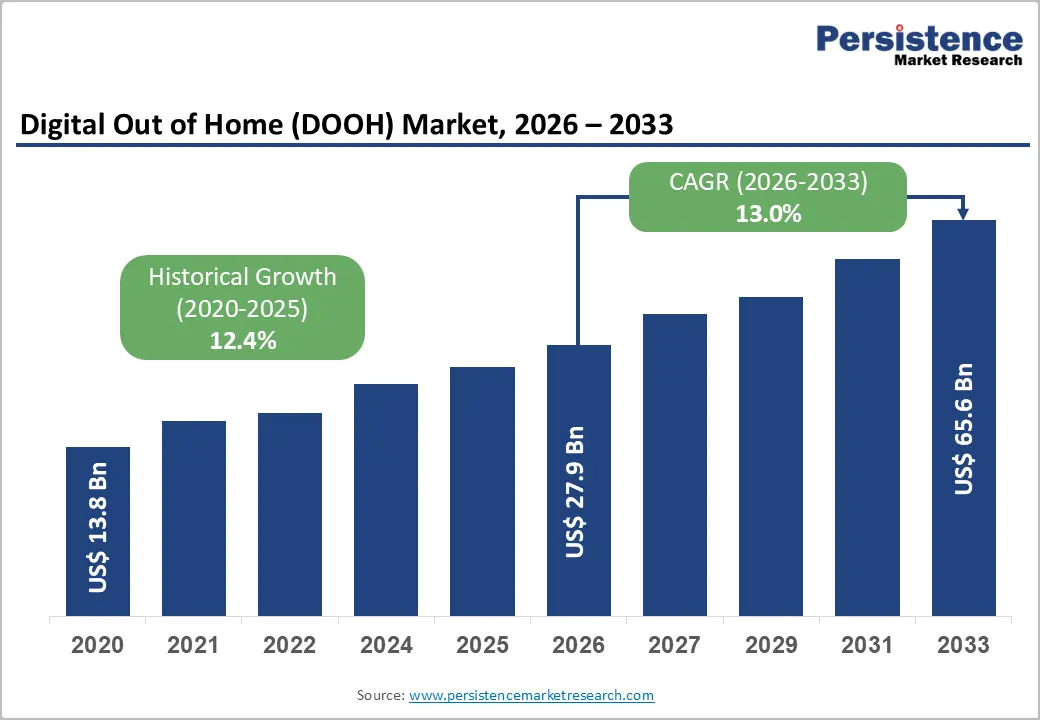
The global Digital Out of Home (DOOH) market is projected to reach US$27.9 billion in 2026 and is expected to expand to US$65.6 billion by 2033, registering a strong CAGR of 13.0% during the forecast period. The market is benefiting from the rapid expansion of digital display infrastructure, increasing urbanization, advances in AI-enabled advertising technologies, and growing adoption of programmatic media buying.
As brands increasingly pursue omnichannel marketing strategies, DOOH has become a critical touchpoint that bridges physical environments with digital advertising ecosystems.
What is Digital Out of Home (DOOH)?
Digital Out of Home (DOOH) refers to digital advertising displayed in public environments through electronic screens rather than traditional printed billboards. These displays include:
- Digital billboards
- Transit displays
- Airport screens
- Shopping mall displays
- Digital kiosks
- Elevator screens
- Retail digital signage
- Stadium displays
- Smart city advertising panels
- Interactive touch displays
Unlike conventional outdoor advertising, DOOH enables advertisers to change creative content instantly, schedule campaigns by time or location, integrate live data feeds, and optimize campaigns based on audience behavior.
Market Overview
Several long-term trends are accelerating the adoption of DOOH worldwide.
These include:
- Rising investments in smart cities
- Declining LED display costs
- Expansion of programmatic advertising
- Increasing digital transformation of outdoor media
- Higher demand for measurable advertising ROI
- Growth of AI-powered audience targeting
- Integration with mobile and connected TV campaigns
The advertising industry is increasingly recognizing DOOH as one of the most impactful media channels because it combines high visibility with digital flexibility.
Key Industry Highlights
Several notable trends define today's DOOH industry.
- North America is expected to dominate the market with nearly 34% market share in 2026.
- Asia Pacific is forecast to be the fastest-growing regional market.
- Digital billboards remain the largest advertising format, accounting for approximately 38% of total revenue.
- Commercial advertising contributes nearly 58% of overall market demand.
- Programmatic DOOH is expanding at over 20% CAGR, making it the fastest-growing transaction model.
Major Market Drivers
Rapid Expansion of Digital Display Infrastructure
The largest growth driver for the DOOH market is the global replacement of static advertising panels with digital LED and LCD displays.
Media companies worldwide continue investing heavily in premium digital inventory because digital displays generate significantly higher revenue than traditional billboards.
Several factors support this trend:
- Lower LED manufacturing costs
- Improved screen durability
- Better display brightness
- Higher energy efficiency
- Reduced maintenance costs
The cost of LED hardware has declined dramatically over the past decade, making digital conversion financially attractive for outdoor advertising companies.
Major players such as JCDecaux have invested billions in digital transformation, with digital assets generating substantially higher revenue per screen compared to static advertising formats.
Growth of Programmatic Advertising
Programmatic advertising is reshaping how outdoor advertising inventory is bought and sold.
Instead of manually negotiating campaigns, advertisers now purchase DOOH inventory using automated platforms connected to:
- Demand Side Platforms (DSPs)
- Supply Side Platforms (SSPs)
- Real-time bidding exchanges
Technology providers including:
- Broadsign
- Vistar Media
- Place Exchange
allow advertisers to purchase outdoor advertising in the same way they buy online display advertising.
Benefits include:
- Better targeting
- Faster campaign deployment
- Audience-based buying
- Improved campaign measurement
- Greater flexibility
Programmatic DOOH has become one of the industry's fastest-growing revenue streams.
Artificial Intelligence is Revolutionizing DOOH
Artificial Intelligence has transformed DOOH from static messaging into an intelligent advertising medium.
Modern AI systems optimize campaigns using:
- Weather conditions
- Traffic density
- Time of day
- Audience demographics
- Local events
- Sports schedules
- Social media trends
- Consumer mobility data
For example, a coffee brand may display hot beverages during cold mornings and iced coffee during hot afternoons automatically.
Similarly, restaurants can advertise lunch promotions precisely during lunchtime traffic.
These contextual capabilities significantly improve advertising effectiveness.
Market Challenges
Regulatory Restrictions
Despite strong growth, the industry faces regulatory challenges.
Governments often regulate:
- Billboard brightness
- Screen animation
- Placement locations
- Operating hours
- Environmental impact
- Driver distraction
In the United States, the Highway Beautification Act regulates billboard installations along federal highways.
Across Europe, each country maintains its own advertising regulations, requiring media owners to navigate multiple compliance standards.
These regulations can slow market expansion while increasing operational costs.
Emerging Opportunities
AI-Powered Dynamic Creative Optimization
One of the biggest opportunities lies in Dynamic Creative Optimization (DCO).
Instead of showing identical advertisements repeatedly, AI enables advertisers to generate multiple creative versions that change automatically depending on context.
Examples include:
- Weather-responsive advertising
- Live sports promotions
- Traffic-triggered messaging
- Location-specific campaigns
- Event-based promotions
Companies such as Broadsign and Daktronics continue investing in AI platforms that automate campaign optimization while improving advertiser ROI.
Product Type Analysis
Digital Billboards Lead the Market
Digital billboards represent the largest DOOH segment, accounting for approximately 38% of market revenue.
Reasons include:
- Premium visibility
- Large audience reach
- High advertiser demand
- Strong urban presence
- Excellent brand awareness
Large media owners like OUTFRONT Media operate premium digital billboards across cities including New York and Los Angeles, attracting global brands such as Netflix and Apple.
Place-Based Media Shows Fastest Growth
Place-based advertising is becoming increasingly important.
These screens appear in:
- Airports
- Shopping malls
- Hospitals
- Universities
- Gyms
- Office buildings
- Hotels
- Restaurants
- Fuel stations
These environments provide longer audience dwell times, allowing advertisers to deliver highly targeted messaging.
Luxury brands, electronics companies, and retailers increasingly prefer these premium advertising environments.
Application Analysis
Commercial Advertising Dominates
Commercial applications contribute nearly 58% of global DOOH revenue.
Industries investing heavily include:
- Retail
- Consumer goods
- Automotive
- Financial services
- Entertainment
- Travel
- Food & Beverage
- E-commerce
Streaming platforms such as Netflix extensively use digital billboards and transit displays to promote new releases.
Institutional Applications Growing Rapidly
Healthcare facilities, universities, government buildings, and transportation hubs are increasingly installing digital communication networks.
These displays serve two purposes:
- Public information
- Advertising revenue generation
Companies like Captivate have successfully monetized office buildings through elevator and lobby digital displays.
End-User Analysis
Retail Leads Market Demand
Retail remains the largest end-user segment, representing approximately 26% of market revenue.
Retailers use DOOH to:
- Increase store traffic
- Promote seasonal campaigns
- Support omnichannel marketing
- Enhance in-store experiences
Retail media networks are becoming increasingly valuable as retailers monetize shopper attention through digital screens.
For example, Kroger operates digital shelf displays that allow consumer packaged goods companies to advertise directly at the point of purchase.
Healthcare Emerges as High-Growth Sector
Healthcare represents one of the fastest-growing opportunities.
Hospitals and clinics increasingly deploy digital displays for:
- Patient education
- Wayfinding
- Healthcare advertising
- Pharmaceutical campaigns
Companies such as PatientPoint combine educational content with targeted pharmaceutical advertising, creating valuable engagement opportunities.
Regional Analysis
North America
North America remains the world's largest DOOH market.
The United States leads due to:
- Mature outdoor advertising infrastructure
- Advanced programmatic platforms
- Extensive digital billboard networks
- Strong advertiser spending
Major airports, highways, transit stations, and smart city projects continue driving digital display expansion.
Canada also represents a rapidly growing market as cities deploy more interactive digital displays across public transportation systems and commercial districts.
Europe
Europe remains one of the most technologically advanced DOOH markets.
Growth is supported by:
- Smart city initiatives
- Digital infrastructure
- High urbanization
- Strong advertiser adoption
United Kingdom
The UK continues expanding programmatic advertising across major cities including London.
Retail, transportation, and financial services remain leading advertisers.
Germany
Germany represents Europe's largest DOOH market by advertising expenditure.
Large-scale digital installations across railway stations, airports, and retail centers continue strengthening market growth.
Asia Pacific
Asia Pacific is expected to register the highest CAGR through 2033.
Growth is fueled by:
- Rapid urbanization
- Rising digital advertising budgets
- Expanding retail infrastructure
- Smart city investments
- Growing middle-class population
China
China operates one of the world's largest digital display networks.
AI-powered advertising, e-commerce integration, and smart city development continue driving market expansion.
Large metropolitan areas increasingly rely on digital displays for both commercial advertising and public communication.
India
India has emerged as one of the most promising DOOH markets.
Key growth drivers include:
- Rapid urban development
- Expanding shopping malls
- Metro rail projects
- Airport modernization
- Digital-first consumers
- Rising smartphone penetration
Advertisers increasingly use localized campaigns during festivals and regional events, making AI-driven hyper-local advertising particularly attractive.
Competitive Landscape
The DOOH market remains highly competitive, with global media companies controlling premium advertising inventory while technology providers enable programmatic transactions.
Major companies include:
- JCDecaux Group
- Clear Channel Outdoor Holdings
- OUTFRONT Media
- Broadsign International
- Daktronics
- Talon Outdoor
- oOh!media
- QMS Media
- SevenOne Media
- Stroer SE & Co. KGaA
- Exterion Media Group
- EyeMedia LLC
- The Times Group
Competition increasingly focuses on:
- AI-powered campaign optimization
- Premium screen locations
- Audience analytics
- Programmatic capabilities
- Measurement solutions
- Cross-channel integration
Recent Industry Developments
Several recent developments highlight the industry's momentum.
In April 2026, Bell Media expanded its digital advertising portfolio by introducing its 2026 Upfront Digital Offer, integrating premium DOOH inventory with digital video and audio platforms to provide advertisers with broader cross-platform reach.
In January 2026, DIRECTV Advertising announced expanded programmatic access to its DIRECTV Remote DOOH network at CES, enabling advertisers to extend connected TV campaigns into commercial venues through automated buying.
These developments demonstrate how DOOH is becoming an integral component of omnichannel advertising strategies.
Future Outlook
The future of Digital Out of Home advertising is closely tied to advances in AI, automation, and smart-city infrastructure. As advertisers increasingly seek measurable, context-aware, and omnichannel campaigns, DOOH will continue evolving beyond traditional outdoor media into a highly intelligent advertising platform.
Emerging technologies such as 5G connectivity, computer vision, augmented reality (AR), predictive analytics, and real-time audience measurement will further enhance campaign personalization and performance. The growing integration of DOOH with mobile advertising, connected TV (CTV), and retail media networks will create seamless consumer experiences across digital and physical environments.
With ongoing investments in premium digital screens, programmatic platforms, and AI-powered creative optimization, the market is well positioned for sustained expansion. As a result, the global Digital Out of Home (DOOH) market is expected to nearly **triple in value from US$27.9 billion in 2026 to US$65.6 billion by 2033, reinforcing its role as one of the most dynamic and influential segments of the global advertising industry.

 English
 Arabic
 French
 Spanish
 Portuguese
 Deutsch
 Turkish
 Dutch
Dutch
 Italiano
 Russian
 Portuguese (Brazil)
 Greek
Greek