


Every year during NBA free agency, some of the most intriguing stories develop around professional basketball. Players switch teams, franchises assemble championship-caliber rosters, and every rumored contract is followed by fans. However, for casual basketball fans, there might be some confusion surrounding the specifics of the rules of free agency.
This guide will give you NBA Free Agency Explained and will cover everything about free agency, types of free agents, salary caps, contract options, and the importance of this period for every NBA team.
What Is NBA Free Agency?
NBA free agency is the process when players who are eligible to negotiate a new contract can sign with a new team. Depending on the situation of each player, he may stay with his current team, sign with a new franchise, or extend his contract.
Free agency gives players more opportunities in their career and teams an opportunity to strengthen their roster. While some teams try to get a star player through free agency, other teams target role players, veterans, or youngsters.
As one major signing can affect the entire championship race, NBA free agency is among the most captivating moments in basketball.
When does NBA Free Agency Begin?
NBA free agency typically starts after the NBA finals and during the start of the NBA season year. However, this might depend on the rules of the NBA collective bargaining agreement at that particular year.
Team negotiations with players could happen before signing of the contracts is possible. In fact, this might generate huge amounts of excitement due to the possibility that big contracts could be made immediately.
Even as the signing date is crucial, NBA salary cap rules need to be followed among others.
Types of NBA Free Agents
Another important aspect of NBA Free Agency Explained is the different types of free agents.
Unrestricted Free Agents
An unrestricted free agent has no limitations on which team he wants to join. The previous team cannot automatically match the offer of a new team.
Usually, the unrestricted free agents have the most freedom regarding their future careers since they can choose the team they want to play for because of salary, geographical location, chance to win a championship, coaching style, players' attitude, etc.
Restricted Free Agents
The restricted free agent can negotiate offers from other teams, but the previous team has the right to match the qualifying offer.
The team gets the chance to retain the player. This type of free agency usually happens with young players after finishing the first contract with the team.
Player Options
The player option is an agreement according to which the player gets a choice to continue playing for the team next year with the same contract.
For example, the player might want to accept the option due to the financial security of the deal and decline the option in case he wants a larger contract in free agency.
Team Options
A team option gives the franchise the decision to continue or end a contract for a future season. Teams often use these options as a way to manage their roster and salary commitments.
NBA Salary Cap
The NBA salary cap is perhaps the single most significant part of free agency. There are some exceptions to the salary cap in place by the NBA.
The NBA uses soft salary cap, as opposed to a hard one, where a team can go above the salary cap in certain cases. This adds another layer of difficulty when it comes to building rosters in free agency.
The team has to look at the salary cap, luxury tax, contract length, player's salary, and overall future financial flexibility of a player. Therefore, it cannot just take any player it wants.
What Are Bird Rights?
The Bird Rights are a special type of salary cap exception that allows a team to exceed the salary cap when re-signing players.
The Bird Rights become really useful for the team that wishes to keep its players because of the limitations of a salary cap. It may not be able to give a large enough deal to the player under normal circumstances, but Bird Rights will allow doing that.
That is why Bird Rights become especially useful during free agency when a franchise wishes to keep its players.
Sign-and-Trade Deals
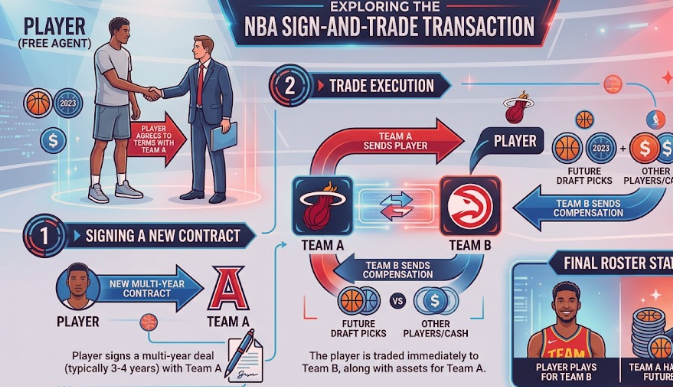
Sometimes, a player might want to play for a different club, but the second club will lack room under the salary cap to sign the player in question. A sign-and-trade deal might be another option for such situations.
Under this type of transactions, the player's original team signs the player and then sends him to another team. This kind of transactions will have certain requirements set by the NBA and can be beneficial for the player and both teams.
How sign-and-trade transactions work.
Importance of NBA Free Agency
NBA free agency can totally alter the future of an organization. What was at the start just a poor playoff contender can suddenly turn into the title favorite after making some important acquisitions in the free agency.
There might be a number of reasons why a team decides to strengthen its roster through free agency. It can be a good three-point shooter, a defensive player, a backup center, or even a seasoned vet.
Free agency impacts the whole league as well, since the movement of a star player can lead to further transactions made by other teams in response to this event.
Closing Thoughts on NBA Free Agency
By gaining insight into NBA Free Agency Explained, you will find it easier to keep track of the offseason news and comprehend the reasoning behind specific actions. The free agency process includes unrestricted players, restricted players, option years, salary cap exemptions, Bird Rights, and sign-and-trade deals.
As a fan, free agency is not just about the signing of players. It is a tactical game that is played by the teams, agents, and players themselves. Each contract might have a significant impact on the future of a team, whether it is building toward a championship season or reconstructing itself.
Whether you have been watching basketball for decades or are new to the NBA, free agency provides you with a different perspective on the process of building successful lineups. One season of the right deals and salary cap management might entirely change the course of any NBA franchise.

 Arabic
 French
 Spanish
 Portuguese
 Deutsch
 Turkish
 Dutch
Dutch
 Italiano
 Russian
 Romaian
 Portuguese (Brazil)
 Greek
Greek