


Fiber Optics Market Overview
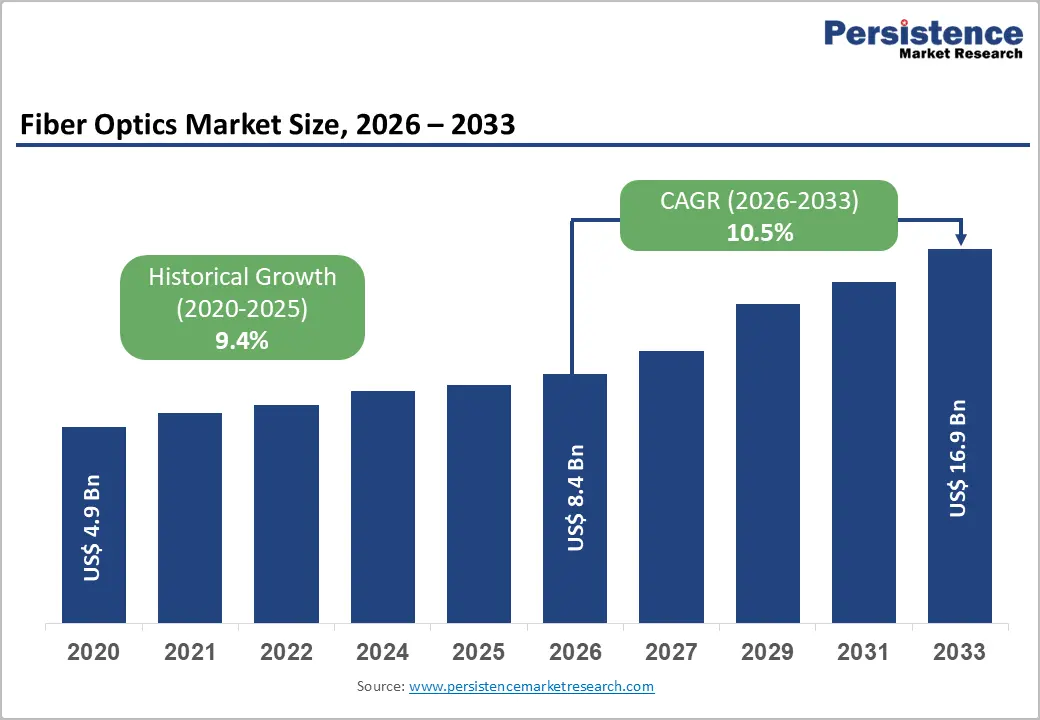
The global fiber optics market size is expected to reach US$ 8.4 billion in 2026 and is projected to grow to US$ 16.9 billion by 2033, expanding at a CAGR of 10.5% between 2026 and 2033. The market is entering a high-growth phase as digital transformation, 5G network expansion, artificial intelligence (AI), cloud computing, and next-generation broadband infrastructure continue to increase global demand for high-speed data transmission.
Fiber optic technology has become the foundation of modern communication networks due to its ability to deliver extremely high bandwidth, lower latency, and reliable connectivity over long distances compared with traditional copper-based networks. The rapid adoption of connected devices, cloud-based services, smart cities, industrial automation, and AI-powered applications is accelerating investments in fiber infrastructure worldwide.
A major growth catalyst for the industry is the expansion of 5G networks, which require extensive fiber backhaul infrastructure to support high-speed mobile connectivity. At the same time, hyperscale data centers are significantly increasing their demand for advanced optical solutions to manage the massive data processing requirements created by generative AI and machine learning workloads.
Governments across North America, Europe, and Asia Pacific are also supporting market growth through large-scale broadband initiatives. For example, the United States Broadband Equity, Access, and Deployment (BEAD) Program, backed by US$ 42.45 billion in funding, is accelerating fiber deployment in rural and underserved communities.
Key Highlights of the Fiber Optics Market
- Market Size (2026): US$ 8.4 billion
- Projected Market Size (2033): US$ 16.9 billion
- Forecast CAGR (2026–2033): 10.5%
- Leading Region: North America with around 38% market share in 2025
- Fastest Growing Region: Asia Pacific with CAGR exceeding 12% through 2033
- Dominant Fiber Type: Single-mode glass optical fiber with approximately 52% share in 2025
- Largest End-use Industry: IT & Telecom with around 43% market share in 2025
- Fastest Growing End-use Segment: Healthcare with CAGR above 13% through 2033
Major Market Drivers
- Rapid Expansion of 5G Networks Driving Fiber Backhaul Demand
The global deployment of 5G infrastructure is one of the strongest growth drivers for the fiber optics market. Unlike previous generations of mobile networks, 5G requires significantly denser infrastructure, including thousands of small cells and advanced backhaul networks.
Fiber optics provides the capacity and reliability required to support high-frequency 5G applications, including autonomous vehicles, industrial IoT, augmented reality, and real-time cloud applications.
According to industry estimates, global mobile subscriptions have surpassed 8 billion, and 5G is expected to represent the largest share of new mobile connections throughout the decade. Telecom operators are increasingly shifting toward fiber-based networks, with a growing percentage of mobile traffic expected to be carried through fiber infrastructure.
Major telecom companies worldwide are investing heavily in fiber deployment to improve network performance and support increasing bandwidth consumption from video streaming, gaming, enterprise applications, and cloud services.
The transition from copper-based networks to fiber-based connectivity represents a long-term structural shift, creating sustained opportunities for fiber manufacturers, cable suppliers, and installation providers.
Government Broadband Investments Accelerating Market Expansion
Government-led broadband initiatives are playing a critical role in expanding fiber optic networks globally. Public investment programs are helping bridge the digital divide by supporting high-speed internet access in rural and remote regions.
In the United States, the Infrastructure Investment and Jobs Act allocated US$ 65 billion toward broadband expansion, including US$ 42.45 billion through the BEAD Program for fiber-based connectivity projects.
Europe is also supporting fiber adoption through its Digital Decade 2030 targets, which aim to provide gigabit connectivity across households and businesses.
In Asia Pacific, countries such as India and China are implementing large-scale digital infrastructure programs. India's BharatNet initiative aims to connect hundreds of thousands of villages using optical fiber networks, creating significant demand for fiber cables, components, and deployment services.
These government-backed projects provide long-term revenue visibility for fiber optic companies and encourage private-sector participation in broadband infrastructure development.
Market Restraints
High Deployment Costs and Infrastructure Challenges
Despite strong growth prospects, the fiber optics market faces challenges related to high installation costs and complex deployment processes.
Fiber network construction requires significant investment in civil infrastructure, including trenching, underground installation, cable laying, and maintenance. Labor expenses represent a major portion of overall deployment costs due to the shortage of skilled technicians capable of handling fiber installation and testing.
These challenges are particularly significant in rural and remote areas where population density is low and return on investment is slower.
Although government subsidies are helping reduce financial barriers, smaller companies often struggle with the high capital requirements associated with large-scale fiber projects.
Supply Chain Risks and Raw Material Constraints
The fiber optics industry also faces supply chain challenges due to dependence on specialized materials and manufacturing processes.
Optical fiber production requires high-purity silica, chemical compounds, and fiber preforms. The supply chain for these materials is concentrated among a limited number of global suppliers, creating risks related to price fluctuations and geopolitical disruptions.
The rapid expansion of AI data centers has further increased demand for advanced fiber solutions, resulting in longer lead times for certain high-performance cable products.
Manufacturers are increasingly investing in supply chain diversification, production capacity expansion, and strategic partnerships to reduce these risks.
Emerging Opportunities in the Fiber Optics Market
AI Data Centers Creating Premium Fiber Demand
Artificial intelligence is transforming the fiber optics industry by creating demand for specialized, high-density optical solutions.
Modern AI data centers require extremely high bandwidth connections between servers, storage systems, and computing clusters. Traditional fiber infrastructure is often insufficient to meet these requirements, creating opportunities for advanced fiber technologies.
Companies such as Corning are developing AI-focused solutions designed specifically for hyperscale data centers. Products such as high-density fiber cables and advanced connectivity solutions help operators maximize space efficiency while supporting next-generation AI workloads.
As technology companies continue increasing AI infrastructure investments, fiber manufacturers offering innovative solutions are positioned to capture premium-value opportunities.
Emerging Markets Supporting Future Growth
Developing economies represent significant growth opportunities for fiber optic companies due to rising internet demand, digital transformation initiatives, and government connectivity programs.
Countries across Southeast Asia, Africa, and Latin America are expanding broadband infrastructure to support digital education, healthcare services, financial inclusion, and economic development.
India, for example, is rapidly expanding fiber connectivity through BharatNet while also supporting nationwide 5G deployment.
Companies that establish local partnerships, distribution networks, and installation capabilities in emerging markets are likely to benefit from long-term infrastructure growth.
Fiber Optics Market Segment Analysis
Fiber Type Insights
Single-mode Glass Optical Fiber Leading the Market
Single-mode glass optical fiber dominates the fiber optics market, accounting for approximately 52% share in 2025.
Its leadership is driven by its ability to transmit data over long distances with minimal signal loss. Single-mode fiber is widely used in:
- 5G backhaul networks
- Long-haul communication systems
- Submarine cables
- Hyperscale data center connections
The increasing need for high-capacity networks continues to strengthen demand for single-mode fiber solutions.
Specialty optical fibers represent the fastest-growing category due to increasing adoption in healthcare imaging, industrial sensing, defense applications, and advanced monitoring systems.
Deployment Analysis
Underground Fiber Deployment Dominates
Underground deployment accounted for approximately 45% market share in 2025.
Operators prefer underground fiber installation in urban areas because it provides:
- Better protection from weather conditions
- Reduced physical damage risks
- Improved network reliability
- Longer operational lifespan
Countries implementing large-scale FTTH programs, including the United States, China, and South Korea, continue to prioritize underground fiber infrastructure.
However, aerial deployment is growing rapidly due to lower installation costs and suitability for rural broadband expansion.
Application Analysis
Communication Segment Leads Market Growth
The communication segment represents around 72% of the fiber optics market in 2025.
Growing demand for:
- High-speed broadband
- Cloud services
- Video streaming
- Online gaming
- Enterprise connectivity
continues to increase the need for fiber-based communication infrastructure.
Telecommunications remains the largest application area, while non-communication applications such as healthcare, industrial automation, and defense are expanding rapidly.
End-use Industry Analysis
IT & Telecom Remains the Largest End-use Sector
The IT and telecom sector accounts for approximately 43% of the fiber optics market in 2025.
Telecom operators are replacing traditional networks with fiber-based systems to support:
- 5G deployment
- Fiber-to-the-home services
- Enterprise connectivity
- Cloud infrastructure
Healthcare is emerging as the fastest-growing end-use segment due to increasing adoption of:
- Surgical imaging systems
- Telemedicine platforms
- Remote patient monitoring
- Hospital networking solutions
Regional Market Insights
North America Fiber Optics Market
North America leads the global fiber optics market with approximately 38% share in 2025.
Growth is supported by:
- Government broadband funding
- 5G infrastructure investments
- AI data center expansion
- Enterprise network upgrades
The United States represents the largest market in the region, driven by major investments from telecom operators such as AT&T, Verizon, and Comcast.
The BEAD Program is expected to accelerate rural fiber deployment through 2030, creating significant opportunities for manufacturers and service providers.
Europe Fiber Optics Market
Europe accounts for approximately 20% of global fiber optics demand.
Market growth is supported by:
- EU Digital Decade initiatives
- National broadband programs
- Data center expansion
- Digital infrastructure modernization
Germany, the UK, and France represent major European markets.
Germany is accelerating fiber deployment through its Gigabitstrategie program, while the UK continues expanding full-fiber networks through Project Gigabit.
France has achieved strong FTTH penetration and continues investing in enterprise and public-sector connectivity.
Asia Pacific Fiber Optics Market
Asia Pacific is the fastest-growing fiber optics market, with CAGR exceeding 12% through 2033.
Growth drivers include:
- Large-scale 5G deployment
- Smart city projects
- Government broadband initiatives
- Domestic fiber manufacturing capabilities
China remains the largest market due to its extensive telecom infrastructure and fiber production capacity.
India is emerging as a high-growth market due to BharatNet expansion, rapid 5G adoption, and increasing digitalization.
Japan and Southeast Asian countries are also contributing significantly through advanced optical technologies and broadband investments.
Competitive Landscape
The global fiber optics market is moderately consolidated, with leading companies focusing on innovation, capacity expansion, and strategic partnerships.
Major players include:
- Corning Incorporated
- Prysmian Group
- Sterlite Technologies Limited
- Sumitomo Electric Industries
- Fujikura Ltd.
- OFS Fitel
- CommScope
- Yangtze Optical Fiber and Cable (YOFC)
- Furukawa Electric
- FiberHome Technologies
Companies are increasingly investing in:
- AI-ready fiber solutions
- High-density cable technologies
- Manufacturing expansion
- Long-term partnerships with telecom operators and hyperscalers
Future Outlook of the Fiber Optics Market
The fiber optics market is positioned for strong growth through 2033 as global economies continue transitioning toward digital-first infrastructure.
The combination of 5G expansion, AI data centers, cloud computing, government broadband programs, and increasing demand for high-speed connectivity will continue driving market expansion.
While deployment costs and supply chain challenges remain important considerations, technological innovation and public-private investment are expected to create significant opportunities for industry participants.
With the market projected to nearly double from US$ 8.4 billion in 2026 to US$ 16.9 billion by 2033, fiber optics will remain a critical technology supporting the next generation of global communication networks.

 English
 Arabic
 French
 Spanish
 Portuguese
 Deutsch
 Turkish
 Dutch
Dutch
 Italiano
 Russian
 Romaian
 Portuguese (Brazil)