


Data Center Monitoring Market Overview
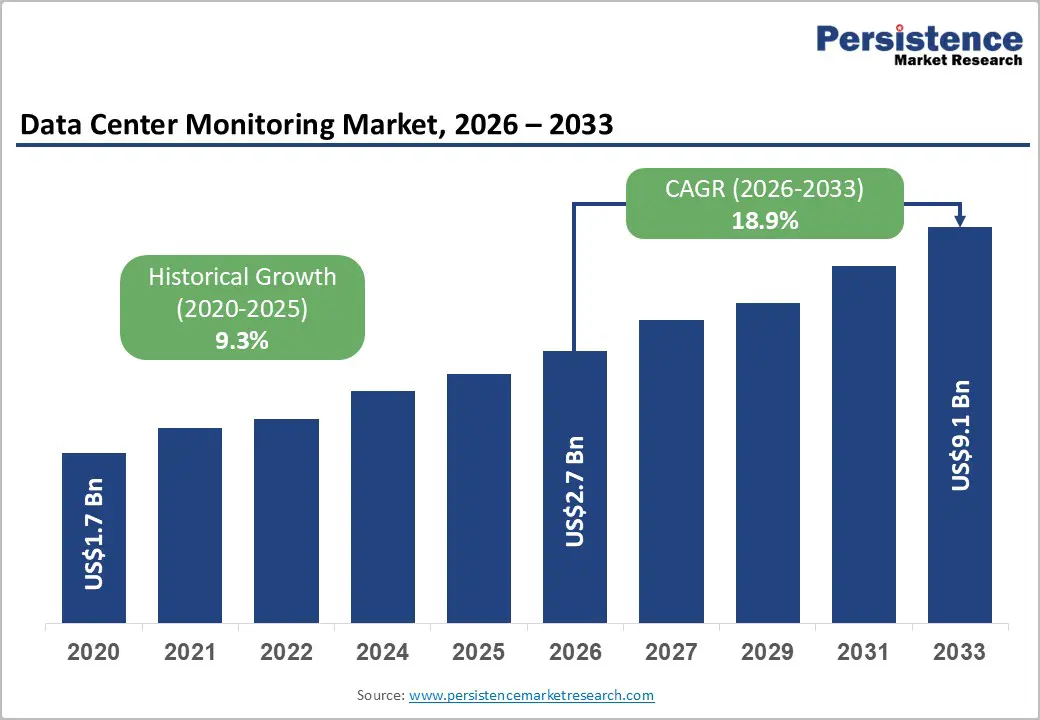
The global data center monitoring market size is expected to reach significant growth momentum over the forecast period, driven by increasing data center complexity, rising electricity consumption, rapid AI adoption, and growing demand for infrastructure reliability. The market is projected to be valued at US$2.7 billion in 2026 and is expected to reach US$9.1 billion by 2033, expanding at a CAGR of 18.9% between 2026 and 2033.
Modern data centers are becoming increasingly complex as enterprises adopt artificial intelligence (AI), cloud computing, edge infrastructure, and high-performance computing (HPC) applications. These technologies are creating higher rack densities, increased power consumption, and more demanding cooling requirements. As a result, organizations are investing heavily in advanced monitoring platforms that provide real-time visibility into power usage, temperature levels, cooling efficiency, asset performance, and cybersecurity risks.
Data center monitoring solutions enable operators to optimize infrastructure performance, prevent downtime, improve energy efficiency, and support sustainability goals. The growing focus on operational resilience and regulatory compliance is further accelerating adoption across hyperscale, enterprise, and colocation data centers worldwide.
Key Market Highlights
- Market Size (2026): US$2.7 billion
- Market Size (2033): US$9.1 billion
- Forecast CAGR (2026–2033): 18.9%
- Leading Region: North America with approximately 41.1% market share in 2026
- Fastest-Growing Region: Asia Pacific
- Dominant Component: Hardware with 46.4% share in 2026
- Leading Solution: Data Center Infrastructure Management (DCIM) with 38.3% share in 2026
AI Workloads and High-Density Infrastructure Driving Market Growth
The rapid expansion of artificial intelligence workloads is one of the most important factors driving demand for advanced data center monitoring solutions. AI training and inference applications require significantly higher computing power compared with traditional enterprise workloads. This has resulted in increased rack power densities, greater thermal challenges, and more complex infrastructure management requirements.
AI-ready data centers require continuous monitoring of critical operational parameters, including power consumption, airflow patterns, temperature fluctuations, cooling performance, and equipment utilization. Real-time monitoring enables operators to identify potential issues before failures occur and maintain consistent service availability.
The growing adoption of high-performance computing systems is also increasing demand for advanced cooling technologies, including liquid cooling solutions. These next-generation cooling architectures require sophisticated monitoring capabilities to maintain optimal performance and prevent overheating risks.
Data center operators are increasingly integrating artificial intelligence and machine learning capabilities into monitoring platforms. AI-powered monitoring systems can analyze operational data, detect anomalies, predict equipment failures, and recommend optimization strategies. This transition from reactive maintenance to predictive infrastructure management is becoming a major market growth driver.
Rising Compliance and Cybersecurity Requirements Strengthen Demand
Increasing regulatory pressure related to energy efficiency, sustainability reporting, and operational resilience is significantly contributing to market expansion. Governments and industry regulators are introducing stricter requirements for tracking energy consumption, carbon emissions, and environmental performance.
European countries, in particular, are emphasizing transparent reporting of data center energy usage and sustainability metrics. These regulations are encouraging operators to deploy monitoring platforms capable of measuring power efficiency, cooling performance, and carbon footprint indicators.
Cybersecurity concerns are also increasing the importance of continuous monitoring. Data centers support critical digital infrastructure for financial services, healthcare, government systems, and large enterprises. Any disruption or security incident can result in significant financial and operational consequences.
Advanced monitoring platforms provide centralized dashboards, automated alerts, incident tracking, and infrastructure visibility, helping organizations improve cybersecurity readiness and operational control.
Market Restraint: Integration Challenges in Legacy Data Centers
Despite strong growth opportunities, integration complexity remains a major challenge for market adoption. Many existing data centers operate with a combination of legacy equipment, traditional building management systems, modern IoT sensors, and multiple software platforms.
Integrating these different systems into a unified monitoring environment can require significant investment in customization, middleware solutions, and technical expertise. Older facilities may lack interoperability capabilities, making modernization projects more complicated.
Small and medium-sized data center operators may hesitate to adopt advanced monitoring platforms due to high initial deployment costs. Implementation challenges, cybersecurity validation requirements, and operational disruptions during migration can also slow adoption.
However, as organizations increasingly prioritize efficiency and reliability, investments in modernization are expected to overcome these challenges over the long term.
Regulatory Reporting and Sustainability Create New Opportunities
The growing focus on sustainability is creating significant opportunities for data center monitoring software providers. Organizations are increasingly required to track energy consumption, carbon emissions, water usage, and operational efficiency metrics.
Monitoring platforms enable automated sustainability reporting by collecting and analyzing real-time infrastructure data. These solutions help operators measure key performance indicators such as power usage effectiveness (PUE), cooling efficiency, and energy optimization levels.
Software providers that combine infrastructure monitoring, environmental analytics, and compliance reporting capabilities are positioned to benefit from rising demand for integrated sustainability solutions.
The trend is especially strong in Europe, where regulatory frameworks are encouraging enterprises and data center operators to improve transparency and adopt standardized reporting practices.
Cloud-Based Monitoring Solutions Gain Momentum
The expansion of edge computing, distributed infrastructure, and multi-location data center environments is increasing demand for cloud-based monitoring solutions.
Traditional monitoring approaches often require extensive on-site resources and manual management. Cloud-based platforms allow organizations to monitor multiple facilities remotely through centralized dashboards and analytics systems.
Cloud monitoring solutions offer several advantages, including:
- Remote infrastructure visibility
- Automated alerts and diagnostics
- Predictive maintenance capabilities
- Faster deployment
- Scalable management across multiple locations
Colocation providers, telecom operators, and cloud service providers are increasingly adopting cloud-based monitoring platforms to manage geographically distributed infrastructure efficiently.
As edge computing continues expanding across industries such as telecommunications, manufacturing, healthcare, and retail, cloud-native monitoring architectures are expected to become a major growth opportunity.
Data Center Monitoring Market Segment Analysis
Component Insights
Hardware Segment Leads the Market
The hardware segment is expected to dominate the data center monitoring market with approximately 46.4% market share in 2026.
Hardware components form the foundation of monitoring infrastructure by enabling real-time data collection from physical environments. These include:
- Intelligent power distribution units (PDUs)
- Temperature sensors
- Humidity monitoring systems
- Environmental monitoring devices
- Power management controllers
Large-scale hyperscale and colocation facilities require extensive hardware deployment to monitor thousands of assets continuously.
The increasing adoption of AI infrastructure, liquid cooling systems, and high-density computing environments is further strengthening demand for advanced monitoring hardware.
Software Segment Experiences Rapid Growth
The software segment is expected to witness strong growth due to increasing demand for automation, predictive analytics, and centralized infrastructure management.
Modern monitoring software platforms provide:
- Asset tracking
- Predictive maintenance
- Capacity planning
- Automated reporting
- AI-based anomaly detection
Organizations are increasingly moving from traditional monitoring methods toward intelligent software platforms that improve efficiency and reduce downtime risks.
Solution Insights
DCIM Solutions Maintain Market Leadership
Data Center Infrastructure Management (DCIM) solutions are projected to hold the largest market share, accounting for approximately 38.3% in 2026.
DCIM platforms provide centralized management across multiple infrastructure areas, including:
- Power systems
- Cooling infrastructure
- Network equipment
- Asset management
- Space utilization
The growing complexity of modern data centers is increasing demand for integrated management solutions that provide complete operational visibility.
Power Monitoring Emerges as a High-Growth Segment
Power monitoring solutions are gaining importance as electricity consumption becomes one of the biggest operational challenges for data centers.
AI workloads require significantly higher power availability, making real-time monitoring of energy consumption, voltage levels, and power quality essential.
Power monitoring systems help operators:
- Reduce energy waste
- Improve capacity planning
- Optimize infrastructure utilization
- Support sustainability goals
Regional Market Analysis
North America Data Center Monitoring Market
North America is expected to remain the leading regional market, accounting for approximately 41.1% market share in 2026.
The region’s leadership is supported by:
- Large-scale hyperscale data center expansion
- Strong cloud adoption
- AI infrastructure investment
- Advanced digital ecosystem
The United States represents the largest market in the region, supported by major technology companies expanding AI-ready data center campuses across states such as Virginia, Texas, Arizona, and Oregon.
U.S. operators are increasingly deploying monitoring solutions for predictive maintenance, energy optimization, and operational resilience.
Canada is also witnessing growth due to increasing investment in sustainable data center infrastructure and renewable energy-powered facilities.
Europe Data Center Monitoring Market
Europe is experiencing strong growth due to strict sustainability regulations and increasing demand for energy-efficient infrastructure.
Germany and the U.K. represent major regional markets.
Germany’s industrial digitalization and strong technology ecosystem are driving adoption of advanced monitoring systems.
The U.K., supported by London’s position as a major connectivity hub, is witnessing increased deployment of DCIM platforms and AI-driven analytics solutions.
Asia Pacific Data Center Monitoring Market
Asia Pacific is projected to be the fastest-growing regional market during the forecast period.
Growth is driven by:
- Rapid digital transformation
- Cloud infrastructure expansion
- Rising internet penetration
- AI adoption
China remains one of the largest markets due to government-backed digital infrastructure development and increasing hyperscale investments.
Japan’s focus on reliability and disaster recovery is supporting demand for advanced monitoring technologies.
India is emerging as a high-growth market due to expanding data center investments in Mumbai, Bengaluru, Hyderabad, and Chennai. Rising demand from fintech, e-commerce, cloud services, and AI applications is accelerating adoption.
Competitive Landscape
The global data center monitoring market is moderately fragmented, with competition among hardware manufacturers, software providers, and infrastructure management companies.
Companies are focusing on:
- AI-powered analytics
- Cloud-based monitoring platforms
- Predictive maintenance solutions
- Sustainability reporting capabilities
- Integrated infrastructure ecosystems
Key Companies Covered:
- Schneider Electric
- Vertiv
- Eaton
- ABB
- Siemens
- Johnson Controls
- Cisco Systems
- IBM
- Huawei Technologies
- Sunbird Software
- Nlyte Software
- Device42
- FNT Software
- Panduit
- CommScope
- Delta Electronics
Recent Industry Developments
In August 2025, Vertiv acquired Waylay NV to enhance its AI-driven monitoring and predictive maintenance capabilities for data center power and cooling infrastructure.
In November 2025, Schneider Electric introduced new EcoStruxure data center solutions designed for high-density AI computing environments, including liquid-cooling-ready systems and advanced monitoring capabilities.
Future Outlook of the Data Center Monitoring Market
The data center monitoring market is expected to experience strong expansion through 2033 as organizations prioritize infrastructure reliability, energy efficiency, and operational intelligence.
The combination of AI-driven workloads, sustainability regulations, cybersecurity requirements, and cloud-based infrastructure expansion will continue shaping market growth.
As data centers become more complex and power-intensive, advanced monitoring solutions will become essential for maintaining uptime, reducing operational costs, and achieving long-term efficiency goals. Companies offering integrated platforms that combine hardware intelligence, AI analytics, automation, and sustainability reporting will be well-positioned to capture emerging opportunities in this rapidly evolving market.

 English
 Arabic
 French
 Portuguese
 Deutsch
 Turkish
 Dutch
Dutch
 Italiano
 Russian
 Romaian
 Portuguese (Brazil)
 Greek
Greek