


Road Safety Systems Market Overview
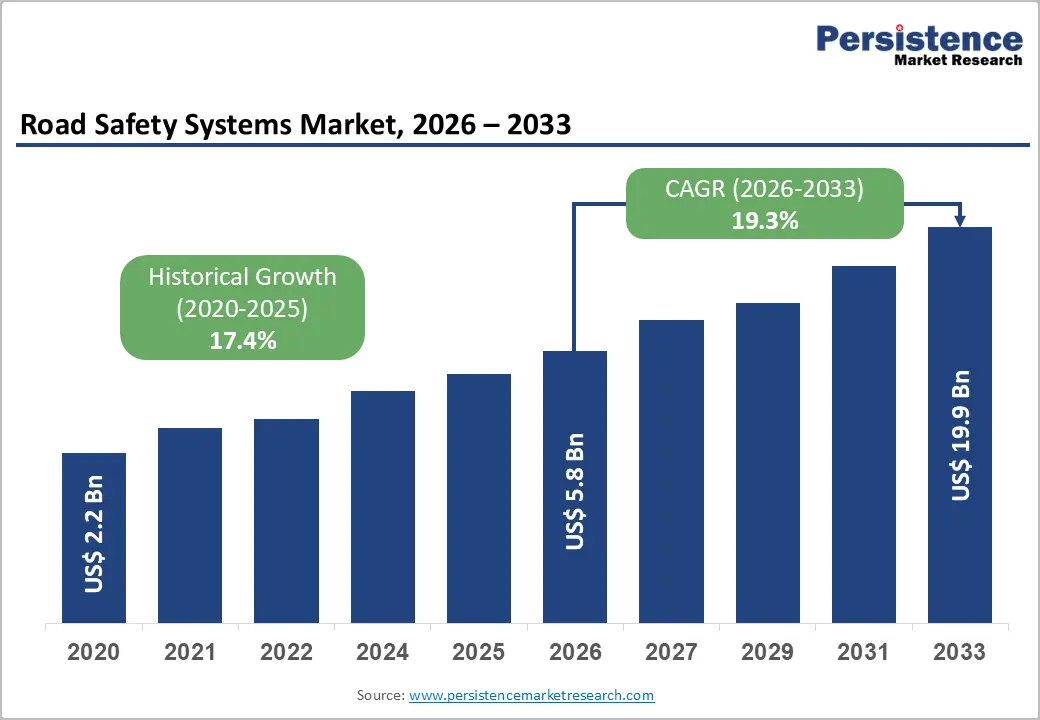
The global road safety systems market size is expected to reach significant growth momentum in the coming years, driven by rising road accident fatalities, increasing government regulations, and rapid adoption of smart transportation technologies. The market is likely to be valued at US$5.8 billion in 2026 and is projected to reach US$19.9 billion by 2033, expanding at a CAGR of 19.3% between 2026 and 2033.
Road safety has become a critical priority for governments, transportation authorities, and urban planners as cities experience increasing vehicle ownership, population growth, and urban congestion. Traditional safety measures are gradually being replaced by advanced technologies such as automated enforcement systems, artificial intelligence (AI)-powered traffic monitoring, connected vehicle solutions, and intelligent transportation systems (ITS).
The rising need to reduce traffic fatalities and improve emergency response times is accelerating investments in technologies including red-light enforcement cameras, speed monitoring systems, incident detection platforms, roadside sensors, and vehicle safety communication systems. In addition, strict regulatory mandates related to advanced driver assistance systems (ADAS) and smart infrastructure development are creating strong opportunities for road safety solution providers worldwide.
Key Market Highlights
- Market Size (2026): US$5.8 billion
- Forecast Value (2033): US$19.9 billion
- Growth Rate: 19.3% CAGR (2026–2033)
- Leading Solution Type: Red light and speed enforcement, accounting for approximately 56.3% share in 2026
- Dominant Service Type: Professional services, holding nearly 81.5% share in 2026
- Leading Region: Europe, with around 37.2% market share in 2026
- Fastest-Growing Region: Asia Pacific, supported by smart city investments and rapid urbanization
Major Growth Drivers of the Road Safety Systems Market
Increasing Number of Road Traffic Fatalities Worldwide
The rising number of road accidents remains the primary factor driving demand for advanced road safety systems. According to the World Health Organization (WHO), approximately 1.19 million people die every year due to road traffic crashes globally, making road accidents one of the leading causes of death among children and young adults aged 5 to 29 years.
The economic impact of road accidents is also substantial. Fatal and non-fatal crash injuries are estimated to cost the global economy nearly US$3.6 trillion annually through healthcare expenses, productivity losses, and infrastructure damage.
Vulnerable road users, including pedestrians, cyclists, and motorcyclists, account for more than half of global road fatalities. This increasing safety concern is encouraging governments and private organizations to invest in advanced road monitoring and prevention technologies.
Road safety systems help reduce accidents by enabling real-time traffic monitoring, automatic violation detection, emergency response coordination, and predictive risk analysis. As cities aim to achieve safer transportation networks, demand for intelligent safety solutions continues to rise.
Implementation of Strict Government Safety Regulations
Government regulations and international road safety programs are significantly influencing market growth. Authorities worldwide are introducing mandatory safety standards requiring advanced technologies in vehicles and transportation infrastructure.
India’s Ministry of Road Transport and Highways (MoRTH), for example, has announced that advanced driver assistance systems (ADAS), including Automatic Emergency Braking, Lane Departure Warning, and Driver Drowsiness Alerts, will become mandatory for new heavy trucks and buses from October 2027.
Similarly, vehicles designed to carry more than eight passengers will require ADAS features starting in April 2026. Such regulations are encouraging automobile manufacturers to integrate safety technologies at a larger scale.
Globally, the United Nations Decade of Action for Road Safety 2021–2030 aims to reduce road deaths and injuries by 50% by 2030. These initiatives are encouraging countries to invest in automated enforcement systems, smart roads, and connected transportation infrastructure.
Market Restraints
Technology Failures and Uneven Adoption Across Regions
Despite strong growth prospects, the road safety systems market faces challenges related to technology reliability and unequal adoption across regions.
Advanced safety infrastructure requires proper installation, maintenance, and integration with existing transportation networks. In some cases, systems that perform well under controlled testing conditions may face limitations in real-world environments.
For example, research published in PLOS ONE highlighted that certain roadside barriers may fail to redirect vehicles safely during actual crashes despite successfully passing laboratory tests. Differences in crash angles, road conditions, and environmental factors can affect system performance.
Developing countries also face challenges due to limited funding, weak enforcement mechanisms, inadequate road infrastructure, and insufficient traffic data systems. These factors can slow the deployment of advanced road safety technologies.
Emerging Opportunities in the Road Safety Systems Market
Growth of Intelligent Transportation Systems and IoT Integration
The integration of Artificial Intelligence (AI), Internet of Things (IoT), and Intelligent Transportation Systems (ITS) is transforming road safety from reactive accident management into predictive prevention.
Smart traffic systems equipped with sensors, cameras, and analytics platforms can identify dangerous conditions before accidents occur. These technologies monitor traffic patterns, detect violations, optimize signal timing, and provide real-time alerts to drivers and authorities.
A notable example is Los Angeles’ Automated Traffic Surveillance and Control (ATSAC) system. Initially developed for the 1984 Olympics with 118 traffic signals, the system has expanded to more than 4,850 adaptive signals across the city. It adjusts traffic signals based on real-time conditions and has helped reduce intersection delays.
Connected vehicle programs are also gaining momentum. New York City’s Connected Vehicle Pilot Program uses AI and IoT technologies to detect incidents and improve emergency response efficiency.
Increasing Adoption of Digital Twins for Road Safety Planning
Digital twin technology is creating new opportunities for transportation safety management. A digital twin creates a virtual representation of physical roads, traffic systems, and infrastructure, allowing authorities to simulate and analyze different scenarios.
Research published in Nature Scientific Reports (2025) demonstrated that digital twins could identify crash risks under varying weather and visibility conditions that conventional simulations may overlook.
Transportation agencies can use digital twins to:
- Monitor infrastructure conditions
- Predict road damage
- Test traffic management strategies
- Improve pedestrian safety planning
- Optimize emergency response systems
Countries such as Singapore are using large-scale digital twins to monitor urban infrastructure and support smarter transportation planning.
Road Safety Systems Market Segment Analysis
Solution Type Insights
Red Light and Speed Enforcement Segment Leads the Market
The red light and speed enforcement segment is expected to dominate the road safety systems market, accounting for approximately 56.3% share in 2026.
Speeding and traffic signal violations remain among the most common causes of severe road accidents. Governments are increasingly deploying automated enforcement technologies to monitor highways, intersections, and accident-prone zones.
Modern enforcement solutions use advanced cameras, radar systems, and AI-based analytics to detect violations automatically. Technologies such as Jenoptik’s TraffiStar and VECTOR SR cameras can monitor multiple lanes, identify violations, and process penalties without manual intervention.
The growing focus on reducing dangerous driving behavior is expected to maintain strong demand for automated enforcement solutions.
Incident Detection and Response Segment Growth
The incident detection and response segment is also expected to witness strong adoption. Faster emergency response after accidents can significantly reduce fatalities and improve road safety outcomes.
Advanced incident detection systems use cameras, sensors, and AI algorithms to identify:
- Vehicle collisions
- Traffic congestion
- Road obstacles
- Dangerous driving patterns
These systems can automatically adjust speed limits, close affected lanes, and alert drivers through digital signs and connected vehicle platforms.
Service Type Analysis
Professional Services Maintain Market Leadership
The professional services segment is projected to account for approximately 81.5% share in 2026.
Road safety systems require extensive planning, installation, integration, and maintenance. Professional services include:
- System consulting
- Infrastructure assessment
- Software integration
- Installation support
- Training
- Technical maintenance
As cities modernize transportation networks, demand for specialized expertise continues to increase.
Managed Services Experience Rapid Growth
Managed services are emerging as one of the fastest-growing areas of the market. Governments and municipalities are increasingly outsourcing the operation and maintenance of road safety systems.
This approach allows public agencies to reduce operational complexity while ensuring continuous system upgrades and reliability.
For example, Jenoptik’s agreement with the City of Brampton, Ontario, involves a five-year managed service contract covering the delivery, installation, operation, and maintenance of 185 automated speed enforcement cameras.
Regional Analysis
Europe Road Safety Systems Market Trends
Europe is expected to lead the global market, accounting for approximately 37.2% share in 2026.
The region’s leadership is supported by advanced transportation infrastructure, strict safety regulations, and coordinated Intelligent Transportation Systems initiatives.
In 2024, nearly 19,940 people died in road crashes across the European Union. The EU’s Vision Zero strategy aims to reduce road fatalities by half by 2030 and eliminate deaths by 2050.
Countries across Europe are investing in:
- Automated traffic enforcement
- Smart highways
- Connected vehicles
- Digital traffic management platforms
Asia Pacific Road Safety Systems Market Trends
Asia Pacific is projected to experience the fastest growth during the forecast period due to rapid urbanization, rising vehicle ownership, and smart city initiatives.
Countries including China, India, Japan, and South Korea are investing heavily in intelligent transportation infrastructure.
China invests billions annually in smart traffic management systems, while India’s Smart Cities Mission supports AI-powered transportation solutions.
China Road Safety Systems Market Trends
China represents one of the largest opportunities in Asia Pacific due to its extensive road network and high vehicle population.
The country is deploying:
- AI-powered surveillance systems
- Smart highways
- Vehicle-to-infrastructure communication
- Automated traffic management platforms
Government investments in connected transportation infrastructure continue to strengthen market growth.
India Road Safety Systems Market Trends
India is becoming a major growth market due to increasing road accidents and stronger government regulations.
The country recorded approximately 4.8 lakh road accidents and 1.72 lakh fatalities in 2023, creating urgent demand for safety improvements.
Regulatory initiatives such as mandatory ADAS requirements and Bharat NCAP upgrades are expected to accelerate adoption of advanced safety technologies.
North America Road Safety Systems Market Trends
North America remains a mature but technologically advanced market.
The United States continues investing through federal safety programs, including funding under the Infrastructure Investment and Jobs Act.
Cities are expanding automated enforcement programs and adopting AI-based traffic analytics. San Francisco, for example, approved California’s first automated speed safety program featuring 33 speed camera locations.
Competitive Landscape
The global road safety systems market is moderately fragmented, with competition among transportation technology providers, infrastructure companies, and mobility solution specialists.
Leading companies are focusing on integrated solutions combining:
- AI analytics
- Cloud platforms
- Vehicle-to-everything (V2X) communication
- Automated enforcement
- Predictive traffic management
Major players operating in the market include:
- Kapsch TrafficCom AG
- SWARCO AG
- Verra Mobility
- Sensys Gatso Group AB
- Jenoptik AG
- Siemens Mobility
- Teledyne FLIR
- Dahua Technology
- Motorola Solutions
- Iteris Inc.
- Conduent Incorporated
Recent Industry Developments
- In October 2025, Jenoptik Smart Mobility Solutions and TrafficTech Middle East secured a contract with Greater Amman Municipality in Jordan to deploy automated speed and red-light enforcement systems.
- In April 2025, Frontline Road Safety acquired InfraStripe, expanding its roadway safety and traffic management capabilities.
- In January 2025, Bain Capital announced an agreement to acquire Frontline Road Safety, strengthening its position in roadway infrastructure services.
Future Outlook of the Road Safety Systems Market
The road safety systems market is expected to witness strong expansion through 2033 as governments prioritize safer transportation networks and smart city development.
The combination of AI, IoT, connected vehicles, digital twins, and automated enforcement technologies will reshape how road risks are identified and managed. While challenges remain around infrastructure costs and regional adoption gaps, increasing regulatory pressure and rising public safety concerns will continue driving investment.
With a projected growth from US$5.8 billion in 2026 to US$19.9 billion by 2033, the road safety systems market is positioned as a critical component of future intelligent mobility ecosystems.

 English
 Arabic
 French
 Spanish
 Portuguese
 Deutsch
 Turkish
 Italiano
 Russian
 Romaian
 Portuguese (Brazil)
 Greek
Greek