


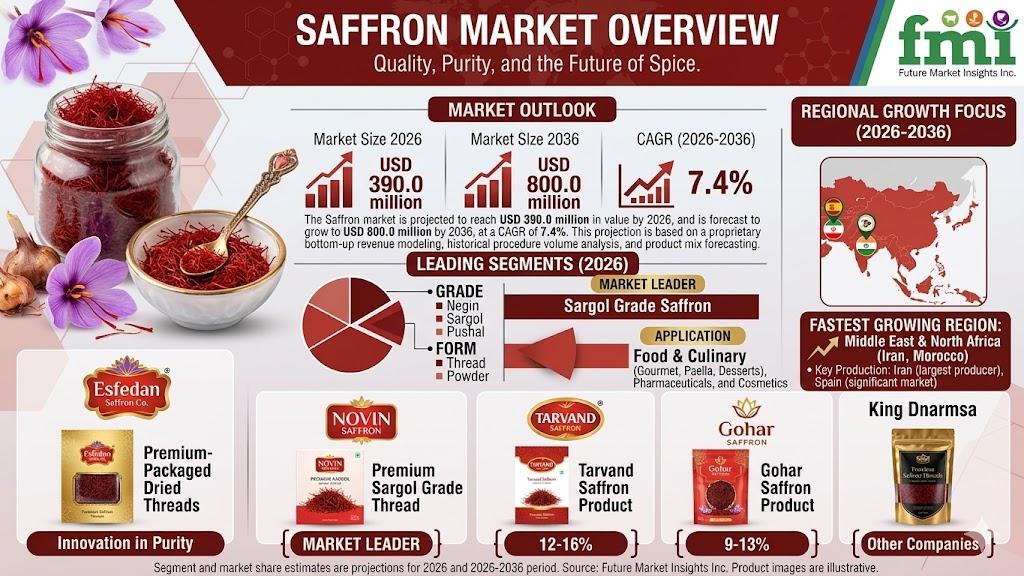
NEWARK, Del., USA | February 17, 2026 — According to the latest market analysis by Future Market Insights, the global saffron market is entering a transformative phase, driven by constrained supply, rising demand for high-value bioactive compounds, and rapid advancements in controlled-environment agriculture. Valued at USD 390.0 million in 2026, the market is projected to reach USD 800.0 million by 2036, expanding at a CAGR of 7.4%.
Unlike traditional growth models, saffron’s expansion is being shaped by scarcity economics, where climate volatility, declining yields in key producing regions, and increasing quality standards are elevating pricing power across the value chain.
Quick Stats – Saffron Market
- Market Size (2026): USD 390.0 Million
- Forecast Value (2036): USD 800.0 Million
- CAGR (2026–2036): 7.4%
- Leading Form: Threads (45.0%)
- Top Functionality: Flavoring & Colorant (46.0%)
- Key Growth Markets: China (8.0%), India (7.8%), USA (7.2%), Spain (6.5%), Iran (6.0%)
- Key Players: Gohar Saffron, Rowhani Saffron Co., Saffron Tech, Saharkhiz Saffron, Azafarm Group
Executive Insight for Decision Makers
The saffron market is shifting from a volume-driven spice trade to a value-driven bioactive ingredient industry. Increasing demand for pharmaceutical-grade crocin, safranal, and antioxidant compounds is pushing manufacturers toward standardized extraction technologies and lab-controlled cultivation.
Decision makers focusing on traceability, clean-label compliance, and high-purity extract solutions will be best positioned to capitalize on this premiumization wave.
Market Momentum: From Spice to Science
The market’s evolution is driven by structural shifts:
- Declining traditional cultivation output due to climate instability
- Rising demand for clinical-grade bioactive compounds
- Expansion into nutraceuticals, cosmetics, and functional foods
- Shift toward controlled-environment agriculture (CEA) and vertical farming
Saffron is transitioning from a culinary luxury ingredient to a multi-industry functional compound.
Segment Leadership Defining Market Direction
- Threads (45.0%) dominate due to authenticity and anti-adulteration assurance
- Flavoring & Colorant (46.0%) lead driven by clean-label demand
- Liquid/Extract Forms gaining momentum for industrial applications
- Pharmaceutical & Cosmetic Applications expanding rapidly
Key Market Trends: Innovation Reshaping the Industry
- Emergence of lab-grown and indoor cultivated saffron
- Growth in standardized saffron extracts for nutraceuticals
- Increasing use in cosmetics for antioxidant and anti-inflammatory benefits
- Shift toward traceable, GI-tagged, and certified origin products
- Development of high-yield vertical farming systems
Consumer Trends: Premiumization Meets Functionality
- Rising demand for natural, clean-label ingredients
- Increasing adoption in functional foods and beverages
- Growth in luxury gifting and prestige consumption markets
- Strong interest in health benefits, including anti-inflammatory properties
Consumers are prioritizing quality, authenticity, and functional value over price sensitivity.
Regional Growth Landscape
- China (8.0% CAGR): Strong demand from traditional medicine and luxury consumption
- India (7.8% CAGR): GI-tagged Kashmir saffron and processing modernization
- USA (7.2% CAGR): Diversified sourcing and demand for certified supply chains
- Spain (6.5% CAGR): Global processing and re-export hub
- Iran (6.0% CAGR): Volume leader constrained by geopolitical and trade challenges
Emerging Asian markets are driving demand, while Europe dominates value-added processing and re-exporting.
Competitive Landscape: Innovation, Traceability & Control
The saffron market is characterized by a mix of traditional producers and ag-tech disruptors:
- Gohar Saffron & Rowhani Saffron Co. – Heritage leaders with strong supply networks
- Saffron Tech – Pioneer in indoor saffron cultivation and ag-tech innovation
- Saharkhiz Saffron & Azafarm Group – Expanding portfolios with premium offerings
Competition is increasingly defined by traceability, technological capability, and product standardization.
👉 Get Access to the Report Sample: https://www.futuremarketinsights.com/reports/sample/rep-gb-11625
Strategic Takeaways
- Manufacturers: Invest in extraction technologies and standardized bioactive compounds
- Retailers: Focus on premium, GI-certified, and traceable saffron products
- Investors: Target ag-tech and indoor farming innovations
- Brands: Leverage health benefits and clean-label positioning
Why This Market Matters
As global demand shifts toward functional, natural, and high-value ingredients, saffron is evolving into a strategic commodity across food, pharmaceutical, and cosmetic industries.
Its transformation from “red gold” spice to a science-backed bioactive ingredient marks a new era of growth defined by innovation, scarcity, and premiumization.
For forward-looking stakeholders, the saffron market represents not just expansion—but a fundamental reinvention of value creation.
About Future Market Insights (FMI)
Future Market Insights (FMI) is a leading provider of market intelligence and consulting services, serving clients in over 150 countries. Headquartered in Delaware, USA, with a global delivery center in India and offices in the UK and UAE, FMI delivers actionable insights across industries including automotive, technology, consumer products, manufacturing, energy, and chemicals.
An ESOMAR-certified research organization, FMI provides custom and syndicated market research reports and consulting services, supporting both Fortune 1,000 companies and SMEs with data-driven decision-making.
Contact Us
Future Market Insights Inc.
Christiana Corporate, 200 Continental Drive,
Suite 401, Newark, Delaware - 19713, USA
T: +1-347-918-3531
Sales Enquiries: sales@futuremarketinsights.com

 English
 Arabic
 French
 Spanish
 Portuguese
 Turkish
 Dutch
Dutch
 Italiano
 Russian
 Romaian
 Portuguese (Brazil)
 Greek
Greek