


The global energy landscape is undergoing a profound transformation, driven by the rapid integration of renewable energy sources, rising electricity costs, and increasing pressure to improve energy efficiency. At the center of this transition lies the demand response (DR) system market, a critical enabler of grid flexibility and stability.
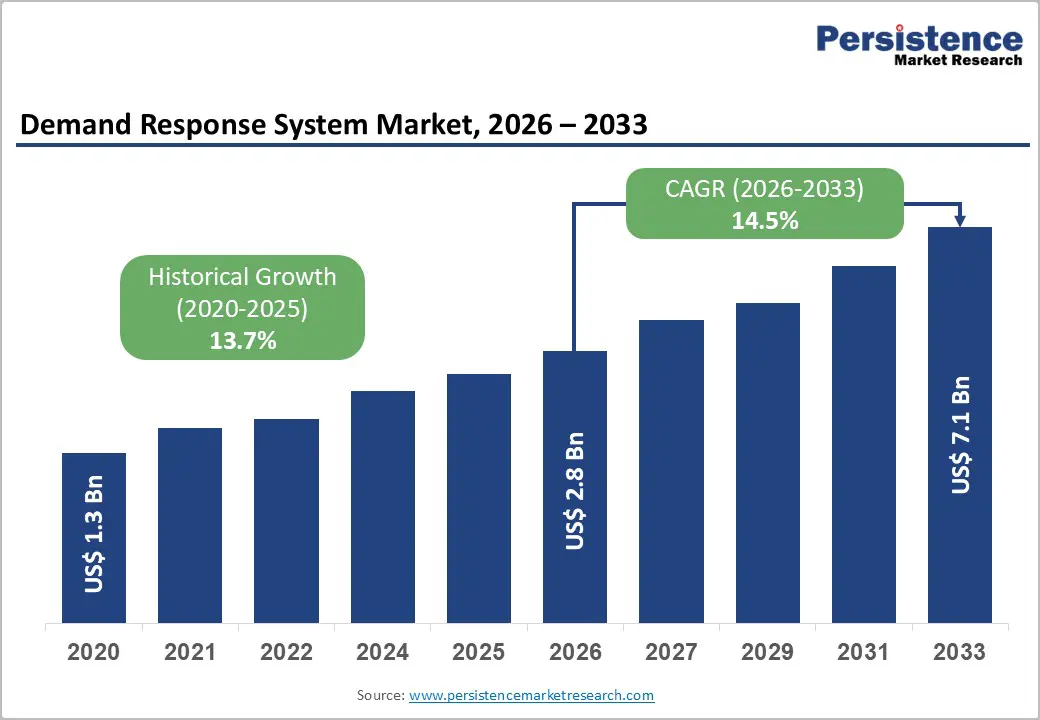
The global demand response system market was valued at US$ 2.8 billion in 2026 and is projected to reach US$ 7.1 billion by 2033, expanding at a robust CAGR of 14.5%. This growth reflects the growing importance of intelligent energy management solutions that can dynamically balance electricity demand and supply.
Demand response systems allow utilities and consumers to adjust electricity consumption during peak demand periods, helping reduce strain on the grid, lower energy costs, and support sustainable energy goals.
Market Overview
Demand response systems are becoming indispensable components of modern power infrastructure. These systems enable real-time communication between utilities and end-users, allowing for automated or manual adjustments in electricity consumption.
The market is primarily driven by three factors:
Increasing integration of renewable energy sources
Rising electricity costs
Government regulations promoting energy efficiency
Renewable energy sources such as wind and solar are inherently intermittent, creating challenges for grid stability. Demand response systems help mitigate these fluctuations by adjusting consumption patterns rather than increasing generation capacity.
Additionally, growing energy costs are encouraging both residential and industrial users to adopt energy optimization solutions. Governments worldwide are also implementing stringent policies to reduce carbon emissions, further accelerating demand for DR systems.
Key Market Highlights
Regional Leadership and Growth Trends
North America dominates the demand response system market, holding approximately 40% market share. This leadership is supported by advanced grid infrastructure, widespread adoption of smart meters, and favorable regulatory frameworks.
Meanwhile, the Asia-Pacific region is the fastest-growing market, expected to expand at a CAGR of 22% through 2033. Rapid urbanization, industrial growth, and smart grid initiatives in countries like India and China are driving regional demand.
Segment Insights
Automated Demand Response (ADR) systems account for nearly 75% of the market, reflecting the preference for real-time, algorithm-driven load management.
The industrial sector is the largest end-user segment, contributing around 45% of market revenue.
Residential demand response is the fastest-growing segment, driven by smart home technologies and increasing consumer awareness.
Market Dynamics
Key Growth Drivers
Renewable Energy Integration and Grid Stability
The global shift toward renewable energy is one of the most significant drivers of demand response adoption. As solar and wind energy capacity increases, so does the need for systems that can manage their variability.
Demand response systems enable utilities to:
Balance supply and demand in real time
Reduce reliance on fossil-fuel backup generation
Enhance grid reliability
For instance, large-scale grid operators have demonstrated how demand response resources can significantly contribute to peak load management, making them essential for future energy systems.
Rising Electricity Costs and Efficiency Mandates
Electricity prices are steadily increasing across both developed and developing economies. This trend is pushing consumers and businesses to seek cost-saving solutions.
Demand response systems help users:
Reduce peak demand charges
Optimize energy consumption
Participate in incentive-based programs
Government mandates also play a crucial role. Policies aimed at reducing energy consumption and carbon emissions are encouraging utilities to adopt demand-side management strategies.
Market Restraints
High Implementation Costs
One of the primary challenges facing the market is the high initial investment required for infrastructure deployment. This includes:
Advanced metering infrastructure (AMI)
Communication networks
Control systems
For smaller utilities and developing regions, these costs can be prohibitive.
Integration Complexity
Integrating demand response systems with existing grid infrastructure is technically complex. Legacy systems often require upgrades, and interoperability issues can delay deployment.
Additionally, retrofitting older systems increases project costs and implementation timelines.
Data Privacy and Cybersecurity Concerns
Demand response systems rely heavily on real-time data collection, raising concerns about:
Consumer privacy
Data security
Cyber threats
As energy systems become more connected, ensuring robust cybersecurity measures is essential to prevent potential disruptions.
Market Opportunities
Residential Demand Response and Smart Homes
The residential sector represents a massive untapped opportunity. Despite accounting for a significant share of electricity consumption, participation in demand response programs remains relatively low.
The integration of DR capabilities into smart home devices is expected to drive growth. Technologies such as:
Smart thermostats
Smart plugs
Home energy management systems
are enabling seamless consumer participation.
These systems use artificial intelligence to learn user behavior and automatically optimize energy consumption, making demand response more accessible and user-friendly.
Industrial Demand Response for Peak Optimization
Industrial users are among the most valuable participants in demand response programs due to their high energy consumption and ability to adjust loads quickly.
Automated demand response systems allow industries to:
Reduce energy costs by 10–20%
Optimize production schedules
Minimize operational disruptions
Industries such as manufacturing, oil and gas, and food processing are increasingly adopting these solutions to enhance efficiency and competitiveness.
Category-Wise Insights
Component Analysis
Hardware components dominate the market, accounting for approximately 58% of total market value.
Key hardware elements include:
Smart meters
Smart thermostats
Load control switches
Smart plugs
The widespread deployment of smart meters is particularly significant, with installations expected to surpass 1 billion units globally.
Software and services are also gaining traction, driven by the need for advanced analytics, system integration, and ongoing maintenance.
System Type Analysis
Automated demand response systems lead the market due to their ability to operate without human intervention.
Key benefits include:
Real-time response to grid conditions
Improved reliability
Seamless integration with energy management systems
These systems leverage advanced algorithms and machine learning to optimize energy consumption patterns.
End-User Analysis
The demand response market is segmented into:
Industrial (largest share)
Commercial
Residential (fastest-growing)
Industrial users dominate due to high energy usage and strong financial incentives. Commercial buildings also benefit from predictable energy patterns and multiple controllable systems.
Residential adoption is accelerating with the proliferation of smart home technologies and increased awareness of energy savings.
Regional Insights
North America
North America remains the most mature market for demand response systems. The region benefits from:
Advanced infrastructure
Strong regulatory support
High smart meter penetration
Utilities in the region actively engage consumers through dynamic pricing and incentive programs, driving widespread adoption.
Europe
Europe is the second-largest market, driven by strict energy efficiency targets and sustainability initiatives.
Government policies are encouraging:
Reduced energy consumption
Increased renewable integration
Consumer participation in energy programs
Countries like Germany, France, and the UK are leading the adoption of advanced demand response solutions.
Asia-Pacific
Asia-Pacific is emerging as the fastest-growing region due to:
Rapid urbanization
Industrial expansion
Government-led smart grid initiatives
India and China are at the forefront, investing heavily in modernizing their energy infrastructure. Programs such as smart meter rollouts and grid digitization are creating significant growth opportunities.
Competitive Landscape
The demand response system market is moderately fragmented, with a mix of global technology leaders and specialized solution providers.
Major companies include:
Honeywell International Inc.
General Electric
ABB
Eaton
Oracle
Enel X
AutoGrid Systems, Inc.
Trilliant Holdings Inc.
These companies focus on innovation, platform integration, and the use of artificial intelligence to enhance system capabilities.
Recent Developments
Recent innovations highlight the growing importance of integrated energy solutions:
Eaton introduced the AbleEdge home energy management system, simplifying residential energy optimization.
Johnson Controls launched Metasys 14.0, a building automation system designed to improve energy efficiency and occupant comfort.
Such developments demonstrate the increasing convergence of smart technologies and demand response systems.
Future Outlook
The demand response system market is poised for significant growth as global energy systems become more complex and decentralized.
Key trends shaping the future include:
Expansion of smart grids
Increased adoption of AI and machine learning
Growth of distributed energy resources
Rising consumer participation in energy programs
As the world transitions toward a sustainable energy future, demand response systems will play a crucial role in ensuring grid stability, reducing costs, and optimizing energy usage.
Conclusion
The demand response system market is at the forefront of the global energy transition. With rising renewable energy integration, increasing electricity costs, and strong regulatory support, the market is set to expand rapidly in the coming years.
While challenges such as high implementation costs and cybersecurity concerns remain, ongoing technological advancements and policy support are expected to overcome these barriers.
From industrial facilities to smart homes, demand response systems are transforming how energy is consumed and managed—paving the way for a more efficient, resilient, and sustainable energy ecosystem.

 English
 French
 Spanish
 Portuguese
 Deutsch
 Turkish
 Dutch
Dutch
 Italiano
 Russian
 Romaian
 Portuguese (Brazil)
 Greek
Greek