


Food Service Industry Set to Reach USD 6.46 Trillion by 2035 as Urbanization, Convenience Dining, and Digital Ordering Drive Global Growth
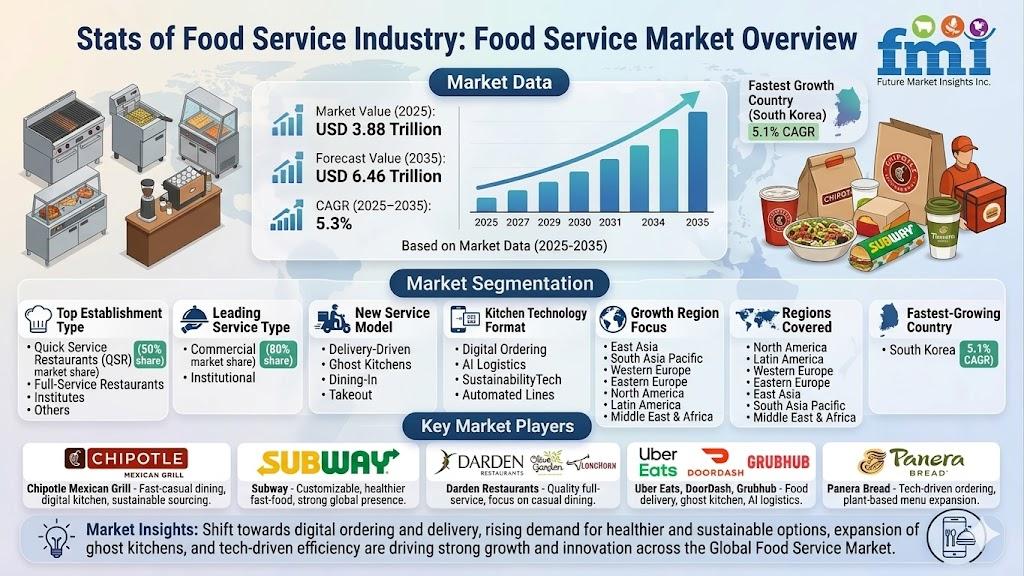
The global food service industry is projected to grow from USD 3.88 trillion in 2025 to USD 6.46 trillion by 2035, registering a CAGR of 5.3% during the forecast period. Growth is fueled by rising urbanization, increasing disposable incomes, and shifting consumer lifestyles that increasingly favor dining out, convenience foods, and food delivery services. The expansion of digital ordering platforms and evolving dining formats is further accelerating industry transformation.
Market Overview & Key Statistics
- The market is valued at USD 3.88 trillion in 2025 and is expected to reach USD 6.46 trillion by 2035, reflecting steady global expansion.
- A CAGR of 5.3% highlights consistent growth supported by evolving consumption patterns.
- Quick Service Restaurants (QSRs) dominate the establishment type segment, accounting for approximately 50% market share in 2025.
- Commercial food service leads by service type, contributing nearly 80% of total market revenue.
- South Korea emerges as a key growth market, projected to expand at a CAGR of 5.1% during the forecast period.
Key Market Segments
- By Establishment Type: Quick Service Restaurants (QSRs) lead, followed by Full-Service Restaurants (FSRs), cafés, and cloud kitchens.
- By Service Type: Commercial dominates, with institutional food services (schools, hospitals, corporate catering) forming a stable segment.
- By Delivery Mode: Dine-in, takeaway, and rapidly growing online delivery channels.
- By Cuisine Type: Includes local/traditional cuisines, international cuisines, and fusion offerings catering to diverse consumer preferences.
Demand Drivers
- Rapid urbanization and busy lifestyles increasing reliance on convenience dining.
- Growth in online food delivery platforms and mobile ordering apps.
- Rising disposable incomes and middle-class expansion, particularly in emerging markets.
- Increasing demand for diverse cuisines, premium dining, and experiential food services.
- Expansion of cloud kitchens and delivery-only business models.
Supply Chain Analysis (Who Supplies Whom)
- Agricultural Producers & Food Suppliers: Provide raw ingredients such as grains, vegetables, meat, and dairy.
- Food Processors & Distributors: Ensure quality, storage, and timely delivery of ingredients.
- Food Service Operators: Include QSR chains, restaurants, cafés, and catering services.
- Technology Providers: Enable online ordering, POS systems, and delivery logistics platforms.
- Delivery Aggregators & Logistics Providers: Bridge the gap between restaurants and consumers.
- End Consumers: Urban households, working professionals, and on-the-go consumers.
Pricing Trends
- Pricing varies widely across QSR, casual dining, and premium segments.
- Value meals and combo offers are widely used to attract price-sensitive consumers.
- Premium and experiential dining formats command higher margins.
- Dynamic pricing and discounts through online platforms and loyalty programs are becoming common.
Competitive Landscape
The global food service industry is highly fragmented, with a mix of multinational chains and regional players competing across formats. Key players include:
- McDonald’s Corporation
- Yum! Brands (KFC, Pizza Hut)
- Starbucks Corporation
- Domino’s Pizza Inc.
- Restaurant Brands International
Competition is driven by menu innovation, pricing strategies, digital integration, and expansion into delivery and cloud kitchen models.
Regional Analysis
- North America: Mature market driven by strong QSR presence and digital ordering adoption.
- Europe: Growth supported by premium dining trends and diverse cuisine offerings.
- Asia Pacific: Fastest-growing region led by rising urban populations, delivery adoption, and expanding middle class.
- Latin America & Middle East & Africa: Emerging regions with increasing investments in organized food service and franchising.
👉 𝐆𝐞𝐭 𝐀𝐜𝐜𝐞𝐬𝐬 𝐭𝐨 𝐭𝐡𝐞 𝐑𝐞𝐩𝐨𝐫𝐭 𝐒𝐚𝐦𝐩𝐥𝐞: https://www.futuremarketinsights.com/reports/sample/rep-gb-15889
Key Trends Shaping the Market
- Surge in online food delivery and app-based ordering ecosystems.
- Growth of cloud kitchens and virtual restaurant brands.
- Rising demand for healthy, organic, and plant-based menu options.
- Integration of AI, data analytics, and automation in operations.
- Increasing focus on sustainability, eco-friendly packaging, and waste reduction.
Risks & Challenges
- Rising food and labor costs impacting profit margins.
- Intense competition leading to price wars and customer retention challenges.
- Regulatory compliance and food safety standards across regions.
- Supply chain disruptions affecting ingredient availability and pricing.
Investment Opportunities & Future Outlook
- Expansion opportunities in Asia Pacific and emerging economies.
- Growth in delivery-first models and cloud kitchens.
- Investment in technology-driven operations and automation.
- Increasing partnerships with delivery platforms and digital ecosystems.
Looking ahead, the food service industry will continue to evolve as a convenience-driven, technology-enabled ecosystem. Businesses that adapt to digital transformation, consumer preferences, and sustainability demands will be best positioned to capitalize on long-term growth opportunities.
Contact Us
Future Market Insights Inc.
Christiana Corporate, 200 Continental Drive,
Suite 401, Newark, Delaware - 19713, USA
T: +1-347-918-3531
For Sales Enquiries: sales@futuremarketinsights.com

 English
 Arabic
 French
 Spanish
 Portuguese
 Deutsch
 Turkish
 Italiano
 Russian
 Romaian
 Portuguese (Brazil)
 Greek
Greek