


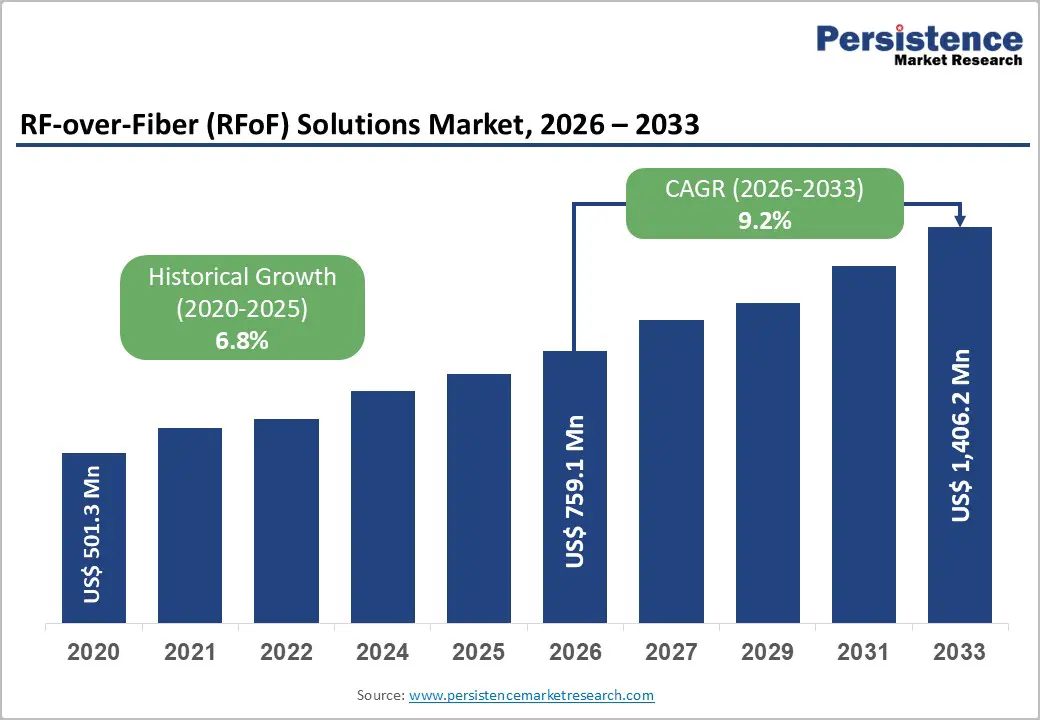
The global RF-over-Fiber (RFoF) solutions market is entering a transformative phase, fueled by the exponential growth of high-frequency communication systems and the rapid evolution of next-generation network infrastructure. Valued at approximately US$ 759.1 million in 2026, the market is projected to reach US$ 1,406.2 million by 2033, expanding at a CAGR of 9.2% during the forecast period.
This growth trajectory is closely linked to the accelerating deployment of 5G networks and early-stage 6G developments, both of which demand ultra-low latency, high bandwidth, and long-distance signal transmission capabilities. RFoF technology, which enables radio frequency signals to be transmitted over optical fiber, is emerging as a critical enabler in this evolving connectivity landscape.
Understanding RF-over-Fiber Technology
RF-over-Fiber technology involves converting RF signals into optical signals, transmitting them through fiber optic cables, and reconverting them back into RF signals at the receiving end. This approach offers several advantages over traditional coaxial cable systems, including:
- Minimal signal loss over long distances
- Immunity to electromagnetic interference (EMI)
- Enhanced bandwidth capacity
- Reduced weight and maintenance requirements
As wireless communication systems continue to operate at higher frequencies—especially in millimeter-wave bands—traditional copper-based transmission mediums struggle to keep up. RFoF addresses these limitations, making it a preferred solution across telecommunications, defense, aerospace, and satellite communication sectors.
Market Drivers
Rising Demand for High Bandwidth and Low Latency
The increasing consumption of data, driven by video streaming, cloud computing, and IoT applications, is placing immense pressure on existing network infrastructure. RFoF solutions offer the bandwidth and low latency required to support these demands, particularly in dense urban environments and high-traffic networks.
In addition, 5G and future 6G networks rely heavily on distributed antenna systems (DAS) and centralized radio access network (C-RAN) architectures. RFoF enables seamless signal transmission between remote radio heads and centralized processing units, ensuring efficient network performance.
Immunity to Electromagnetic Interference (EMI)
One of the most significant advantages of RFoF technology is its immunity to electromagnetic interference. In environments such as military operations, industrial facilities, and densely populated urban areas, EMI can severely disrupt signal integrity.
Optical fiber, being non-conductive, eliminates this issue, ensuring stable and secure communication. This feature is particularly valuable in defense and aerospace applications, where reliability is critical.
Growth in Defense and Aerospace Modernization
Governments worldwide are investing heavily in modernizing defense and aerospace systems. RFoF technology plays a crucial role in these upgrades, enabling high-performance communication in challenging environments.
Applications include:
- Electronic warfare systems
- Radar and surveillance systems
- Satellite communication networks
- Naval and airborne communication platforms
The ability of RFoF systems to maintain signal integrity under extreme conditions makes them indispensable in these sectors.
Market Restraints
High Initial Investment and Deployment Costs
Despite its advantages, RFoF technology requires significant upfront investment. Deploying fiber optic infrastructure, particularly in rural or remote areas, can be capital-intensive.
Additionally, system integration involves specialized expertise and extensive testing, further increasing costs. For small and medium-sized enterprises (SMEs), these factors can be a barrier to adoption.
Technical Complexity and Integration Challenges
RFoF systems must address several technical challenges, including:
- Chromatic dispersion
- Temperature-induced phase shifts
- Signal degradation in multimode fibers
Moreover, integrating RFoF solutions with existing legacy systems can be complex, requiring custom engineering and compatibility adjustments. These challenges can slow down deployment timelines and limit scalability.
Emerging Opportunities
Expansion of AI-Driven Data Centers
The rapid growth of artificial intelligence and machine learning is driving demand for high-performance data centers. These facilities require low-latency, high-bandwidth interconnects to support intensive computational workloads.
RFoF solutions enable efficient signal transmission across distributed data center architectures, making them ideal for AI-driven environments. As hyperscale data centers continue to expand globally, the demand for RFoF technology is expected to rise significantly.
Adoption of C-RAN and Open RAN Architectures
Telecom operators are increasingly transitioning to centralized RAN (C-RAN) architectures, which centralize baseband processing and connect remote radio units via fiber.
RFoF plays a key role in this architecture by enabling high-fidelity RF signal transmission over fiber links. Additionally, the adoption of Open RAN standards is promoting interoperability and reducing costs, further accelerating RFoF deployment.
Segment Analysis
By Component
RFoF transceiver modules dominate the market, accounting for over 46% of the share in 2026. These modules integrate optical and RF functionalities, simplifying system design and reducing equipment requirements.
Meanwhile, RFoF links are emerging as the fastest-growing segment, driven by the need for long-distance, low-loss signal transmission in telecom and satellite applications.
By Frequency Band
The 3 GHz to 8 GHz band leads the market with more than 36% share, supported by its widespread use in 5G mid-band deployments and radar systems.
However, frequencies above 18 GHz are witnessing the fastest growth, with a CAGR of 14.7%, driven by advanced satellite communications and defense applications requiring ultra-wide bandwidth.
By Application
Cellular fronthaul and backhaul represent the largest application segment, accounting for over 32% of the market in 2026. The increasing demand for high-speed mobile data and network densification is driving this segment.
On the other hand, commercial satellite ground stations are expected to grow at the fastest rate. The rise of low-Earth orbit (LEO) satellite constellations and multi-beam antenna systems is creating significant demand for RFoF solutions.
Regional Insights
North America
North America leads the global RFoF market, holding over 35% market share in 2026. The region benefits from:
- Extensive 5G deployment
- High telecom capital expenditure
- Strong defense and aerospace sectors
Major metropolitan areas have already implemented RFoF-enabled architectures, supported by investments from leading telecom operators and government initiatives.
Asia Pacific
Asia Pacific is the fastest-growing region, with a projected CAGR of 14.8%. Key growth drivers include:
- Rapid 5G rollout in countries like China and India
- Expanding fiber optic infrastructure
- Increasing defense and satellite communication investments
India, in particular, presents significant growth opportunities due to large-scale fiber deployment programs and rising demand for high-speed connectivity.
Europe
Europe holds a substantial market share, driven by:
- Advanced telecommunications infrastructure
- Regulatory support for fiber-based networks
- Strong presence of defense and aerospace programs
Countries such as Germany, the UK, and France are leading the adoption of RFoF technology, particularly in C-RAN deployments and secure communication systems.
Competitive Landscape
The RFoF solutions market is moderately fragmented, with a mix of specialized technology providers and established photonics companies. Key players focus on:
- High-performance, low-latency solutions
- Customization for specific applications
- Ruggedized designs for harsh environments
- Integration with existing RF and optical systems
Strategic partnerships, product innovation, and long-term contracts are common strategies used to gain a competitive edge.
Key Industry Developments
Recent developments highlight the growing importance of RFoF technology:
- A strategic partnership between Hytech Associates and RFOptic aims to expand the reach of RFoF solutions across telecom and industrial applications.
- RFOptic has introduced advanced RFoF product series designed for electronic warfare and next-generation wireless testing, supporting frequencies up to 18 GHz.
These developments underscore the increasing demand for high-performance RF transmission solutions in both commercial and defense sectors.
Future Outlook
The future of the RF-over-Fiber solutions market looks promising, driven by several key trends:
- Continued expansion of 5G and early adoption of 6G technologies
- Growth in satellite communication networks, particularly LEO constellations
- Increasing demand for high-speed, low-latency data transmission
- Rising investments in defense and aerospace modernization
As networks become more complex and data-intensive, the need for reliable and high-capacity communication solutions will continue to grow. RFoF technology is well-positioned to meet these demands, offering a scalable and future-proof solution.
Conclusion
The RF-over-Fiber (RFoF) solutions market is poised for significant growth in the coming years, driven by advancements in telecommunications, defense, and data center infrastructure. Its ability to deliver high-bandwidth, low-latency, and interference-free communication makes it a critical technology in the digital age.
While challenges such as high deployment costs and technical complexity remain, ongoing innovations and increasing adoption across industries are expected to overcome these barriers. As the world moves toward a more connected and data-driven future, RFoF solutions will play a pivotal role in enabling next-generation communication networks.

 Arabic
 French
 Spanish
 Portuguese
 Deutsch
 Turkish
 Dutch
Dutch
 Italiano
 Russian
 Romaian
 Portuguese (Brazil)
 Greek
Greek