


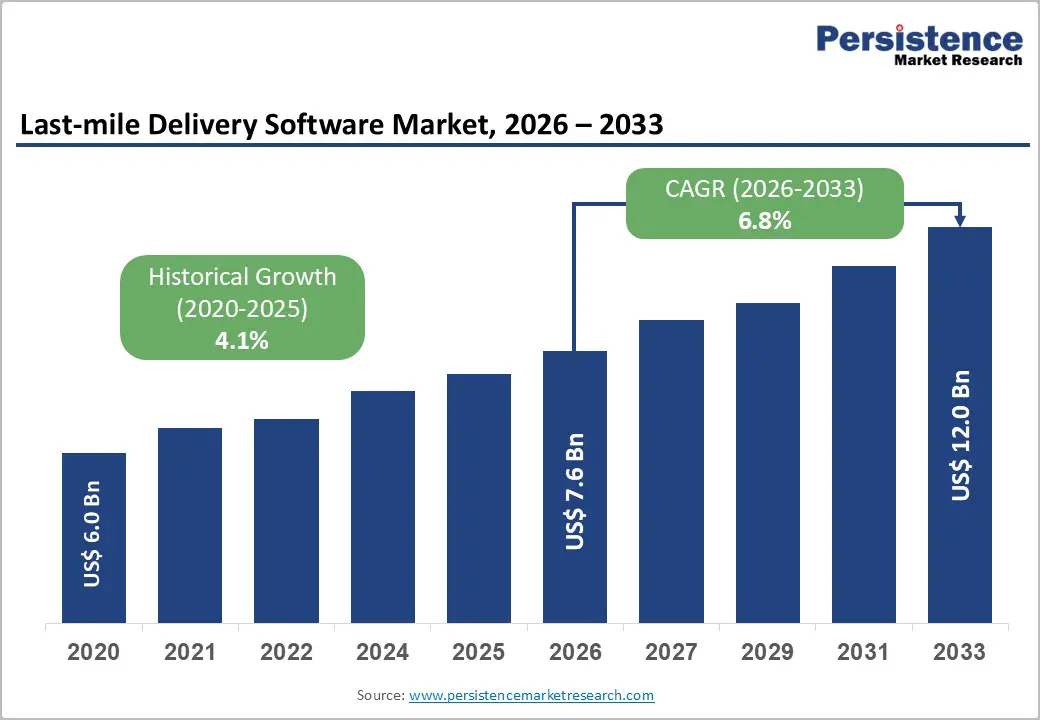
The global last-mile delivery software market is entering a phase of sustained growth, driven by the explosive rise of e-commerce and evolving consumer expectations. Valued at US$ 7.6 billion in 2026, the market is projected to reach US$ 12.0 billion by 2033, expanding at a CAGR of 6.8%. What was once a logistical afterthought—the final step of delivery—is now the most critical and complex segment of the supply chain.
As companies race to meet same-day and next-day delivery demands, last-mile delivery software has become a strategic necessity rather than a luxury. From route optimization to real-time tracking and automated dispatching, these solutions are transforming how goods reach consumers across the globe.
Understanding Last-mile Delivery Software
Last-mile delivery software refers to digital platforms designed to optimize the final stage of the delivery process—from a distribution center to the customer’s doorstep. These systems integrate multiple capabilities, including route planning, fleet management, driver tracking, customer notifications, and performance analytics.
With the rapid digitization of logistics, businesses are increasingly relying on intelligent software solutions to handle rising delivery volumes, minimize costs, and enhance customer satisfaction.
Key Market Highlights
The market presents a compelling mix of maturity and growth opportunities across regions and segments:
- North America leads with a 41% market share, driven by advanced logistics infrastructure and high technology adoption.
- Asia Pacific is the fastest-growing region, with a CAGR of 8.3%, fueled by urbanization and e-commerce expansion.
- Cloud-based solutions dominate, accounting for around 55% of the market due to scalability and cost efficiency.
- Courier, express, and parcel services are among the fastest-growing application segments.
- Integration with automation technologies such as robots and autonomous vehicles presents a major growth opportunity.
Market Dynamics
Drivers: E-commerce Boom and Rising Delivery Expectations
The rapid growth of online shopping has fundamentally reshaped last-mile logistics. Companies like Amazon.com, Inc. have set new benchmarks for delivery speed, pushing logistics providers to adopt advanced digital tools.
Consumers today expect:
- Real-time tracking updates
- Flexible delivery windows
- Faster shipping options
To meet these expectations, businesses are investing heavily in delivery software that enables dynamic routing, predictive analytics, and seamless communication.
Across Europe, countries such as Germany, the United Kingdom, France, and Spain are witnessing strong growth in online retail. This surge is driving widespread adoption of delivery management platforms that can handle complex logistics networks efficiently.
Drivers: Digital Transformation of Logistics Operations
The logistics industry is undergoing a major transformation, with companies embracing cloud computing, automation, and data analytics.
Technology leaders like Oracle Corporation, Microsoft Corporation, and SAP SE are offering cloud-based platforms that provide:
- End-to-end supply chain visibility
- AI-driven route optimization
- Predictive demand forecasting
In Asia Pacific, countries such as China, Japan, and India are investing in smart warehouses and automated fulfillment systems, further boosting demand for integrated delivery software solutions.
Restraints: High Implementation and Integration Costs
Despite strong growth prospects, the market faces notable challenges—particularly for small and medium-sized businesses (SMEs).
Implementing last-mile delivery software often involves:
- Integration with legacy ERP and warehouse systems
- Infrastructure upgrades
- Staff training and workflow redesign
These factors significantly increase the total cost of ownership, making it difficult for smaller players to adopt advanced solutions.
In developing regions, many logistics providers still rely on manual planning methods due to budget constraints, slowing overall market penetration.
Restraints: Data Security and Compliance Concerns
As delivery platforms become increasingly cloud-based, concerns around data privacy and cybersecurity are growing.
Delivery software handles sensitive information such as:
- Customer addresses
- Payment details
- Route and operational data
Strict regulations, especially in Europe, require companies to invest heavily in secure infrastructure and compliance systems. This adds complexity and cost, particularly for organizations operating in regulated sectors like healthcare and finance.
Opportunities Shaping the Future
Rise of SaaS-based Delivery Platforms
Cloud-based Software-as-a-Service (SaaS) solutions are rapidly replacing traditional on-premise systems. These platforms offer:
- Lower upfront costs
- Scalability for fluctuating demand
- Easy integration with existing systems
Companies like Oracle Corporation, Microsoft Corporation, and SAP SE are leading this transition by providing flexible, subscription-based solutions.
As internet infrastructure improves globally, SaaS platforms are expected to become the dominant deployment model, especially among mid-sized enterprises.
Integration with Autonomous and Robotic Delivery Systems
The next frontier in last-mile delivery lies in automation. Companies such as Locus Robotics Corp. and Uber Technologies, Inc. are pioneering solutions that combine robotics with intelligent software.
Emerging technologies include:
- Autonomous delivery vehicles
- Delivery drones
- Warehouse robots
These innovations rely heavily on advanced software for navigation, scheduling, and coordination. As adoption grows, last-mile delivery platforms will play a central role in enabling smart logistics ecosystems.
Category-wise Analysis
Software Insights: Cloud-based Solutions Lead the Market
Cloud-based delivery software dominates the market, accounting for approximately 55% of the total share. Its popularity stems from:
- Real-time accessibility
- Automatic updates
- Reduced IT infrastructure costs
Businesses with fluctuating delivery volumes—such as e-commerce retailers and courier companies—find cloud solutions particularly beneficial.
In North America and Europe, companies are rapidly shifting from on-premise systems to cloud platforms to improve agility and efficiency.
Application Insights: E-commerce as the Core Growth Engine
The e-commerce segment holds the largest share of the market, contributing around 35% by 2025.
Retail giants like Amazon.com, Inc. have redefined customer expectations, making delivery speed and transparency critical competitive factors.
Delivery software enables e-commerce companies to:
- Manage high order volumes
- Optimize delivery routes
- Provide real-time customer updates
As online shopping continues to expand globally, this segment will remain the primary driver of market growth.
Regional Insights
North America: A Mature and Technology-driven Market
North America remains the largest market for last-mile delivery software, led by the United States.
Key factors driving growth include:
- Advanced logistics infrastructure
- High e-commerce penetration
- Strong presence of technology providers
Companies like Amazon.com, Inc. and Walmart are investing heavily in logistics innovation, while software providers such as Oracle Corporation, Microsoft Corporation, and SAP SE continue to enhance platform capabilities.
Europe: Sustainability and Regulation Driving Adoption
Europe’s market is shaped by strict environmental regulations and a strong focus on sustainability.
Logistics providers are using delivery software to:
- Optimize routes and reduce fuel consumption
- Track carbon emissions
- Comply with regulatory requirements
Countries like Germany, the U.K., France, and Spain are leading adoption, supported by smart-city initiatives and growing demand for eco-friendly delivery solutions.
Asia Pacific: The Fastest-growing Market
Asia Pacific is emerging as the most dynamic region, driven by rapid urbanization and digital transformation.
Key growth drivers include:
- Expanding e-commerce markets in China and India
- Rising disposable incomes
- Government-led digital infrastructure initiatives
In Southeast Asia, countries such as Vietnam, Thailand, and Indonesia are investing in modern logistics networks, creating new opportunities for cloud-based delivery software providers.
Competitive Landscape
The last-mile delivery software market is moderately consolidated, with a mix of global giants and specialized players.
Leading companies include:
- Oracle Corporation
- Microsoft Corporation
- SAP SE
- Amazon.com, Inc.
- Uber Technologies, Inc.
These companies are focusing on:
- AI-powered route optimization
- Real-time analytics
- Cloud integration
- Automation readiness
At the same time, niche providers are targeting specialized use cases such as pharmaceutical delivery and hyperlocal logistics.
Recent Industry Developments
The market continues to evolve rapidly, with key players introducing innovative solutions:
- In September 2024, Oracle Corporation launched an AI-powered cloud-based delivery platform with real-time visibility and predictive analytics.
- In March 2025, Locus Robotics Corp. introduced autonomous robots integrated with delivery software to enhance warehouse operations.
- In July 2025, Uber Technologies, Inc. expanded its platform with dynamic routing and automated customer notifications.
These developments highlight the growing convergence of software, automation, and artificial intelligence in last-mile logistics.
Future Outlook
The future of the last-mile delivery software market is closely tied to broader trends in digital transformation and automation.
Key trends to watch include:
- Increased adoption of AI and machine learning
- Expansion of autonomous delivery technologies
- Growing demand for sustainable logistics solutions
- Greater integration across supply chain systems
As businesses continue to prioritize speed, efficiency, and customer experience, last-mile delivery software will become an indispensable component of modern logistics.
Conclusion
The last-mile delivery software market is no longer a niche segment—it is a critical enabler of global commerce. With e-commerce continuing to expand and customer expectations rising, the demand for intelligent, scalable, and efficient delivery solutions will only grow.
While challenges such as high implementation costs and data security concerns persist, the shift toward cloud-based platforms and automation presents significant opportunities.
Companies that invest in advanced delivery technologies today will be better positioned to compete in the fast-evolving logistics landscape of tomorrow.

 English
 Arabic
 French
 Spanish
 Portuguese
 Deutsch
 Dutch
Dutch
 Italiano
 Russian
 Romaian
 Portuguese (Brazil)
 Greek
Greek