


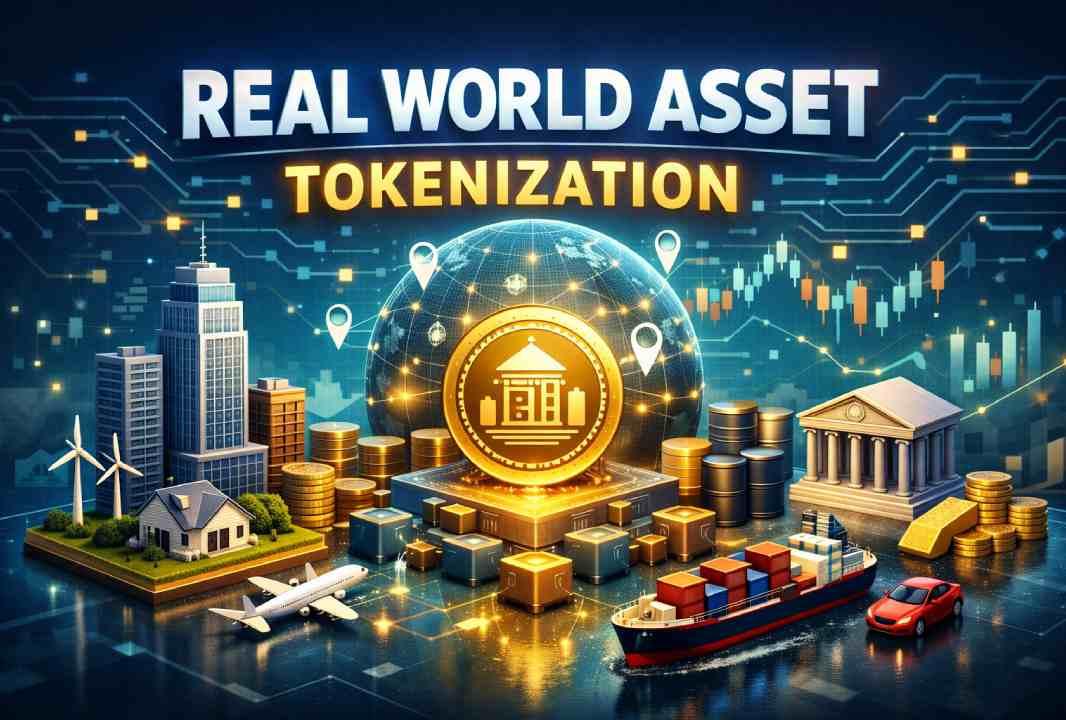
Traditional finance has operated through centralized institutions, lengthy settlement systems, intermediaries, and geographically restricted investment opportunities for decades. Banks, brokerage firms, custodians, clearing houses, and asset managers have long controlled how assets are issued, traded, verified, and transferred. While this structure created stability and regulatory oversight, it also introduced inefficiencies such as limited liquidity, high transaction costs, restricted accessibility, and slow settlement cycles.
Real World Asset (RWA) tokenization is now reshaping this traditional financial structure by bringing physical and traditional financial assets onto blockchain networks. Assets such as real estate, bonds, commodities, treasury bills, private equity, invoices, carbon credits, and fine art can now be represented digitally as blockchain-based tokens. These tokens act as programmable digital representations of ownership, value, or rights tied to real-world assets.
Understanding Real World Asset Tokenization
Real world asset tokenization refers to the process of converting ownership rights of physical or traditional financial assets into digital blockchain tokens. These tokens are stored and transferred on distributed ledger networks while maintaining a direct link to the underlying asset.
The tokenization process generally involves:
- Asset identification and valuation
- Legal structuring and ownership verification
- Smart contract creation
- Digital token issuance
- Compliance and investor onboarding
- Marketplace integration for trading and liquidity
Each token represents a fraction or unit of ownership in the underlying asset. Investors can buy, sell, or transfer these digital tokens similarly to cryptocurrencies while still maintaining exposure to real-world value.
Examples of tokenized assets include:
- Commercial real estate properties
- Government bonds and treasury products
- Precious metals such as gold and silver
- Private credit funds
- Infrastructure assets
- Agricultural commodities
- Intellectual property rights
- Revenue-generating assets
This approach transforms traditionally illiquid assets into digitally transferable financial instruments that can be traded more efficiently.
The Limitations of Traditional Financial Systems
To understand the impact of RWA tokenization, it is important to examine the structural inefficiencies within traditional finance.
Heavy Dependence on Intermediaries
Traditional financial systems rely on multiple intermediaries to process transactions. Banks, brokers, custodians, clearing houses, and settlement institutions each play a role in validating and transferring ownership. This layered structure increases operational complexity and transaction costs. Every intermediary introduces delays, administrative overhead, and reconciliation requirements. Cross-border transactions become even more complicated due to multiple jurisdictional processes and banking systems.
Limited Market Accessibility
Traditional investment markets are often restricted to institutional investors or high-net-worth individuals. Assets such as commercial real estate, private equity, or infrastructure funds usually require significant capital commitments.
Retail investors frequently face barriers such as:
- High minimum investment requirements
- Geographic restrictions
- Limited market access
- Complex legal documentation
- Long settlement timelines
As a result, wealth-building opportunities remain concentrated among larger financial participants.
Illiquid Asset Structures
Many real-world assets are inherently illiquid. Selling a commercial building, private equity stake, or fine art collection may take weeks or months. Liquidity limitations reduce market efficiency and limit investor flexibility. Traditional secondary markets for alternative assets are also fragmented and difficult to access.
Slow Settlement Infrastructure
Conventional financial markets often operate on delayed settlement systems such as T+2 or T+3 cycles. Transactions require reconciliation between multiple parties before ownership officially transfers. These delays increase counterparty risk, operational costs, and capital inefficiencies.
How Tokenization Is Restructuring Traditional Finance
Fractional Ownership Expands Investor Participation
One of the biggest structural changes introduced by tokenization is fractional ownership. Instead of purchasing an entire asset, investors can buy smaller tokenized fractions. For example, a commercial property worth $20 million can be divided into thousands of blockchain tokens. Investors can participate with smaller capital allocations while still gaining exposure to the asset’s value and income generation.
This fundamentally changes investment accessibility by:
- Lowering capital barriers
- Expanding retail participation
- Increasing portfolio diversification
- Opening global investment access
Fractionalization democratizes access to markets previously dominated by institutional investors.
Blockchain-Based Settlement Improves Efficiency
Blockchain infrastructure enables near-instant settlement processes compared to traditional financial rails. Instead of waiting days for transaction verification and reconciliation, smart contracts can automate ownership transfers in real time. This reduces reliance on intermediaries and simplifies transaction processing.
The shift toward blockchain settlement improves:
- Transaction speed
- Transparency
- Auditability
- Capital efficiency
- Operational accuracy
Financial institutions are increasingly exploring tokenized settlement systems to modernize outdated infrastructure.
Smart Contracts Automate Financial Operations
Smart contracts are programmable agreements deployed on blockchain networks. They automatically execute transactions when predefined conditions are met. In traditional finance, processes such as dividend distribution, compliance checks, coupon payments, and asset transfers often require manual coordination between institutions. Tokenization enables these functions to become automated through smart contracts.
Applications include:
- Automated interest payments
- Revenue-sharing distributions
- Compliance verification
- Investor onboarding
- Collateral management
- Loan servicing
Automation reduces administrative costs while improving transparency and operational reliability.
Increased Liquidity for Traditionally Illiquid Assets
Tokenization introduces secondary market opportunities for assets that were previously difficult to trade. Digital asset marketplaces allow investors to trade tokenized ownership stakes more efficiently than traditional over-the-counter systems.
This improves liquidity for:
- Real estate investments
- Private market assets
- Infrastructure projects
- Fine art collections
- Venture capital holdings
Greater liquidity increases investor flexibility while potentially improving asset valuation efficiency.
Global Investment Accessibility
Traditional financial systems often involve geographic restrictions and complex cross-border investment processes. Blockchain-based tokenization removes many of these limitations by enabling global digital participation. Investors from different regions can access tokenized opportunities through blockchain marketplaces, provided regulatory requirements are satisfied.
This global accessibility:
- Expands investor reach
- Enhances capital formation
- Connects emerging markets with global liquidity
- Improves market inclusivity
Tokenization creates a more interconnected financial ecosystem that operates beyond traditional geographic limitations.
The Impact on Major Financial Sectors
Real Estate Finance
Real estate is among the largest sectors being transformed by tokenization. Traditional real estate investments require large capital commitments and involve lengthy legal procedures. Tokenization simplifies ownership structures by digitizing property rights into blockchain-based assets.
Benefits include:
- Fractional property ownership
- Increased liquidity
- Faster property transfers
- Automated rental distributions
- Transparent ownership records
Tokenized real estate platforms are enabling broader participation in commercial and residential property markets.
Bond and Fixed-Income Markets
Government bonds and corporate debt instruments are also entering blockchain ecosystems.
Tokenized bonds can improve efficiency through:
- Automated coupon payments
- Faster settlement
- Reduced issuance costs
- Improved transparency
- Enhanced investor accessibility
Central banks and financial institutions are increasingly experimenting with blockchain-based debt issuance models.
Private Equity and Venture Capital
Private equity investments have traditionally been difficult for retail investors to access due to high entry requirements and illiquid structures. Tokenization allows private market assets to be fractionalized and traded digitally. This expands participation opportunities while increasing liquidity options for investors. Blockchain infrastructure may also simplify fund administration and compliance management.
Commodity Markets
Gold, oil, agricultural products, and other commodities are being tokenized to improve trading efficiency and accessibility.
Tokenized commodities provide:
- Transparent ownership verification
- Simplified storage representation
- Faster global trading
- Fractional commodity investment exposure
This approach modernizes commodity trading while improving accessibility for smaller investors.
Institutional Adoption of Tokenized Finance
Major financial institutions are increasingly exploring tokenization infrastructure. Banks, asset managers, and investment firms recognize the potential for blockchain systems to improve operational efficiency and reduce settlement friction.
Institutional interest is growing because tokenization can:
- Lower operational costs
- Improve asset mobility
- Increase market efficiency
- Expand revenue opportunities
- Enable programmable finance models
Several global institutions are actively developing digital asset custody solutions, tokenized securities platforms, and blockchain settlement networks. This institutional involvement is accelerating the integration of blockchain technology into mainstream financial systems.
The Relationship Between Traditional Finance and DeFi
Real world asset tokenization is also bridging traditional finance with decentralized finance (DeFi). DeFi protocols originally focused primarily on crypto-native assets. However, tokenized RWAs are introducing real-world value into decentralized ecosystems.
Examples include:
- Tokenized treasury products used as collateral
- Real estate-backed lending platforms
- Yield-bearing tokenized bonds
- Commodity-backed stable assets
This integration expands the utility of decentralized financial systems while connecting blockchain infrastructure to traditional capital markets. As a result, tokenized RWAs are becoming a foundational layer between centralized finance and decentralized financial ecosystems.
Regulatory Evolution and Compliance
Regulation remains one of the most important components of tokenized finance. Since tokenized assets often represent securities or ownership rights, compliance frameworks are critical for legal adoption.
Governments and regulatory bodies are increasingly developing frameworks for:
- Digital securities issuance
- Investor protection
- KYC and AML compliance
- Custody standards
- Cross-border digital asset trading
Compliance-focused tokenization platforms are implementing programmable regulations directly into smart contracts.
This allows:
- Automated investor eligibility checks
- Jurisdictional compliance enforcement
- Transfer restrictions
- Identity verification integration
Regulatory clarity is expected to accelerate institutional confidence and broader adoption.
Challenges Slowing Mass Adoption
Despite its potential, tokenization still faces several structural and regulatory challenges.
Regulatory Uncertainty
Different jurisdictions maintain varying rules regarding digital assets and tokenized securities. Global regulatory fragmentation complicates international adoption.
Technical Infrastructure Limitations
Scalability, interoperability, and blockchain security remain ongoing challenges. Institutional-grade infrastructure is still evolving.
Custody and Asset Verification
Ensuring secure custody of both digital tokens and underlying physical assets requires trusted verification systems.
Market Education
Traditional investors and institutions may require time to understand blockchain systems, smart contracts, and tokenized asset structures.
Liquidity Development
Although tokenization improves liquidity potential, mature secondary markets are still developing in many sectors.
The Future of Tokenized Finance
The long-term impact of real world asset tokenization could fundamentally reshape the global financial system.
Future developments may include:
- Fully tokenized securities exchanges
- Blockchain-based settlement networks
- Tokenized government debt systems
- Cross-border programmable finance ecosystems
- Integrated digital identity verification systems
- AI-driven tokenized asset management platforms
As blockchain infrastructure matures, financial markets may become increasingly digital, automated, and interconnected. Tokenization may eventually reduce the distinction between traditional finance and blockchain finance altogether.
How Tokenization Could Redefine Ownership Models
Beyond improving efficiency, tokenization is changing how ownership itself is structured. Traditional ownership systems are often rigid, paper-based, and geographically restricted. Tokenization introduces programmable and divisible ownership frameworks that are more flexible.
This could lead to:
- Shared ownership economies
- Community-funded infrastructure
- Decentralized investment syndicates
- Borderless capital participation
- Programmable revenue-sharing ecosystems
Digital ownership models may become increasingly integrated into future financial systems across industries.
Conclusion
Real world asset tokenization is transforming traditional finance by introducing blockchain-based efficiency, accessibility, liquidity, and automation into legacy financial systems. Through fractional ownership, smart contract automation, global investment participation, and programmable compliance, tokenization is modernizing how assets are issued, traded, and managed.
Traditional finance has historically relied on intermediaries, delayed settlements, and geographically restricted investment structures. Tokenization challenges these limitations by enabling digitally transferable ownership models that operate on transparent and decentralized infrastructure.

 English
 Arabic
 French
 Portuguese
 Deutsch
 Turkish
 Dutch
Dutch
 Italiano
 Russian
 Romaian
 Portuguese (Brazil)
 Greek
Greek