


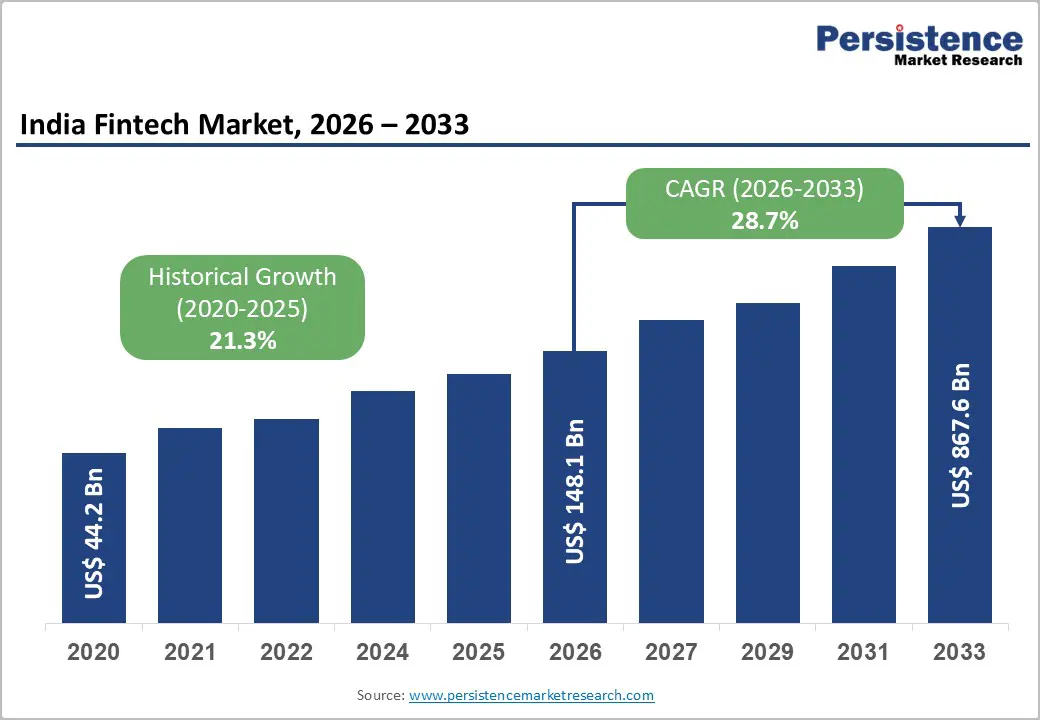
The India fintech ecosystem is undergoing a transformational shift, driven by rapid digitization, rising smartphone usage, government-backed financial inclusion programs, and a growing appetite for seamless digital financial services. The India fintech market is projected to grow from US$148.1 billion in 2026 to an impressive US$867.6 billion by 2033, expanding at a remarkable CAGR of 28.7% during the forecast period.
India has emerged as one of the world’s fastest-growing fintech hubs, fueled by innovations in digital payments, AI-powered lending, embedded finance, blockchain solutions, and mobile-first banking experiences. The widespread adoption of Unified Payments Interface (UPI), increasing penetration of internet connectivity, and the rapid expansion of micro, small, and medium enterprises (MSMEs) are accelerating market momentum.
The fintech revolution is no longer limited to urban consumers. Tier-2 and Tier-3 cities are increasingly becoming important growth centers as digital literacy improves and affordable internet access expands across rural India. Consumers today demand instant, secure, and user-friendly financial solutions, creating enormous opportunities for fintech companies, banks, and NBFCs.
Rapid Growth of Digital Payments and UPI Ecosystem
Digital payments remain the largest segment in the India fintech market, accounting for more than 39% market share in 2026 and generating over US$57.8 billion in revenue. The explosive rise of UPI has fundamentally transformed how consumers and businesses conduct transactions.
UPI has become the backbone of India’s digital economy by enabling instant, real-time, and low-cost transactions between individuals and merchants. The integration of UPI with mobile apps and QR-based payment systems has significantly improved convenience and accessibility. Consumers increasingly rely on digital payment platforms for utility bills, online shopping, peer-to-peer transfers, subscriptions, and in-store purchases.
The rise in smartphone penetration and affordable mobile data has further strengthened digital payment adoption. Merchants across urban and rural markets are embracing QR code-based payment systems to reduce dependency on cash transactions. Small retailers, street vendors, and service providers now widely accept digital payments, improving transparency and transaction efficiency.
The increasing popularity of contactless payments, mobile wallets, and embedded payment solutions is also reshaping consumer behavior. As e-commerce and quick-commerce platforms continue expanding, digital payment volumes are expected to witness exponential growth over the next decade.
AI and Machine Learning Transforming Financial Services
Artificial Intelligence (AI) and Machine Learning (ML) represent the dominant technology segment in the India fintech market, capturing over 36% market share in 2026 and contributing more than US$53.3 billion in value.
AI-driven financial services are revolutionizing how fintech platforms operate by improving fraud detection, customer service, credit scoring, and risk management. Financial institutions increasingly rely on AI-powered systems to analyze customer behavior, predict risks, and deliver personalized financial products.
Chatbots and virtual assistants powered by AI are enhancing customer experiences by offering 24/7 support and faster query resolution. Machine learning algorithms enable fintech companies to process vast volumes of transaction data in real time, improving operational efficiency and reducing fraud risks.
Automated credit scoring models are particularly important in expanding financial inclusion. Traditional credit evaluation systems often fail to assess borrowers without formal credit histories. AI-based lending platforms use alternative datasets, including transaction histories and digital behavior, to evaluate creditworthiness more accurately.
Personalized wealth management and robo-advisory services are also gaining traction among young investors seeking affordable and accessible financial planning tools. AI continues to improve investment recommendations, portfolio management, and customer engagement strategies.
Expansion of Digital Lending and Instant Credit Access
Digital lending has emerged as the fastest-growing segment in the India fintech market. Consumers and MSMEs increasingly demand quick and convenient access to credit without lengthy documentation or approval processes.
Fintech lenders are leveraging digital platforms to offer instant personal loans, buy-now-pay-later (BNPL) services, merchant financing, and working capital loans. The growth of UPI-based transaction data and alternative credit assessment models has significantly improved lending efficiency.
MSMEs, which form the backbone of India’s economy, often struggle to secure financing from traditional banks due to strict collateral requirements and complex approval procedures. Fintech companies are bridging this gap by offering flexible loan products tailored to business needs.
PoS terminal-based lending is gaining strong momentum across retail and merchant ecosystems. Businesses can now access instant credit directly through payment terminals based on transaction volumes and repayment histories. This approach reduces friction in credit access and improves financial inclusion for small merchants.
Co-lending partnerships between fintech firms and traditional banks are also transforming the lending landscape. Under these models, banks provide capital while fintech companies handle customer acquisition, underwriting, and digital servicing. This collaboration improves loan disbursement speed while minimizing risk exposure.
Blockchain Technology Creating New Opportunities
Blockchain is expected to witness the fastest growth among fintech technologies, expanding at a CAGR of 33.5% during the forecast period. The technology is gaining traction due to its ability to enhance security, transparency, and operational efficiency.
As digital payments and cross-border transactions increase, blockchain offers a secure framework for faster settlement and fraud prevention. Financial institutions are exploring blockchain applications for remittances, smart contracts, digital identity verification, and decentralized finance solutions.
The decentralized nature of blockchain improves trust in peer-to-peer lending and digital transactions while reducing reliance on intermediaries. It also enhances traceability and auditability, helping fintech companies meet regulatory compliance requirements more effectively.
Cross-border payment systems powered by blockchain are particularly attractive for reducing transaction costs and settlement delays. As India continues strengthening its digital economy infrastructure, blockchain integration is expected to accelerate across banking, insurance, and investment platforms.
Role of Banks and NBFCs in Fintech Expansion
Banks remain the leading end-users in the India fintech market, accounting for more than 34% market share in 2026 with a valuation exceeding US$50.4 billion.
Traditional banks are rapidly digitizing their services to meet changing customer expectations. Mobile banking apps, digital onboarding, AI-driven customer support, and embedded finance offerings are helping banks remain competitive in the evolving financial ecosystem.
Consumers increasingly prefer integrated digital banking experiences that combine payments, investments, insurance, and lending services within a single platform. Banks are leveraging fintech partnerships to enhance service delivery and improve operational agility.
Meanwhile, non-banking financial companies (NBFCs) are emerging as the fastest-growing end-user segment. NBFCs play a critical role in serving underbanked populations and small businesses that may not qualify for conventional bank loans.
Their ability to offer instant approvals, flexible repayment options, and tech-enabled financial solutions has positioned NBFCs as major drivers of financial inclusion. Many fintech NBFCs focus on niche lending categories such as MSME loans, BNPL solutions, consumer finance, and rural credit services.
Financial Inclusion Driving Market Growth
Financial inclusion remains one of the strongest growth drivers for the India fintech market. Millions of consumers and small businesses in rural and semi-urban regions still lack access to formal banking and credit services.
Fintech platforms are helping bridge this gap by delivering affordable and accessible financial solutions through smartphones and digital channels. Government initiatives promoting digital payments, Jan Dhan accounts, Aadhaar integration, and Direct Benefit Transfers (DBTs) have significantly strengthened the financial inclusion ecosystem.
The rise of embedded finance is further expanding access to financial products. Embedded finance integrates lending, insurance, and payment solutions directly into non-financial platforms such as e-commerce apps, ride-hailing services, and logistics platforms.
This seamless integration improves customer convenience while enabling fintech companies to reach previously underserved user segments. The increasing adoption of embedded financial services across multiple industries is expected to unlock substantial growth opportunities over the coming years.
Challenges Facing the India Fintech Industry
Despite strong growth prospects, the India fintech market faces several challenges related to regulation, compliance, cybersecurity, and competition.
Regulatory uncertainty remains a major concern for fintech companies. Proposed market share caps on UPI transactions and evolving compliance requirements can affect operational planning and investment strategies. Companies must comply with multiple frameworks, including Reserve Bank of India (RBI) guidelines, data privacy regulations, and cybersecurity mandates.
Cybersecurity threats are also increasing as digital financial transactions grow rapidly. Fintech platforms handle massive volumes of sensitive financial and personal data, making them attractive targets for cyberattacks and fraud.
Maintaining customer trust requires continuous investment in cybersecurity infrastructure, fraud detection systems, and secure data management practices. Companies must also ensure transparency in how user data is collected, stored, and utilized.
Intense competition within the fintech ecosystem is another challenge. Established payment giants, emerging startups, banks, and global technology firms are all competing for market share, driving pressure on profitability and customer acquisition costs.
Competitive Landscape and Key Players
The India fintech market features a moderately consolidated competitive structure with strong participation from both established leaders and innovative startups.
Major fintech companies are focusing on customer-centric digital experiences, AI integration, and strategic partnerships to strengthen their market positions. Payment leaders dominate transaction volumes, while lending platforms and wealth-tech providers continue expanding rapidly.
Key companies operating in the India fintech market include:
Recent industry developments indicate strong innovation momentum. Payment aggregators, AI-driven financial solutions, buyer protection programs, and embedded finance services are becoming central to competitive differentiation.
Future Outlook
The future of the India fintech market looks exceptionally promising as digital transformation continues reshaping the country’s financial ecosystem. The convergence of AI, blockchain, embedded finance, and digital lending is creating new opportunities for innovation and financial accessibility.
Growing smartphone adoption, expanding internet penetration, supportive government initiatives, and rising consumer confidence in digital transactions will continue driving fintech adoption across India. Tier-2 and Tier-3 cities are expected to emerge as key growth engines as fintech companies deepen their regional presence.
Financial institutions that prioritize customer experience, cybersecurity, AI integration, and regulatory compliance will be best positioned to capitalize on future opportunities. As the ecosystem matures, strategic collaborations between banks, NBFCs, and fintech startups will further accelerate innovation and market expansion.
With the market projected to reach US$867.6 billion by 2033, India is set to become one of the most influential fintech markets globally, shaping the future of digital finance and financial inclusion.

 English
 Arabic
 French
 Spanish
 Portuguese
 Turkish
 Dutch
Dutch
 Italiano
 Russian
 Romaian
 Portuguese (Brazil)
 Greek
Greek