


The rapid expansion of artificial intelligence (AI), machine learning (ML), cloud computing, and edge infrastructure is fundamentally transforming how modern data centers operate. Traditional server architectures, built around fixed combinations of compute, storage, and networking resources, are increasingly unable to meet the dynamic demands of next-generation workloads. This challenge is accelerating the adoption of composable disaggregated infrastructure (CDI), a flexible and software-defined approach that allows organizations to dynamically allocate hardware resources based on workload requirements.
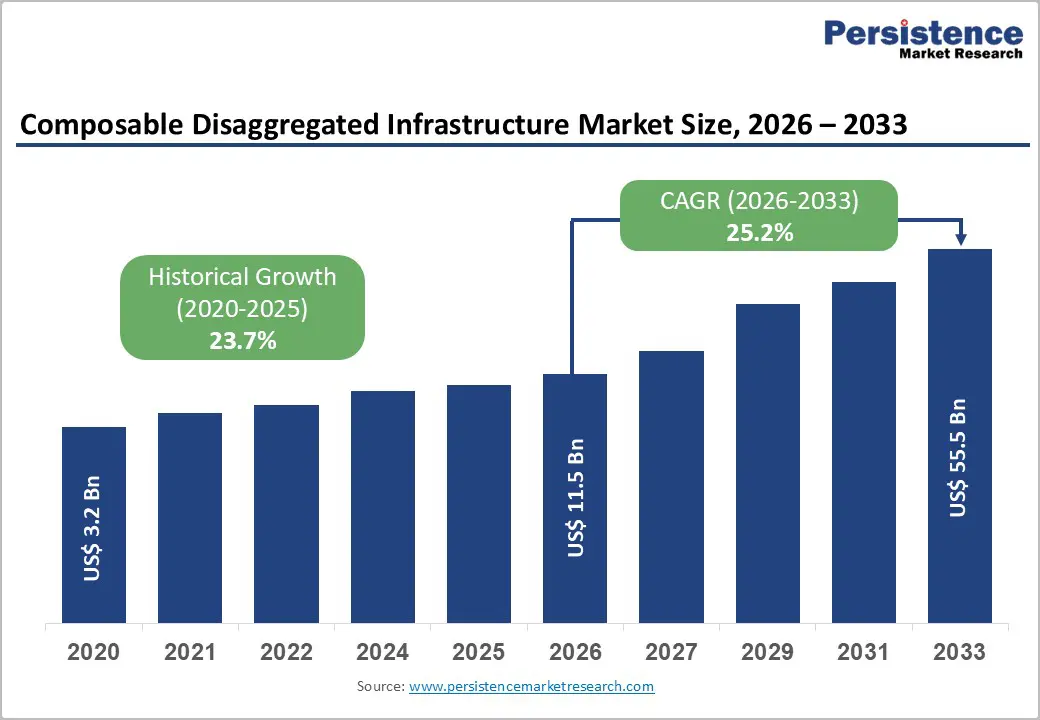
The global composable disaggregated infrastructure market is expected to reach US$ 11.5 billion in 2026 and is projected to grow to US$ 55.5 billion by 2033, expanding at a remarkable CAGR of 25.2% between 2026 and 2033. The market’s growth is being fueled by increasing demand for scalable, energy-efficient, and highly automated IT environments capable of supporting AI training, cloud-native applications, and edge computing ecosystems.
Composable disaggregated infrastructure enables enterprises and hyperscalers to pool compute, storage, memory, and networking resources into shared resource fabrics that can be dynamically configured through software. This approach dramatically improves infrastructure utilization, reduces hardware waste, and supports highly agile operations.
Understanding Composable Disaggregated Infrastructure
Composable disaggregated infrastructure separates hardware resources from traditional monolithic servers and transforms them into software-managed pools. These pools can then be assembled and reassembled in real time depending on application needs.
Unlike conventional architectures where compute and storage remain permanently tied together, CDI enables organizations to provision resources independently. Through API-driven orchestration and Infrastructure-as-Code (IaC), workloads can instantly access the exact amount of processing power, memory, or storage required.
This architecture is especially valuable in environments with fluctuating or unpredictable workloads, such as:
- AI and ML model training
- Hyperscale cloud computing
- Edge computing deployments
- High-performance computing (HPC)
- Big data analytics
- Telecommunications infrastructure
The increasing adoption of Kubernetes, containerization, and software-defined infrastructure further strengthens the role of CDI in modern enterprise environments.
Market Drivers
Rising AI and Machine Learning Workloads
One of the strongest growth drivers for the composable disaggregated infrastructure market is the explosion of AI and machine learning applications. Modern AI training workloads require massive compute power, GPU acceleration, and low-latency networking.
Traditional static infrastructure often leads to overprovisioning, where expensive GPUs and servers remain underutilized. Composable infrastructure solves this issue by allowing resources to be dynamically allocated only when required.
GPU disaggregation is becoming increasingly important in AI environments because it enables multiple workloads to share expensive accelerator hardware efficiently. Enterprises can scale GPU resources dynamically without purchasing excessive dedicated systems.
As organizations increasingly deploy generative AI, large language models, and advanced analytics platforms, demand for flexible infrastructure architectures will continue to rise rapidly.
Growing Demand for Hybrid and Multi-Cloud Environments
Organizations worldwide are shifting toward hybrid and multi-cloud ecosystems to improve flexibility and business continuity. However, managing workloads across multiple cloud and on-premise environments requires highly agile infrastructure.
Composable infrastructure supports hybrid cloud strategies by enabling centralized orchestration and software-defined resource management. Enterprises can optimize workloads across private clouds, public clouds, and edge environments without being constrained by rigid hardware configurations.
Cloud providers, which account for approximately 50% of the market share in 2025, are heavily investing in composable architectures to improve scalability, resource efficiency, and multi-tenant performance.
Increasing Focus on Data Center Efficiency
Data centers consume enormous amounts of electricity, and sustainability concerns are becoming a critical operational priority. Traditional infrastructure often suffers from low utilization rates, with many servers operating at only 15–20% capacity.
Composable infrastructure improves utilization rates to above 70% by enabling real-time resource pooling and allocation. This significantly reduces idle hardware consumption and lowers operational costs.
Industry estimates suggest that composable systems can reduce power usage by 25–40%, making them attractive for organizations pursuing carbon reduction and energy efficiency goals.
With global data center electricity consumption continuing to rise, operators are increasingly investing in sustainable and energy-efficient infrastructure models.
Key Market Opportunities
Expansion of Edge Computing
The rapid growth of edge computing presents one of the largest opportunities for the composable disaggregated infrastructure market.
Billions of connected IoT devices are generating massive amounts of real-time data that require low-latency processing closer to end users. Edge environments demand highly scalable and flexible infrastructure capable of adapting to rapidly changing workloads.
Composable systems enable localized resource pooling at edge nodes, improving performance while minimizing latency. As industries such as manufacturing, healthcare, autonomous transportation, and smart cities expand edge deployments, CDI adoption is expected to accelerate significantly.
Hyperscale Data Center Modernization
Hyperscale operators are actively modernizing data centers using modular and disaggregated architectures. Open hardware initiatives and rack-level disaggregation designs are becoming increasingly popular because they enhance scalability and simplify infrastructure management.
Organizations participating in open ecosystem initiatives are driving innovation in high-speed interconnects, memory pooling, and software-defined orchestration platforms.
This modernization trend is expected to create substantial demand for integration services, composable software platforms, and AI-optimized infrastructure solutions.
Market Restraints
Complexity of Integration and Orchestration
Despite its advantages, composable disaggregated infrastructure introduces substantial implementation complexity.
Managing dynamically pooled resources requires expertise in orchestration frameworks, containerization technologies, and software-defined networking. Many enterprises lack the internal skills needed to deploy and maintain such environments effectively.
Integration with legacy infrastructure can also extend deployment timelines and increase operational costs. Without mature automation frameworks and standardized deployment models, some organizations remain hesitant to adopt composable systems.
Cybersecurity Challenges
Highly dynamic infrastructure environments create broader attack surfaces and introduce additional cybersecurity risks.
As workloads and resources move dynamically across infrastructure pools, maintaining consistent security policies becomes more difficult. Organizations must implement advanced zero-trust architectures, continuous monitoring systems, and micro-segmentation strategies to secure composable environments.
Highly regulated industries such as healthcare, finance, and government remain cautious about large-scale deployment due to concerns regarding compliance and data protection.
Component Analysis
Composable Software Dominates the Market
Composable software accounts for approximately 42% of the market share in 2025, making it the leading component segment.
Software platforms act as the orchestration layer for composable infrastructure by enabling:
- API-driven automation
- Infrastructure-as-Code deployment
- Real-time resource provisioning
- Workload optimization
- Integration with Kubernetes ecosystems
These capabilities are essential for supporting cloud-native applications and DevOps workflows.
The growing importance of software-defined infrastructure management continues to drive demand for advanced orchestration platforms.
Disaggregated Hardware Emerging Rapidly
Disaggregated hardware is among the fastest-growing segments due to increasing adoption of:
- GPU pooling
- CXL-enabled memory expansion
- High-speed fabric interconnects
- Modular storage architectures
Hardware innovation is critical for enabling high-performance AI clusters and scalable edge deployments. Advances in next-generation interconnect technologies are improving latency and throughput across disaggregated systems.
Application Insights
IT & ITES Leading Adoption
The IT & ITES sector dominates the application landscape with a 35% market share in 2025.
Digital transformation initiatives, cloud-native application deployment, and growing demand for scalable computing infrastructure are driving adoption across technology service providers.
Composable infrastructure helps organizations reduce downtime, optimize hardware utilization, and accelerate service delivery.
Healthcare Emerging as a High-Growth Segment
Healthcare is expected to become one of the fastest-growing application areas.
AI-powered diagnostics, telemedicine platforms, medical imaging systems, and genomic research require highly scalable and low-latency infrastructure environments.
Hospitals and research institutions are increasingly investing in composable systems to manage data-intensive healthcare workloads while maintaining security and compliance standards.
Regional Analysis
North America Leading the Global Market
North America holds approximately 38% of the global market share in 2025, led primarily by the United States.
The region benefits from:
- Strong hyperscale cloud adoption
- Advanced semiconductor ecosystems
- Large AI investments
- Presence of leading technology companies
- Government support for semiconductor manufacturing and AI infrastructure
Major hyperscalers are aggressively deploying composable architectures to support AI workloads and improve operational efficiency.
Asia Pacific Experiencing Fastest Growth
Asia Pacific is the fastest-growing regional market, accounting for around 32% of global share in 2025.
Rapid digitalization across China, India, Japan, and Southeast Asia is fueling demand for scalable cloud and edge infrastructure.
The expansion of smart cities, manufacturing automation, and telecommunications infrastructure is accelerating regional adoption of composable systems.
Growing investments in advanced data centers and AI ecosystems are expected to sustain strong market growth throughout the forecast period.
Europe Advancing Through Industry 4.0 Initiatives
Europe remains an important market driven by industrial digitalization and sustainability goals.
Industry 4.0 initiatives, cloud interoperability frameworks, and green data center policies are encouraging adoption of modular infrastructure architectures across manufacturing and enterprise sectors.
European organizations are also emphasizing cybersecurity and data sovereignty, creating demand for secure composable environments.
Competitive Landscape
The composable disaggregated infrastructure market is moderately consolidated, with major technology vendors competing through innovation, strategic partnerships, and AI-focused product development.
Key competitive strategies include:
- Development of AI-optimized infrastructure
- Integration with open hardware ecosystems
- Expansion of software-defined orchestration capabilities
- Support for edge and hybrid cloud environments
- Flexible infrastructure-as-a-service business models
Leading companies are heavily investing in ARM-based architectures, GPU acceleration platforms, and next-generation interconnect technologies to strengthen market positioning.
Recent Industry Developments
Several important developments are shaping the competitive landscape:
- In April 2025, advanced AI-optimized disaggregated server platforms were introduced to support large-scale AI training workloads.
- In February 2025, new modular server systems powered by next-generation processors enhanced AI readiness and energy efficiency for hyperscale environments.
- In November 2024, scalable GPU disaggregation platforms were launched to improve HPC and AI infrastructure flexibility.
These innovations demonstrate the industry’s growing focus on AI acceleration, modularity, and scalable infrastructure design.
Future Outlook
The future of the composable disaggregated infrastructure market appears exceptionally strong as organizations increasingly prioritize flexibility, automation, and efficiency in their IT environments.
The convergence of AI, edge computing, cloud-native architectures, and sustainability initiatives will continue driving adoption globally. Emerging technologies such as Compute Express Link (CXL), advanced memory pooling, and AI-driven orchestration are expected to further enhance composable infrastructure capabilities.
As enterprises modernize legacy systems and hyperscalers expand next-generation data centers, composable disaggregated infrastructure is poised to become a foundational architecture for the future digital economy.
Conclusion
Composable disaggregated infrastructure is rapidly transforming the global data center landscape by enabling dynamic, software-defined resource management for modern workloads. The technology offers substantial advantages in scalability, performance optimization, energy efficiency, and operational flexibility.
Driven by surging AI adoption, cloud expansion, and edge computing growth, the market is projected to expand from US$ 11.5 billion in 2026 to US$ 55.5 billion by 2033 at a CAGR of 25.2%.
Although challenges related to integration complexity and cybersecurity remain, continued innovation in orchestration software, disaggregated hardware, and open infrastructure ecosystems will accelerate adoption across industries.
As organizations seek to build agile, intelligent, and sustainable IT environments, composable disaggregated infrastructure will play a critical role in shaping the next generation of global digital infrastructure.

 English
 Arabic
 French
 Spanish
 Portuguese
 Deutsch
 Turkish
 Italiano
 Russian
 Romaian
 Portuguese (Brazil)
 Greek
Greek