


The global electronics manufacturing industry is undergoing a major transformation driven by miniaturization, artificial intelligence (AI), electric vehicles (EVs), semiconductor innovation, and smart manufacturing technologies. As electronic assemblies become increasingly complex, manufacturers are under growing pressure to ensure flawless quality and defect-free production. This has significantly accelerated the adoption of Automated Optical Inspection (AOI) systems across industries worldwide.
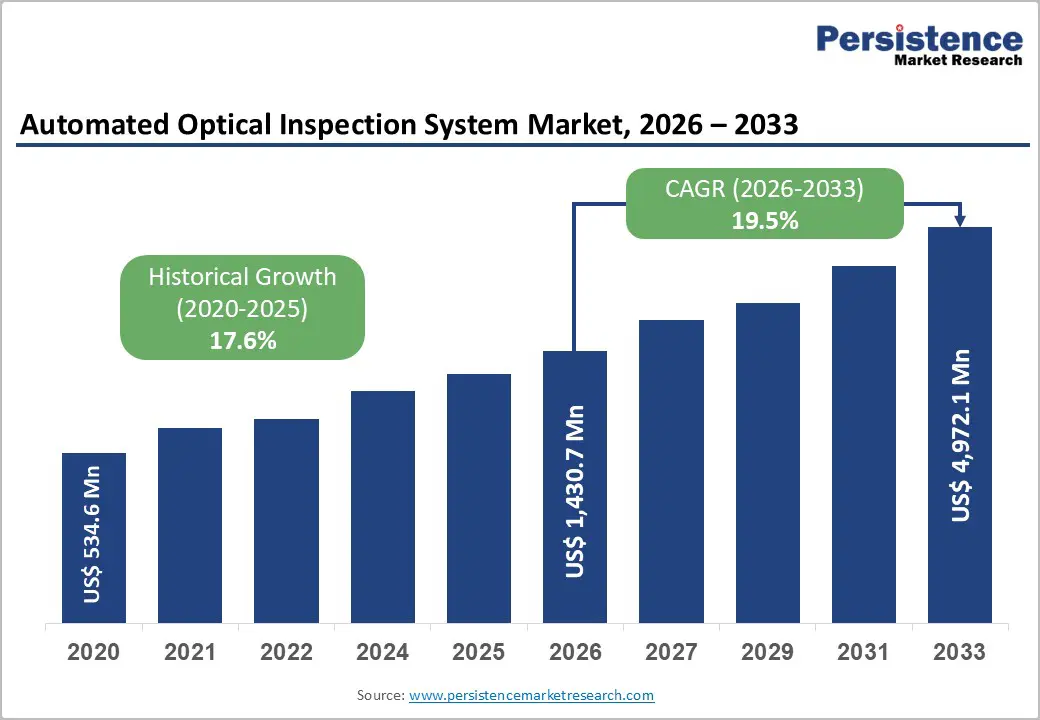
The global automated optical inspection system market size is projected to rise from US$ 1,430.7 Mn in 2026 to US$ 4,972.1 Mn by 2033. The market is expected to register an impressive CAGR of 19.5% during the forecast period from 2026 to 2033. Rising demand for high-precision quality control, AI-enabled inspection systems, and real-time manufacturing analytics are among the key factors fueling this growth trajectory.
AOI systems have become indispensable in electronics manufacturing because they provide rapid, accurate, and non-contact inspection of printed circuit boards (PCBs), semiconductor packages, solder joints, and electronic components. These systems help manufacturers reduce defects, improve product reliability, minimize production downtime, and optimize operational efficiency.
Rising Complexity in Electronics Manufacturing Driving AOI Adoption
Modern electronics manufacturing is evolving rapidly with the increasing use of compact and high-density components. Advanced technologies such as 5G infrastructure, AI hardware, wearable electronics, automotive electronics, and Internet of Things (IoT) devices require highly sophisticated PCB designs and semiconductor architectures.
Traditional manual inspection methods are no longer capable of identifying microscopic defects or handling large-scale production volumes efficiently. AOI systems address this challenge by using advanced cameras, lighting technologies, and machine vision algorithms to automatically detect defects such as solder bridges, missing components, polarity errors, misalignment, and insufficient soldering.
The semiconductor industry is one of the biggest contributors to AOI demand. Semiconductor devices require near-zero defect tolerance because even minor manufacturing errors can lead to performance failures. According to the Semiconductor Industry Association (SIA), global semiconductor sales reached US$ 82.5 billion in January 2026, reflecting strong production activity worldwide. This expansion in semiconductor fabrication and packaging is creating substantial demand for advanced inspection systems.
Additionally, electronics manufacturers are increasingly integrating AOI solutions into smart factory environments under Industry 4.0 initiatives. Inline AOI systems now enable real-time monitoring and immediate defect correction within automated production lines, helping manufacturers improve production yield and reduce waste.
AI and Machine Learning Revolutionizing AOI Systems
One of the most transformative trends in the AOI market is the integration of artificial intelligence and machine learning technologies. Traditional AOI systems relied heavily on rule-based inspection algorithms that often generated false defect calls and required extensive manual programming.
Modern AI-powered AOI systems use deep learning algorithms capable of recognizing patterns, learning from historical defect data, and adapting to changing production conditions. These intelligent systems significantly reduce false calls, improve inspection accuracy, and minimize operator intervention.
AI-enabled AOI solutions can automatically classify defects, identify process drifts, and optimize inspection recipes over time. Manufacturers benefit from faster setup times, improved throughput, and reduced production costs. This technological advancement is particularly valuable in high-volume semiconductor and automotive electronics manufacturing, where production precision is critical.
Organizations such as the U.S. National Institute of Standards and Technology (NIST) are actively supporting the development of AI-assisted metrology frameworks, further accelerating the adoption of intelligent inspection technologies across regulated industries.
3D AOI Systems Emerging as the Dominant Technology
Among all technologies, 3D AOI systems dominate the market, accounting for more than 57% market share in 2026 with a value exceeding US$ 815 Mn. Their popularity is driven by their superior capability to inspect complex electronic assemblies and high-density PCBs.
Unlike traditional 2D inspection systems, 3D AOI systems provide volumetric and height measurement data, allowing accurate inspection of solder joints, component coplanarity, and solder paste volume. This enables manufacturers to detect defects that may remain invisible in 2D inspections, particularly in miniaturized semiconductor packages and multilayer PCB assemblies.
The rapid rise of EVs, ADAS systems, and advanced consumer electronics is further strengthening the need for 3D inspection technologies. Automotive manufacturers especially rely on 3D AOI systems to ensure the reliability of safety-critical electronic components.
At the same time, 2D AOI systems continue to experience steady demand because of their affordability and ease of integration into standard PCB assembly lines. Improvements in high-resolution imaging and AI-driven software are also enhancing the performance of 2D inspection solutions.
Inline AOI Systems Becoming Essential for Smart Manufacturing
Inspection mode analysis shows that inline AOI systems hold over 60% market share in 2026, with a value exceeding US$ 858 Mn. Inline systems are increasingly preferred because they allow real-time inspection directly within the production process.
These systems help manufacturers identify and correct defects immediately, reducing production downtime and minimizing material wastage. Continuous inspection also ensures consistent product quality and regulatory compliance, which is essential in industries such as aerospace, automotive, and semiconductors.
The growing shift toward fully automated smart factories is expected to further accelerate the deployment of inline AOI systems. Manufacturers are increasingly integrating AOI platforms with robotics, industrial IoT sensors, and manufacturing execution systems (MES) to create highly connected production environments.
Offline AOI systems are also witnessing significant growth, particularly in research laboratories, prototype testing facilities, and low-volume manufacturing operations. These systems provide flexibility for batch inspections, failure analysis, and engineering evaluations without interrupting production activities.
Defect Detection Remains the Largest Application Segment
Defect, pattern, and position detection applications command the largest market share at over 32% in 2026, valued at more than US$ 457.8 Mn. The increasing complexity of electronics manufacturing requires fast and highly accurate defect detection capabilities to ensure product reliability.
AOI systems are widely used to identify solder defects, component misalignment, missing parts, polarity issues, and incorrect placements during PCB assembly. High-speed automated inspections significantly reduce rework costs while improving manufacturing efficiency.
Meanwhile, Data Matrix and Barcode Recognition is emerging as the fastest-growing application segment, projected to register a CAGR of 24.3% during the forecast period. Electronics manufacturers are increasingly implementing serialization and traceability systems to monitor products throughout the supply chain.
AOI systems equipped with barcode and data matrix recognition capabilities help manufacturers improve inventory tracking, prevent counterfeiting, and comply with regulatory standards. As smart factories continue to digitize operations, traceability-focused inspection technologies are expected to gain further importance.
Semiconductor and Automotive Industries Leading Demand
The semiconductor industry remains the largest end-use sector for AOI systems, accounting for over 30% market share in 2026 with a value exceeding US$ 429 Mn. Semiconductor fabrication requires extreme precision because microscopic defects can result in device failure.
AOI systems are extensively used in wafer inspection, semiconductor packaging, PCB assembly, and chip testing processes. Growing demand for AI chips, high-performance computing devices, and advanced consumer electronics is further increasing the need for reliable semiconductor inspection solutions.
The automotive sector is expected to witness the fastest growth, with a projected CAGR of 23.8%. The rapid expansion of electric vehicles, autonomous driving technologies, infotainment systems, and advanced driver assistance systems (ADAS) is significantly increasing electronic content in vehicles.
Automotive manufacturers must adhere to strict quality and safety standards, making automated inspection solutions essential for ensuring defect-free electronic assemblies. As EV production continues to rise globally, AOI adoption in automotive electronics manufacturing is expected to surge.
Asia Pacific Dominates the Global AOI Market
Asia Pacific holds the dominant position in the global AOI market with over 45% share in 2026, valued at approximately US$ 643.8 Mn. The region’s leadership is supported by its massive electronics manufacturing ecosystem across China, Taiwan, South Korea, and Japan.
China remains the world’s largest PCB manufacturing hub, accounting for more than half of global PCB production. This creates enormous demand for advanced inspection technologies. Taiwan and South Korea are leading semiconductor manufacturing centers, driving investments in high-precision AOI systems for advanced semiconductor nodes.
Japan continues to play a crucial role in inspection technology innovation, while emerging economies such as India, Vietnam, Malaysia, and Thailand are rapidly expanding their electronics manufacturing capacities through government-supported industrial initiatives.
North America is also expected to witness substantial growth due to semiconductor fab expansion supported by the CHIPS and Science Act. Increasing investments in AI-driven manufacturing automation and advanced aerospace electronics production are creating new growth opportunities for AOI vendors in the region.
Europe is strengthening its position through the European Chips Act and increasing adoption of Industry 4.0 manufacturing technologies. Countries such as Germany, France, the United Kingdom, and the Netherlands are investing heavily in semiconductor production and advanced industrial automation.
Competitive Landscape and Industry Developments
The automated optical inspection market is moderately consolidated, with leading companies competing through technological innovation, AI integration, and advanced imaging capabilities. Major players are focusing on expanding service networks, improving machine vision software, and developing modular inspection platforms.
Key companies operating in the market include Koh Young Technology, Mirtec, Omron Corporation, CyberOptics Corporation, Viscom AG, Nordson Corporation, Test Research Inc., AOI Systems Ltd., GÖPEL electronic GmbH, and Orbotech Ltd.
Recent industry developments highlight the growing focus on AI-powered inspection solutions. In March 2026, Sciotex launched compact benchtop automated inspection systems designed to simplify AI-based machine vision implementation for low-to-medium volume manufacturing environments.
Similarly, Viscom AG introduced its AI-assisted vAI ProVision inspection software at APEX Expo 2026. The software automatically generates inspection programs for AOI and AXI systems, helping manufacturers reduce programming complexity and improve production efficiency.
Conclusion
The Automated Optical Inspection System market is entering a period of rapid expansion fueled by rising electronics complexity, semiconductor growth, EV adoption, and Industry 4.0 transformation. As manufacturers increasingly prioritize zero-defect production and real-time quality control, AOI systems are becoming critical components of modern manufacturing operations.
The integration of AI, machine learning, and 3D imaging technologies is further enhancing inspection accuracy and operational efficiency, opening new growth opportunities across semiconductor, automotive, pharmaceutical, and electronics industries.
With Asia Pacific leading global adoption and North America and Europe accelerating investments in semiconductor manufacturing, the AOI market is poised for remarkable long-term growth. Companies that continue investing in intelligent inspection technologies and smart manufacturing integration are expected to gain a strong competitive advantage in this evolving industry landscape.

 English
 Arabic
 French
 Spanish
 Portuguese
 Turkish
 Dutch
Dutch
 Italiano
 Russian
 Romaian
 Portuguese (Brazil)
 Greek
Greek