


The global crypto asset management market is entering a transformative phase as digital assets continue to gain legitimacy among institutional investors, corporations, and high-net-worth individuals. Once considered a niche investment segment, cryptocurrency has evolved into a recognized asset class supported by regulatory advancements, sophisticated investment products, and institutional-grade infrastructure.
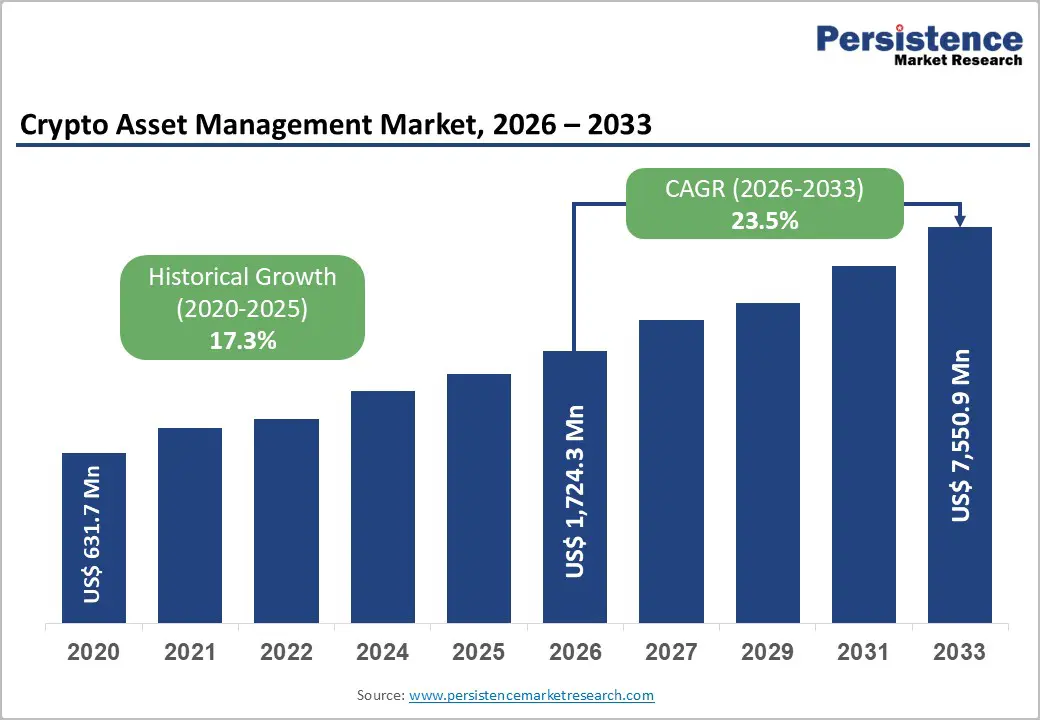
According to recent market projections, the global Crypto Asset Management Market is expected to expand from US$ 1,724.3 million in 2026 to US$ 7,550.9 million by 2033, registering an impressive CAGR of 23.5% during the forecast period. The growth is being fueled by increasing institutional participation, rising adoption of regulated crypto investment products, expanding decentralized finance (DeFi) opportunities, and the integration of advanced technologies such as artificial intelligence and blockchain analytics into portfolio management solutions.
Growing Institutional Acceptance Reshaping the Market
One of the most significant factors driving the crypto asset management market is the rapid increase in institutional adoption. Financial institutions that once remained cautious about digital assets are now actively integrating cryptocurrencies into diversified investment portfolios.
The approval of spot Bitcoin Exchange-Traded Funds (ETFs) in the United States marked a pivotal milestone for the industry. These products have enabled pension funds, hedge funds, family offices, and asset managers to gain regulated exposure to cryptocurrencies without directly managing wallets or private keys. The strong inflow of institutional capital into Bitcoin ETFs demonstrates growing confidence in crypto as a legitimate investment asset.
Large financial institutions are increasingly viewing Bitcoin as a digital store of value comparable to gold. As a result, professional asset management firms are witnessing rising demand for secure custody, portfolio optimization, compliance monitoring, and risk management solutions tailored specifically for digital assets.
Research indicates that a growing number of institutional investors plan to allocate a larger percentage of their portfolios to cryptocurrencies over the next several years, creating significant opportunities for crypto asset management providers.
Regulatory Clarity Strengthening Investor Confidence
Regulatory uncertainty has historically been one of the biggest barriers to widespread crypto adoption. However, recent developments across major economies are helping establish clearer rules and greater transparency within digital asset markets.
The implementation of the Markets in Crypto-Assets (MiCA) framework across the European Union represents one of the most comprehensive regulatory initiatives for the crypto sector. The regulation provides standardized requirements for crypto asset service providers, stablecoin issuers, and digital asset exchanges.
Similarly, regulators in the United States, Singapore, Japan, Hong Kong, and other key markets are developing frameworks that support compliant digital asset operations while protecting investors.
Improved regulatory clarity offers several benefits:
- Enhanced investor protection
- Greater market transparency
- Increased institutional participation
- Reduced legal uncertainty
- Standardized compliance procedures
As regulations become more defined, investors are increasingly relying on professional crypto asset managers to navigate compliance requirements and optimize investment strategies.
Technology Innovation Transforming Asset Management
Technology continues to play a central role in the evolution of crypto asset management solutions.
Modern platforms are integrating artificial intelligence, machine learning, blockchain analytics, and automated trading algorithms to improve portfolio performance and risk management capabilities.
AI-powered systems can analyze vast amounts of market data in real time, identify trends, detect anomalies, and optimize asset allocations. These capabilities allow asset managers to respond quickly to market movements and make more informed investment decisions.
Blockchain analytics tools also provide enhanced transparency by enabling firms to track transaction flows, monitor wallet activity, assess risk exposure, and identify suspicious transactions.
Additionally, automation is reducing operational complexity by streamlining portfolio rebalancing, compliance reporting, tax calculations, and custody management.
As digital asset markets become increasingly sophisticated, advanced technology platforms will remain a key differentiator among market participants.
Solutions and Platforms Lead Market Revenue
By offering, solutions and platforms account for more than 70% of total market share in 2026, generating over US$ 1.2 billion in revenue.
The dominance of this segment reflects the growing need for integrated infrastructure capable of managing digital assets across multiple exchanges, wallets, and blockchain networks.
Leading platforms typically offer:
- Portfolio management dashboards
- Automated rebalancing tools
- Secure custody solutions
- Trading execution systems
- Risk management analytics
- Compliance monitoring capabilities
- Tax reporting functions
Institutional investors increasingly prefer unified platforms that consolidate these functions into a single ecosystem, improving operational efficiency while reducing security risks.
Meanwhile, professional services represent the fastest-growing segment. Demand for advisory services, compliance consulting, tax planning, and DeFi integration continues to increase as investors seek specialized expertise in navigating the complex digital asset landscape.
Bitcoin Remains the Dominant Asset Class
Bitcoin continues to maintain its position as the leading asset type within managed crypto portfolios.
In 2026, Bitcoin accounts for more than 43% of market share, with a valuation exceeding US$ 741.5 million. Its status as the most recognized cryptocurrency and its reputation as "digital gold" contribute significantly to its dominance.
Institutional investors often use Bitcoin as a foundational portfolio asset due to several advantages:
- High liquidity
- Strong market infrastructure
- Broad institutional acceptance
- Extensive exchange support
- Relative stability compared to smaller cryptocurrencies
However, Ethereum is emerging as the fastest-growing asset category.
Ethereum's importance extends beyond its role as a cryptocurrency. It serves as the foundation for decentralized finance applications, smart contracts, tokenized assets, and blockchain-based financial services.
The growing adoption of staking, decentralized exchanges, and tokenized investment products is driving increased institutional interest in Ethereum-based investment strategies.
As blockchain ecosystems continue expanding, Ethereum's utility-driven demand is expected to support substantial growth within managed portfolios.
Institutional Investors Drive Market Expansion
Institutional investors represent the largest investor category, accounting for over 45% of the market in 2026.
This segment includes:
- Hedge funds
- Pension funds
- Asset management firms
- Insurance companies
- Family offices
- Sovereign wealth funds
The increasing allocation of digital assets within institutional portfolios is creating strong demand for advanced custody, security, compliance, and reporting solutions.
Institutions require infrastructure that meets rigorous operational and regulatory standards. Crypto asset management platforms are addressing these needs through institutional-grade custody services, multi-signature security systems, insurance coverage, and sophisticated portfolio analytics.
At the same time, corporate treasury adoption is emerging as a major growth driver.
Many corporations are exploring cryptocurrencies as part of treasury diversification strategies, viewing digital assets as potential hedges against inflation and currency depreciation. As businesses increase their exposure to digital assets, specialized treasury management solutions are becoming increasingly important.
Emerging Opportunities in Tokenization and DeFi
The tokenization of real-world assets represents one of the most promising opportunities in the crypto asset management industry.
Tokenization enables traditional assets such as:
- Real estate
- Bonds
- Equities
- Commodities
- Private equity investments
to be represented digitally on blockchain networks.
This innovation offers numerous benefits, including fractional ownership, increased liquidity, faster settlement, and improved transparency.
Asset managers are increasingly exploring tokenized investment products that combine traditional financial assets with blockchain-based infrastructure.
Simultaneously, decentralized finance is creating new yield-generation opportunities through:
- Staking
- Lending
- Liquidity provisioning
- Yield farming
- Decentralized asset management protocols
These strategies enable investors to generate returns beyond traditional capital appreciation.
Firms capable of integrating tokenized assets and DeFi yield strategies into professionally managed portfolios are expected to gain a significant competitive advantage over the coming years.
North America Maintains Market Leadership
North America remains the largest regional market, accounting for more than 36% of global revenue in 2026.
The United States serves as the primary growth engine due to several factors:
- Spot Bitcoin ETF approvals
- Strong institutional participation
- Advanced financial infrastructure
- Robust venture capital investment
- Growing regulatory maturity
Major crypto asset management providers, custodians, and investment firms are headquartered in North America, contributing to the region's leadership position.
Meanwhile, Asia Pacific is emerging as the fastest-growing regional market, projected to register a CAGR of 28.1%.
Countries such as Singapore, Japan, South Korea, and Hong Kong are implementing supportive regulatory frameworks while fostering innovation in blockchain technology and digital finance.
The region's large technology-savvy population, expanding fintech ecosystem, and increasing institutional participation are expected to drive sustained market growth.
Europe is also becoming a significant growth center, supported by the implementation of MiCA regulations that establish a harmonized regulatory framework across the European Union.
Challenges Remain Despite Strong Growth Prospects
Despite favorable market conditions, several challenges continue to impact the industry.
Market volatility remains a major concern. Cryptocurrencies often experience substantial price fluctuations that can complicate portfolio management and increase investment risk.
Cybersecurity threats also represent a persistent challenge. Hacks, scams, and protocol vulnerabilities continue to result in significant financial losses across the digital asset ecosystem.
Additionally, regulatory fragmentation across jurisdictions creates operational complexities for firms operating internationally. Different licensing requirements, reporting standards, and compliance obligations increase costs and slow market expansion.
Addressing these challenges will require continued investment in security infrastructure, regulatory engagement, and risk management capabilities.
Future Outlook
The future of the crypto asset management market appears exceptionally promising. Growing institutional acceptance, clearer regulatory frameworks, technological innovation, and the emergence of tokenized assets are creating a strong foundation for long-term expansion.
As digital assets become increasingly integrated into mainstream finance, investors will continue seeking professional management solutions that offer security, compliance, transparency, and optimized performance.
Companies that successfully combine institutional-grade infrastructure with advanced analytics, regulatory expertise, and innovative investment products will be best positioned to capitalize on the market's extraordinary growth potential.
With the market projected to exceed US$ 7.5 billion by 2033, crypto asset management is rapidly evolving from a specialized niche into a critical component of the global financial ecosystem.

 Arabic
 French
 Spanish
 Portuguese
 Deutsch
 Turkish
 Dutch
Dutch
 Italiano
 Russian
 Romaian
 Portuguese (Brazil)
 Greek
Greek