


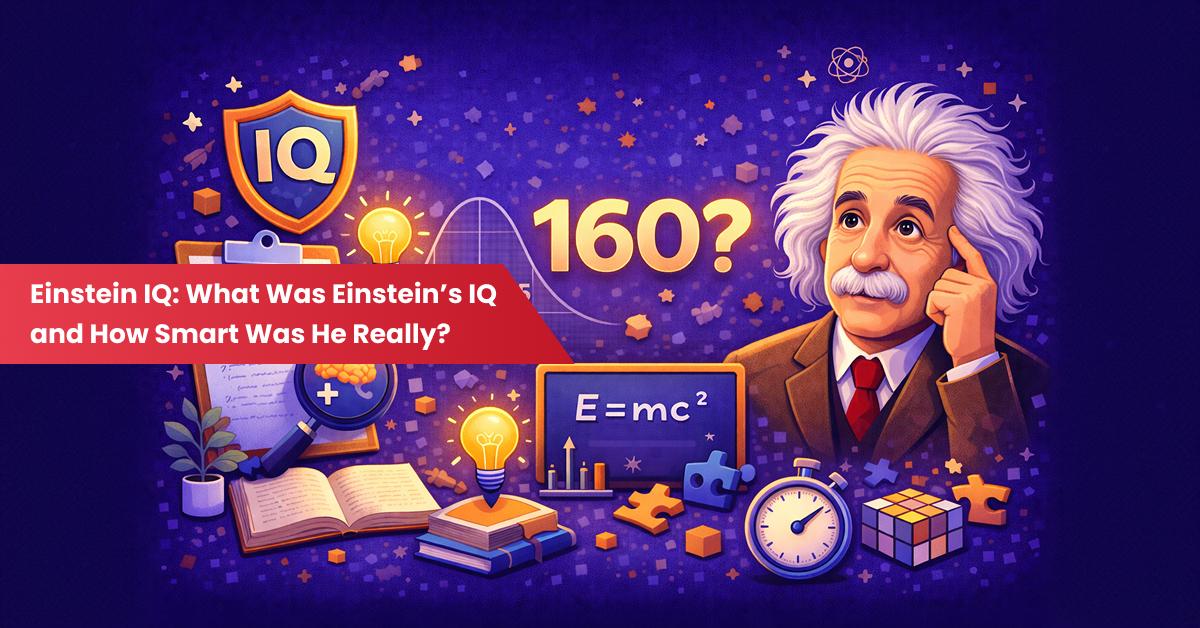
When people discuss extraordinary intelligence, one figure almost always comes up: Albert Einstein. His name is practically synonymous with genius, and his scientific contributions reshaped how humanity understands space, time, and gravity. Because of this reputation, many people wonder about einstein's iq and try to measure his intelligence using a single number.
But how smart was Einstein really, and can his intelligence be meaningfully explained through IQ at all? The answer is more complex than most online claims suggest.
The Origins of the Einstein IQ Question
The curiosity around einstein's iq comes from a natural human tendency to quantify intelligence. People want to compare abilities, rank genius levels, and simplify complex achievements into understandable numbers. IQ scores seem to offer that simplicity.
However, Einstein never took a verified modern IQ test. That means there is no official record of his intelligence quotient. Despite this, many websites and articles claim that his IQ was around 160 or higher. These numbers are estimates, not facts.
The fascination with Einstein’s intelligence score often overshadows what he actually did. Instead of focusing on a test result, it is more useful to examine how his mind worked and why he became one of the most influential scientists in history.
Why Einstein Never Had an Official IQ Score
Einstein lived from 1879 to 1955, a time when psychological testing was still developing. Modern IQ tests such as the Stanford Binet and later Wechsler scales were not widely standardized during his early life in a way that would have produced a verified, reliable score.
Even if Einstein had taken a test later in life, it would not necessarily reflect his true intellectual abilities. IQ tests measure specific cognitive skills such as pattern recognition, logical reasoning, and verbal comprehension. They do not measure creativity, imagination, or the ability to develop revolutionary scientific theories.
Einstein’s work required a type of thinking that goes beyond standardized testing. He was more interested in understanding the fundamental nature of reality than in performing timed problem solving tasks.
The Myth of a 160 IQ
One of the most repeated claims online is that Einstein had an IQ of 160. This number is often presented as fact, but it is actually a symbolic estimate. It is based on the assumption that someone who made such groundbreaking discoveries must have an extremely high IQ.
The problem with this assumption is that it works backward from achievement to intelligence score. There is no historical document or scientific record that confirms this number.
The truth is that einstein's iq cannot be measured retroactively. Intelligence is not something that can be accurately reconstructed from biography alone.
What IQ Actually Measures
To understand why Einstein’s IQ is uncertain, it helps to understand what IQ tests are designed to measure.
Modern IQ tests evaluate cognitive abilities such as:
-
Logical reasoning
-
Mathematical problem solving
-
Spatial awareness
-
Working memory
-
Verbal comprehension
These skills are useful for predicting academic performance and certain types of job success. However, they do not fully capture creativity, intuition, or long term innovative thinking.
Einstein’s genius was not just about solving structured problems. It was about imagining entirely new frameworks for physics.
Einstein’s Real Intellectual Strengths
Instead of focusing only on einstein's iq it is more accurate to look at his intellectual strengths.
Einstein had a remarkable ability to visualize abstract concepts. One famous example is his thought experiments. He would imagine scenarios such as traveling alongside a beam of light or being in a falling elevator. These mental simulations helped him develop theories that changed physics forever.
He also showed exceptional intuition for mathematical relationships, even though he often preferred conceptual reasoning over formal mathematical complexity.
His intelligence combined logic with imagination. This combination is rare and cannot be fully captured by IQ testing.
The Theory of Relativity and Creative Thinking
Einstein’s most famous contribution, the theory of relativity, demonstrates the depth of his thinking. The special theory of relativity, published in 1905, introduced the idea that time and space are relative depending on the observer’s motion.
Later, his general theory of relativity described gravity not as a force but as the curvature of spacetime caused by mass and energy.
These ideas required a complete rethinking of how the universe works. They were not simply mathematical solutions but conceptual breakthroughs.
This type of creativity is one reason why discussions about einstein's iq often miss the point. His intelligence cannot be reduced to solving puzzles quickly or scoring high on standardized tests.
IQ Limitations in Explaining Genius
IQ tests are useful tools, but they have clear limitations. They measure performance on specific tasks under controlled conditions. They do not measure lifelong intellectual development or the ability to produce revolutionary ideas.
Einstein’s genius involved long periods of reflection, curiosity, and imaginative exploration. These qualities develop over time and are influenced by personality, environment, and persistence.
A person with a very high IQ might excel in academic testing but may not necessarily produce groundbreaking scientific theories. Similarly, someone with average test results could still make major discoveries under the right circumstances.
Why Einstein Became a Symbol of Intelligence
The question of einstein's iq persists because Einstein represents the idea of ultimate intelligence in popular culture. His image, often associated with wild hair and a thoughtful expression, has become a global symbol of genius.
However, this symbolic status simplifies his actual life and work. Einstein was not just a genius in isolation. He was a scientist who worked within a broader intellectual community, engaging with other physicists and building on existing scientific knowledge.
His success was not just due to raw intelligence but also curiosity, persistence, and a willingness to challenge established ideas.
Misinterpretations in Popular Media
Many websites and social media posts exaggerate Einstein’s IQ to make content more engaging. They often claim precise numbers without evidence or suggest comparisons with modern IQ test results.
These claims are misleading because they treat intelligence as a fixed measurable value that can be applied across time and context.
In reality, Einstein’s intelligence cannot be separated from his historical environment, education, and scientific challenges. His achievements were the result of both natural ability and years of dedicated study.
Intelligence Beyond Testing
One of the most important lessons from studying Einstein is that intelligence is not one dimensional. Modern psychology recognizes multiple types of intelligence, including analytical, creative, emotional, and practical intelligence.
Einstein excelled in theoretical and conceptual intelligence. His ability to question assumptions and think in new ways was more important than any numerical score.
This is why discussions about einstein's iq often fail to capture the true nature of his mind. Intelligence is not just about answering questions correctly. It is about asking the right questions in the first place.
The Role of Curiosity and Imagination
Einstein once emphasized the importance of curiosity and imagination in scientific discovery. He believed that imagination was more important than knowledge because knowledge is limited, while imagination can explore everything.
This mindset played a major role in his scientific breakthroughs. His ability to imagine physical scenarios that could not be directly observed allowed him to develop theories that changed physics forever.
This creative aspect of intelligence is not measured by IQ tests, which focus more on structured problem solving.
Final Thoughts
The question of einstein's iq will likely continue to appear in discussions about intelligence and genius. However, the real answer is that there is no verified IQ score for Albert Einstein, and any number associated with him is an estimate rather than a fact.
More importantly, focusing on a single number misses what made Einstein truly exceptional. His intelligence was not just about solving problems but about redefining how problems are understood.
Einstein’s legacy shows that intelligence is far more complex than any test can measure. It includes creativity, imagination, persistence, and the courage to think differently. These are the qualities that made him one of the most influential minds in history, far beyond any possible IQ score.

 Arabic
 French
 Spanish
 Portuguese
 Deutsch
 Turkish
 Dutch
Dutch
 Italiano
 Russian
 Romaian
 Portuguese (Brazil)
 Greek
Greek