


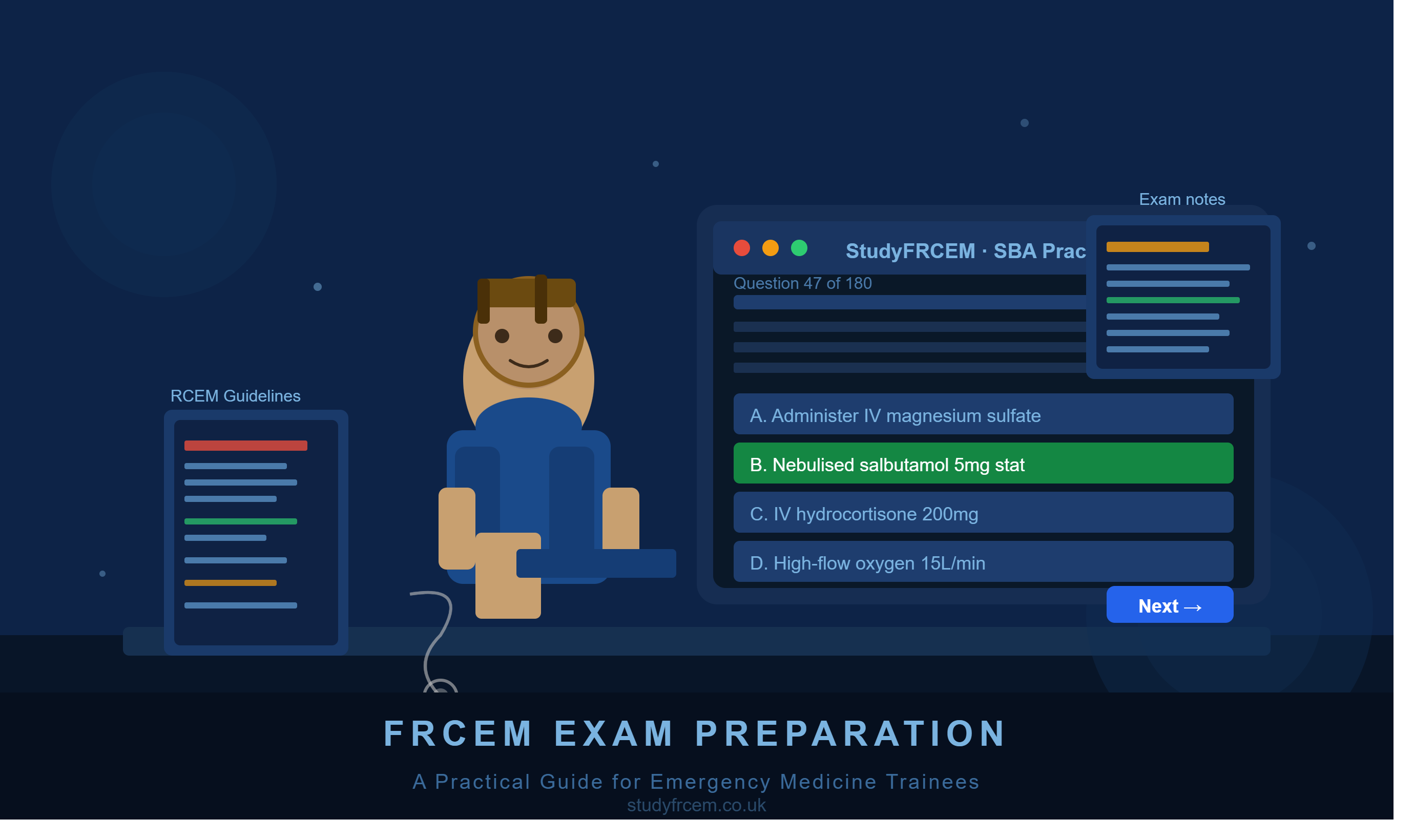
The FRCEM SBA fails good doctors because it doesn't test clinical skill — it tests guideline precision. Candidates who pass choose a question bank mapped to the current RCEM SLO curriculum, updated in real time, and built to explain why wrong answers are wrong — not just why the right answer is right. That single shift in preparation approach is what separates a first-time pass from a repeated fail.
Picture this: a registrar with six years of emergency medicine experience, someone who runs the department when consultants are off, someone junior colleagues come to when they're unsure — sits the FRCEM SBA and fails by eight marks.
It happens constantly. And the reason is almost never lack of knowledge.
It's lack of alignment.
The Exam Tests a Specific Kind of Precision
The FRCEM SBA is 180 questions built directly from the 2021 RCEM curriculum. Every single question maps to one of 12 Specialty Learning Outcomes. Every correct answer traces back to a named guideline — RCEM clinical standards, NICE pathways, BTS protocols, Resuscitation Council UK documents.
Not general clinical practice. Not what your department does. Specific documents with specific numbers.
That's the gap that catches experienced clinicians off guard. You might know COPD management inside out — but if you haven't specifically revised the BTS oxygen target of 88–92%, you'll select a number that feels clinically reasonable and lose the mark. You might be excellent at trauma — but if you're still working from the ABCDE framework instead of xABCDE, you'll answer primary survey questions with confident precision and get them wrong.
The exam is fair. It's just precise in a way that clinical experience alone doesn't cover.
One Decision Changes Everything
Most candidates spend months worrying about how much to study. The more important question is what to study with.
A question bank that wasn't built for the FRCEM curriculum doesn't just fail to help you — it actively sets you back. Every outdated question you drill reinforces a wrong threshold. Every shallow explanation you read instead of a full four-option breakdown is a missed opportunity to understand exactly how the exam traps candidates. By the time you sit the paper, you're not walking in underprepared. You're walking in confidently wrong — which is harder to recover from.
Before committing to any platform, run four quick checks:
Does a trauma question use xABCDE or ABCDE? If it's ABCDE, the content predates a significant curriculum update.
Does a toxicology question reference the 100mg/L paracetamol threshold? If not, it's behind the current guideline.
Does a TIA question mention DAPT or still present aspirin monotherapy as first-line? Aspirin monotherapy means the question was written before current management guidelines.
Does a paediatric resuscitation question reflect RCUK 2025 changes? If it references older algorithms, the content is behind the current exam.
Those four checks take five minutes and tell you everything about whether a platform can be trusted.
Where Your Score Is Won and Lost
The RCEM blueprint isn't evenly distributed. These SLOs carry the most questions and deserve the most preparation time:
Cardiovascular emergencies — 10 to 12 questions. ACS pathways, ECG interpretation, arrhythmias, heart failure, peri-arrest protocols. Every ALS update needs to be current.
Trauma — Primary survey with xABCDE, haemorrhage control, TBI targets. Catastrophic haemorrhage control comes before airway now. If that isn't in your preparation, those marks are already gone.
Stroke and TIA — Thrombolysis window updates, DAPT replacing aspirin, ABCD2 scoring formally retired. Three separate changes, each generating its own category of confident wrong answers from underprepared candidates.
Toxicology — Exact numbers matter here. Paracetamol at 100mg/L. NAC within 8 hours. Sodium bicarbonate for TCA QRS widening. Not approximate — exact.
SLO 10 — Research and Statistics — The most ignored, most learnable, most predictable source of marks in the exam. RCTs, p-values, confidence intervals, sensitivity, specificity, NNT. Two focused weeks here returns more marks per hour than almost any other topic. Most of your competitors skip it entirely. That's your advantage.
How to Actually Use a Question Bank
Volume is not the point. Understanding is.
Start with 25 to 40 questions daily and read every explanation completely — even when you got the question right. The explanation is where preparation actually happens. A question tells you whether you know something. The explanation tells you why you didn't, and why you might get the same question wrong next time dressed in slightly different clinical clothing.
When your SLO analytics show a weak area, go there — not toward the topics you already know. Improving a weak SLO from 58% to 73% adds more to your final score than pushing a strong one from 82% to 86%.
In the final four weeks, add full timed mocks. The cognitive load of a four-hour paper is genuinely different from daily question sessions, and candidates who haven't simulated it consistently underestimate the stamina required on the actual day.
StudyFRCEM — Built From the Blueprint Up
StudyFRCEM at studyfrcem.co.uk was designed with one constraint from the start: every question had to be built against the current RCEM SLO curriculum. All 1,800+ questions are SLO-tagged, updated immediately when guidelines change, and explained with full clinical reasoning covering all four answer options — not just the correct one.
Performance analytics track your score across all 12 SLOs over time. Timed mocks replicate the real exam format. A free demo is available before any commitment — and ten minutes with the actual questions will tell you more about the platform's quality than any description.
Frequently Asked Questions
Why do experienced EM doctors fail the FRCEM SBA?
Clinical experience builds strong instincts — but instincts don't automatically align with specific guideline thresholds. The exam tests what current documents say, not what experienced clinicians do.
How many questions should I complete before sitting?
1,500 to 2,000 is the commonly cited range, but explanation quality matters more than volume. Deep understanding of 1,200 well-explained questions beats shallow completion of 2,500.
When should question practice start?
Day one. Clinical reasoning for a precision exam builds over months of daily exposure — not in the final few weeks of cramming.
What's the most common mistake on a second attempt?
Repeating the same preparation more intensely instead of changing what's being prepared with. If the first attempt failed due to guideline currency or explanation quality, more of the same won't change the result.

 Arabic
 French
 Spanish
 Portuguese
 Deutsch
 Turkish
 Dutch
Dutch
 Italiano
 Russian
 Romaian
 Portuguese (Brazil)
 Greek
Greek