


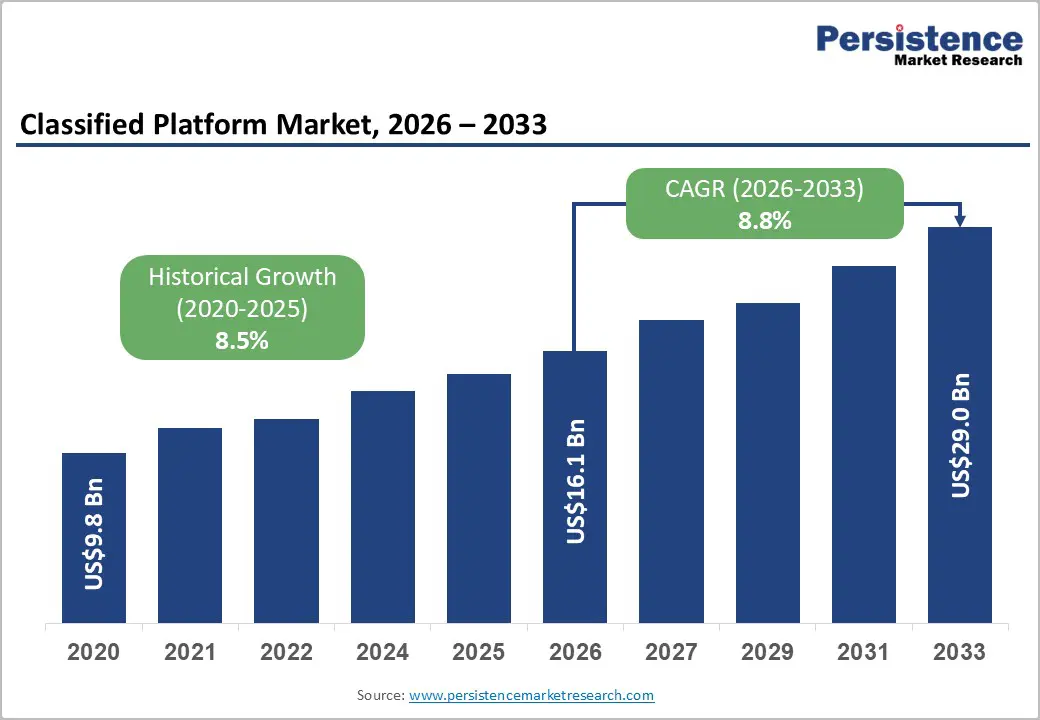
The global classified platform market is projected to reach US$16.1 billion in 2026 and is expected to grow to US$29.0 billion by 2033, expanding at a CAGR of 8.8% during the forecast period from 2026 to 2033. The market is experiencing robust growth as consumers and businesses increasingly shift from traditional newspaper classifieds and offline listings to digital, mobile-first platforms that facilitate peer-to-peer (P2P) and business-to-consumer (B2C) transactions.
Growing internet accessibility, rapid smartphone adoption, and rising consumer preference for convenient online marketplaces are transforming how users buy, sell, rent, and advertise products and services. Classified platforms have evolved beyond simple listing websites into intelligent digital ecosystems powered by artificial intelligence, machine learning, secure payment integration, and location-based services. These technological advancements improve search accuracy, personalize recommendations, strengthen fraud prevention, and enhance overall user trust.
The industry is also benefiting from diversified monetization strategies that extend beyond conventional advertising. Subscription services, premium listings, featured advertisements, lead-generation tools, and value-added services are helping platform operators generate recurring revenue while improving customer engagement. The continued expansion of digital commerce, coupled with increasing demand for hyperlocal transactions, is expected to sustain long-term market growth.
Market Highlights
- Market Size (2026): US$16.1 Billion
- Projected Market Size (2033): US$29.0 Billion
- CAGR (2026–2033): 8.8%
- Leading Region: Asia Pacific (38% market share in 2026)
- Fastest-Growing Region: North America
- Leading Business Model: Vertical Classifieds (57% revenue share)
- Leading Revenue Model: Advertisement-Based (62% revenue share)
Market Dynamics
Driver: Rapid Expansion of Internet and Smartphone Penetration
One of the strongest drivers of the classified platform market is the rapid increase in internet connectivity and smartphone ownership, particularly across emerging economies. Affordable smartphones and inexpensive mobile data have enabled millions of users to access online marketplaces for buying, selling, renting, and job searching.
Countries such as India, Indonesia, Vietnam, Brazil, and several African nations are witnessing a significant migration from traditional classified advertisements to digital platforms. Mobile applications have become the preferred medium because they allow users to upload listings instantly, communicate with buyers directly, and complete transactions from anywhere.
Government initiatives promoting digital infrastructure, expansion of 4G and 5G networks, and increasing financial inclusion through digital payment systems further strengthen market growth. As internet penetration continues to rise, classified platforms benefit from larger user communities, stronger network effects, and increased transaction volumes.
Restraint: Fraudulent Listings and Trust Issues
Despite strong growth prospects, fraudulent listings remain one of the industry's biggest challenges. User-generated content creates opportunities for scammers to publish fake advertisements, misleading property listings, counterfeit products, or fraudulent employment opportunities.
Trust concerns are particularly significant in high-value categories such as real estate, automobiles, and employment services. Buyers often hesitate to complete transactions without proper verification, while sellers may encounter fake inquiries or payment scams.
To address these concerns, classified platform operators continue investing heavily in:
- AI-powered fraud detection
- Identity verification systems
- Secure payment gateways
- Escrow services
- Automated content moderation
- Seller verification programs
Although these technologies significantly improve platform security, they also increase operational costs and regulatory compliance requirements.
Opportunity: AI-Powered Personalization and Transaction Enablement
Artificial intelligence is transforming classified platforms into intelligent digital marketplaces. AI algorithms analyze user behavior, browsing history, location, and purchasing preferences to deliver highly relevant listings and personalized recommendations.
Machine learning also improves:
- Search accuracy
- Dynamic pricing recommendations
- Listing categorization
- Image recognition
- Fraud detection
- Customer support automation
Another major opportunity lies in the transition toward fully transaction-enabled marketplaces. Rather than functioning solely as listing platforms, many companies now integrate payment processing, logistics support, buyer protection programs, and escrow services.
This evolution increases customer retention while creating additional revenue streams through commissions, payment processing fees, subscriptions, and premium marketplace services.
Category-wise Analysis
Business Model Insights
Vertical classified platforms are expected to dominate the market, accounting for approximately 57% of total revenue in 2026. These platforms specialize in specific industries such as real estate, automotive, employment, or rental services, allowing them to deliver more targeted user experiences and generate higher advertising revenue.
Specialized platforms typically attract users with strong purchase intent, enabling advertisers and businesses to pay premium prices for qualified leads. Zillow, Rightmove, Realtor.com, and Indeed are examples of successful vertical marketplaces offering extensive property information, employment opportunities, and advanced search capabilities.
Horizontal classified platforms represent the fastest-growing business model. These platforms cover multiple product categories within a single marketplace, creating larger user communities and stronger network effects.
Facebook Marketplace, Craigslist, and Quikr exemplify this approach by enabling users to buy and sell products, find services, locate housing, and explore employment opportunities through one unified platform.
The integration of AI-powered search, social networking features, and localized recommendations is further strengthening horizontal marketplace growth.
Revenue Model Insights
Advertisement-based revenue continues to dominate the classified platform industry, accounting for approximately 62% of market revenue in 2026. High visitor traffic, growing SME participation, and performance-based advertising make this model highly attractive.
Businesses increasingly invest in:
- Sponsored listings
- Featured advertisements
- Display advertising
- Lead generation campaigns
- Local promotional services
Platforms such as OLX generate significant income by allowing sellers to promote listings for increased visibility.
Subscription-based revenue models are expected to experience the fastest growth during the forecast period. Professional users, real estate agencies, automotive dealers, and recruitment firms increasingly subscribe to premium services that provide advanced analytics, listing management tools, enhanced visibility, and customer relationship management features.
Recurring subscription income improves revenue stability while encouraging long-term customer relationships.
Regional Analysis
Asia Pacific
Asia Pacific is expected to remain the largest regional market, accounting for approximately 38% of global revenue in 2026. Strong smartphone penetration, expanding internet infrastructure, and increasing adoption of digital payments continue driving regional growth.
China remains one of the largest classified markets through platforms such as 58.com, which leverage AI-powered matching technologies across employment, housing, and automotive listings.
India is witnessing rapid expansion as millions of first-time internet users adopt mobile classifieds. Companies including OLX India and Quikr continue expanding localized services across Tier-2 and Tier-3 cities.
Southeast Asian countries are also experiencing remarkable growth through platforms such as Carousell, which combines AI recommendations, seller verification, and integrated logistics to improve transaction efficiency.
North America
North America is projected to become the fastest-growing regional market during the forecast period. The United States leads digital classified adoption through highly monetized sectors including real estate, automotive, employment, and consumer goods.
Facebook Marketplace, Zillow, OfferUp, Realtor.com, CarGurus, and Autotrader continue expanding their AI capabilities to improve user experience and increase transaction completion rates.
Canada also demonstrates strong market growth through platforms like Kijiji, while Mexico benefits from rising smartphone adoption and expanding digital payment infrastructure.
The region's mature digital economy, advanced payment systems, and well-established regulatory environment contribute significantly to continued market expansion.
Europe
Europe represents another significant market driven by localized digital ecosystems, strong consumer protection regulations, and increasing AI adoption.
France's Leboncoin has evolved into a comprehensive marketplace covering multiple product categories while integrating secure payment services and logistics support.
Germany's Kleinanzeigen continues improving AI-powered search functionality and dealer-focused services for automotive and real estate markets.
Strict GDPR regulations encourage platforms to invest in secure data management practices, strengthening consumer confidence while promoting sustainable digital marketplace growth.
Competitive Landscape
The classified platform market is moderately fragmented, featuring a combination of global technology companies and strong regional market leaders. Competition increasingly focuses on technological innovation, user trust, marketplace liquidity, and diversified monetization strategies.
Leading companies continuously invest in artificial intelligence, machine learning, automated moderation systems, identity verification, and integrated transaction capabilities to differentiate their platforms.
Strategic priorities across the industry include:
- AI-driven recommendations
- Mobile-first user experiences
- Fraud prevention technologies
- Subscription services
- Embedded payments
- Logistics partnerships
- Hyperlocal marketplace expansion
- Vertical specialization
As digital marketplaces become more sophisticated, companies are evolving beyond simple classified listings into comprehensive commerce ecosystems offering end-to-end transaction support.
Recent Industry Developments
The classified platform industry continues to witness rapid innovation and strategic expansion.
In April 2026, Servanan International Pte. Ltd. announced the global expansion of its AI-powered marketplace Ok.com, emphasizing free listings across jobs, real estate, vehicles, and second-hand goods while reducing marketplace operating costs through artificial intelligence.
In February 2026, OLX Group introduced new Agentic AI-powered products during the CLAIM AI conference in Lisbon. The new technologies include conversational assistants for property searches and intelligent automotive sales support, reinforcing OLX's strategy to become a fully AI-driven marketplace.
Earlier, in November 2025, Gumtree launched integrated payments and nationwide delivery services throughout the United Kingdom. The initiative transformed Gumtree from a traditional listing website into a transactional marketplace offering secure payment processing and tracked delivery services.
Key Companies Operating in the Market
Major participants shaping the global classified platform market include:
- Craigslist
- Adevinta
- OLX Group
- Gumtree
- Quikr
- Zillow
- Autotrader
- Indeed
- Rightmove
- Locanto
- OfferUp
- Facebook Marketplace
- CarGurus
- TrueCar
- Realtor.com
- Apartments.com
- Avito
- Naspers
- Schibsted
Future Outlook
The classified platform market is expected to maintain strong momentum through 2033 as digital commerce becomes increasingly integrated into everyday consumer behavior. Artificial intelligence, personalized search, trusted payment systems, identity verification, and embedded logistics will redefine how users interact with online marketplaces.
Vertical specialization will continue driving premium monetization opportunities, while horizontal marketplaces will expand user engagement through broader product offerings and social commerce integration. Growing smartphone adoption across emerging economies, combined with advances in AI-powered recommendation engines and fraud prevention technologies, will further accelerate market development.
As classified platforms transition into complete digital commerce ecosystems offering discovery, communication, payments, logistics, and customer protection within a single interface, they are expected to become indispensable components of the global digital economy.

 English
 Arabic
 French
 Spanish
 Portuguese
 Turkish
 Dutch
Dutch
 Italiano
 Russian
 Romaian
 Portuguese (Brazil)
 Greek
Greek