


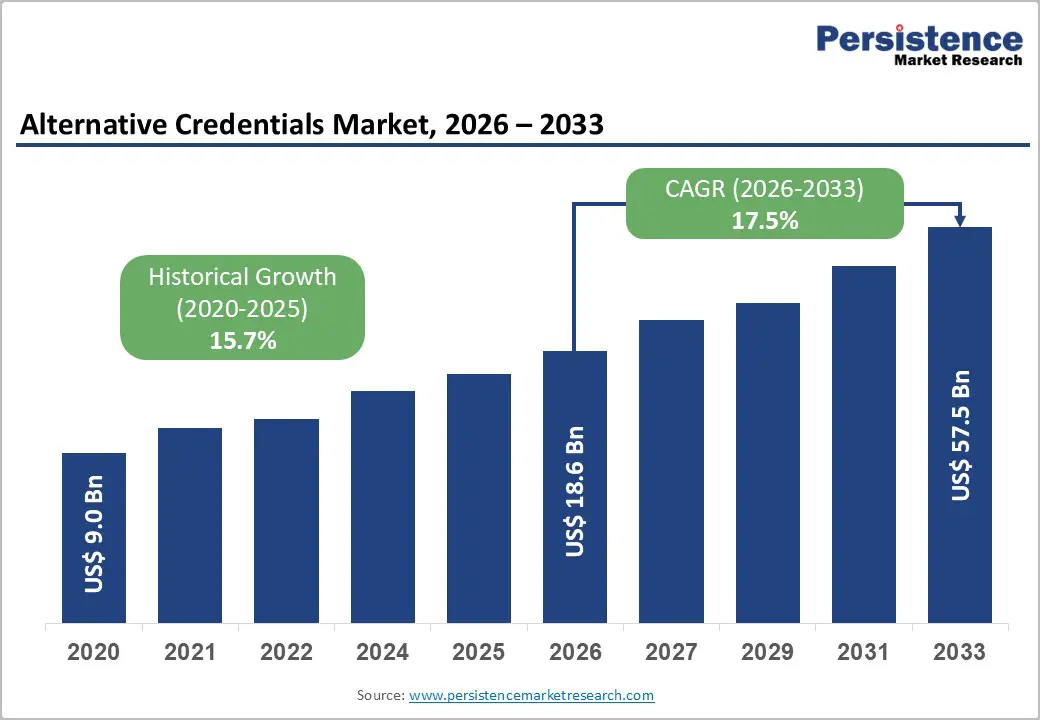
The global alternative credentials market is entering a phase of rapid expansion as organizations, educational institutions, and governments increasingly prioritize skills-based learning and workforce adaptability. The market size is projected to reach US$ 18.6 billion in 2026 and is expected to grow significantly to US$ 57.5 billion by 2033, expanding at a CAGR of 17.5% between 2026 and 2033.
The growing emphasis on verified skills, shorter learning pathways, and continuous professional development is reshaping how individuals demonstrate their capabilities. Traditional degrees are increasingly being complemented by alternative credentials such as professional certificates, digital badges, micro-credentials, and industry certifications that provide targeted validation of job-specific competencies.
The adoption of digital learning platforms, improvements in credential verification technologies, and increasing employer acceptance are accelerating market growth. Companies are moving toward skills-first recruitment models, while learners are seeking affordable and flexible alternatives to traditional education programs. This shift is creating strong demand for credential solutions that are portable, verifiable, and aligned with evolving industry requirements.
Key Market Highlights
- Market Size (2026): US$ 18.6 billion
- Projected Market Size (2033): US$ 57.5 billion
- Growth Rate (2026–2033): CAGR of 17.5%
- Leading Region: North America with approximately 39.8% market share
- Fastest-Growing Region: Asia Pacific with a projected CAGR of 21.3%
- Leading Credential Type: Professional certificates with nearly 31.9% share
- Leading Delivery Mode: Online/hybrid learning with approximately 45.6% share
Skills-Based Hiring Accelerates Alternative Credential Adoption
One of the strongest factors driving the alternative credentials market is the global transition toward skills-first hiring practices. Employers are increasingly focusing on verified capabilities rather than relying solely on traditional academic qualifications. This change is particularly visible in industries experiencing rapid technological transformation, including information technology, artificial intelligence, cybersecurity, healthcare, and advanced manufacturing.
Alternative credentials provide employers with measurable indicators of practical skills and allow candidates to demonstrate expertise in specific areas. Professional certificates and micro-credentials help bridge the gap between academic learning and workplace requirements by offering targeted training aligned with current job roles.
Organizations are also using alternative credentials for internal workforce development. Enterprises are investing in employee upskilling programs to address skill shortages and improve talent mobility. Instead of recruiting only externally, companies are creating pathways for existing employees to gain new competencies through credential-based learning programs.
As workforce needs continue evolving, alternative credentials are becoming an important tool for identifying qualified candidates, improving employee performance, and supporting long-term career development.
Government Initiatives Strengthen Credential Recognition
Government support and policy frameworks are playing a crucial role in accelerating the adoption of alternative credentials worldwide. Many countries are incorporating micro-credentials and modular learning pathways into national education and workforce development strategies.
Governments are encouraging flexible learning systems that allow individuals to continuously upgrade their skills throughout their careers. This approach supports economic competitiveness by helping workers adapt to emerging technologies and changing employment requirements.
In regions such as Europe and Asia Pacific, policymakers are developing qualification frameworks to improve credential recognition and standardization. These initiatives are reducing uncertainty around credential value and encouraging greater participation from universities, employers, and training providers.
The integration of alternative credentials into formal education systems is also expanding their acceptance. Universities are increasingly offering short-term certificates and stackable programs that allow learners to combine multiple credentials toward broader qualifications.
Market Restraints: Lack of Standardization and Quality Concerns
Despite strong growth prospects, the alternative credentials market faces challenges related to recognition, quality assurance, and standardization.
The growing number of credential providers has created a fragmented ecosystem where employers may struggle to evaluate the credibility and relevance of different programs. Without consistent assessment standards, organizations may question whether a credential accurately represents a candidate’s skills.
This challenge is particularly significant for multinational companies operating across different regions. Employers require transparent systems that allow them to compare credentials from various providers and ensure that qualifications meet industry expectations.
Smaller credential providers also face difficulties competing with established education platforms due to limited resources for technology development, employer partnerships, and quality assurance systems.
To overcome these challenges, the market is moving toward stronger verification frameworks, standardized assessment methods, and interoperable digital credential systems.
Blockchain and Digital Verification Create New Opportunities
The increasing adoption of blockchain technology represents a major opportunity for the alternative credentials industry. Blockchain-based systems enable secure, transparent, and tamper-resistant verification of educational achievements and professional skills.
Digital credential wallets allow individuals to store, manage, and share their qualifications across different platforms. These solutions improve trust among learners, employers, and educational institutions by providing instant verification of credentials.
Interoperability is becoming a key focus area as organizations seek credential systems that can integrate with recruitment platforms, learning management systems, and professional networks.
Companies investing in digital identity solutions, credential portability, and open standards are positioned to benefit from rising demand for trusted skill verification.
Growing Demand for AI, Healthcare, and Reskilling Programs
Rapid technological advancement is creating continuous demand for workforce reskilling and upskilling. Industries such as artificial intelligence, cloud computing, cybersecurity, data analytics, and healthcare are experiencing significant skill shortages, increasing demand for specialized credential programs.
Alternative credentials provide professionals with faster pathways to acquire new expertise without requiring years of traditional education. Mid-career professionals are increasingly choosing short-duration programs that allow them to transition into high-growth fields.
Healthcare is emerging as a particularly promising area due to ongoing requirements for certification, compliance training, and professional development. Similarly, AI adoption across industries is increasing demand for specialized credentials related to machine learning, automation, and data-driven decision-making.
Education providers are responding by developing employer-focused programs that combine practical training with recognized certification.
Alternative Credentials Market Segment Analysis
Credential Type Insights
Professional Certificates Lead Market Growth
Professional certificates represent the leading credential category, accounting for approximately 31.9% of the market share in 2026.
These credentials are widely adopted because they provide direct alignment with employer expectations and demonstrate practical job-related skills. Industries such as technology, finance, marketing, and business management increasingly rely on professional certificates to validate workforce capabilities.
Programs offered by organizations such as Google Career Certificates, IBM SkillsBuild, and Microsoft certifications have gained popularity due to their industry relevance and employer recognition.
Their shorter completion timelines, affordability, and practical focus make professional certificates attractive for both individuals and organizations.
Digital Badges Witness Rapid Expansion
Digital badges are expected to be the fastest-growing credential category, supported by increasing demand for flexible and verifiable skill recognition.
Unlike traditional certificates, digital badges allow organizations to validate specific competencies and achievements. Platforms such as Credly and Accredible enable institutions and companies to issue secure digital badges that can be displayed on professional profiles and integrated into talent management systems.
The growth of digital badges is supported by advances in digital verification technology and increasing demand for granular skill tracking.
Delivery Mode Insights
Online/Hybrid Learning Dominates Delivery Models
Online and hybrid delivery models are expected to capture approximately 45.6% market share in 2026.
This model combines flexibility with structured learning, making it highly suitable for working professionals and corporate training programs. Learners can access digital content while participating in instructor-led sessions, assessments, and collaborative activities.
Platforms including Coursera and edX have expanded hybrid learning programs by partnering with universities and enterprises worldwide.
Fully Online Learning Drives Future Growth
Fully online delivery is expected to experience strong growth due to scalability, affordability, and global accessibility.
Platforms such as LinkedIn Learning, Udemy, and Skillsoft provide on-demand learning solutions that allow users to develop skills at their own pace.
Artificial intelligence-powered personalization and adaptive learning technologies are further improving online education experiences, making digital credentials more effective and accessible.
Regional Analysis
North America Alternative Credentials Market Trends
North America is projected to remain the leading regional market, accounting for approximately 39.8% share.
The region benefits from strong digital infrastructure, advanced education technology adoption, and widespread acceptance of skills-based hiring models.
The United States represents a significant portion of the market due to strong employer demand for industry-recognized credentials. Companies such as Google have expanded acceptance of career certificates as alternatives for certain entry-level positions, strengthening employer confidence in alternative learning pathways.
Leading platforms including Coursera, Pearson, Credly, and Instructure are investing in digital credential ecosystems, enterprise learning solutions, and verification technologies.
Europe Alternative Credentials Market Trends
Europe is experiencing steady market growth due to strong policy support for lifelong learning and standardized micro-credential frameworks.
The European Union’s focus on credential portability and recognition is encouraging universities and training providers to adopt modular learning systems.
Countries including Germany, the United Kingdom, France, and Spain are developing workforce programs focused on digital skills, vocational training, and professional development.
Platforms such as FutureLearn and edX are expanding partnerships with European institutions to deliver recognized micro-credential programs.
Asia Pacific Alternative Credentials Market Trends
Asia Pacific is expected to become the fastest-growing region, with a projected CAGR of 21.3%.
The region’s growth is driven by government-led workforce transformation initiatives, increasing internet penetration, and rising demand for affordable digital education solutions.
Countries including India, China, Japan, and Southeast Asian nations are investing heavily in skill development programs.
India’s National Skills Qualification Framework is supporting the adoption of modular credentials, while technology companies are developing digital learning ecosystems to support workforce modernization.
Large learner populations and increasing demand for technology skills make Asia Pacific a critical growth market for alternative credential providers.
Competitive Landscape
The alternative credentials market remains highly fragmented, with competition among digital learning platforms, credential technology providers, universities, and corporate training companies.
Companies are focusing on expanding employer partnerships, improving credential verification, and developing integrated learning ecosystems.
Key market strategies include:
- AI-powered personalized learning solutions
- Blockchain-based credential verification
- Employer-aligned certification programs
- Global platform expansion
- Integration with recruitment and workforce management systems
A notable industry development occurred in March 2025, when iDatafy introduced its SmartResume digital credential wallet, using blockchain-based verification technology to help job seekers present trusted skill records to employers.
Leading Companies in the Alternative Credentials Market
- Coursera
- Pearson
- Credly
- Accredible
- Instructure
- 2U
- edX
- LinkedIn Learning
- Skillsoft
- Udemy
- IBM
- Microsoft
- Certiport
- FutureLearn
- Pluralsight
Future Outlook of the Alternative Credentials Market
The alternative credentials market is expected to experience sustained growth as education and employment systems continue transitioning toward skills-based models. Increasing demand for lifelong learning, digital transformation, and workforce adaptability will remain key growth drivers through 2033.
Future market expansion will depend on improving credential credibility, strengthening interoperability, and integrating advanced technologies such as artificial intelligence and blockchain.
As employers increasingly prioritize demonstrated skills over traditional qualifications, alternative credentials will become a critical component of career advancement, workforce development, and global talent management. Companies and education providers that deliver trusted, flexible, and industry-aligned credential solutions will be best positioned to capture opportunities in this rapidly evolving market.

 English
 Arabic
 French
 Portuguese
 Deutsch
 Turkish
 Dutch
Dutch
 Italiano
 Russian
 Romaian
 Portuguese (Brazil)
 Greek
Greek