


The Foundational Infrastructure Layer
At its core, every Private Cloud Services Market Solution is built upon a foundational infrastructure layer, comprising compute, storage, and networking resources. In a traditional on-premises private cloud, this layer consists of physical hardware owned and operated by the organization, including servers, storage arrays (like SAN or NAS), and networking equipment (such as switches and routers). This hardware is then virtualized using hypervisor software like VMware vSphere, Microsoft Hyper-V, or open-source KVM, which abstracts the physical resources and allows them to be pooled and allocated dynamically. An increasingly popular alternative is hyper-converged infrastructure (HCI), which integrates compute, storage, and virtualization into a single, software-defined solution provided by vendors like Nutanix, Dell (VxRail), and HPE (SimpliVity). HCI simplifies deployment and management, offering a scalable, building-block approach to constructing a private cloud. For hosted private cloud solutions, this entire infrastructure layer is owned and managed by a third-party provider in their data center, with dedicated resources allocated to the client, offering the benefits of a private cloud without the capex burden.
The Management and Automation Platform
The true power of a private cloud solution lies in its management and automation platform, which transforms a simple virtualized environment into a genuine cloud experience. This software layer sits on top of the infrastructure and provides the essential capabilities for orchestration, automation, and self-service. A comprehensive management platform includes a self-service portal where end-users (such as developers or business analysts) can provision their own virtual machines, storage, and other resources from a pre-approved catalog without filing a ticket with the IT department. It also incorporates robust automation engines that handle tasks like resource provisioning, configuration management, and lifecycle management. Advanced solutions integrate orchestration tools that can manage complex, multi-tier application deployments and provide sophisticated monitoring and performance analytics. Leading platforms in this space, such as VMware vRealize Suite, Red Hat CloudForms, and OpenStack, are critical components of a private cloud solution, as they deliver the operational efficiency and agility that are the hallmarks of cloud computing.
Security and Compliance Solutions
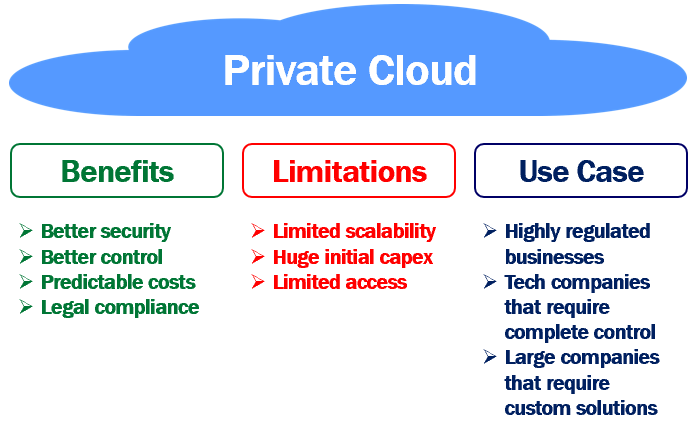
A defining characteristic of any private cloud solution is its strong emphasis on security and compliance. Unlike the shared responsibility model of the public cloud, a private cloud offers a dedicated, isolated environment where an organization can implement a holistic and deeply integrated security posture. This solution stack typically includes multiple layers of defense. At the network level, this involves micro-segmentation, which creates fine-grained security policies to isolate workloads from each other and prevent the lateral movement of threats within the data center. It also includes integrated firewall services, intrusion detection and prevention systems (IDS/IPS), and robust identity and access management (IAM) controls to ensure only authorized users can access resources. For compliance, private cloud solutions often feature built-in auditing and reporting tools that can automatically generate evidence to demonstrate adherence to industry regulations like HIPAA, PCI DSS, or government security standards. These security components are not add-ons but are fundamentally woven into the architecture of the private cloud solution, providing a fortified environment for an organization's most sensitive data and applications.
Integration with Hybrid and Multi-Cloud Ecosystems
Modern private cloud solutions are no longer designed to be isolated islands of infrastructure. Instead, they are engineered to serve as a seamless component of a broader hybrid and multi-cloud strategy. A key part of the solution is the set of tools and services that enable interoperability with public cloud providers. This includes unified management consoles that provide a single pane of glass to view and manage resources across both private and public clouds. Solutions like Google Anthos, Azure Arc, and AWS Outposts exemplify this approach, extending their native cloud services and management paradigms directly into the on-premises private cloud. Furthermore, a robust private cloud solution includes services for data mobility, allowing for the easy migration of virtual machines and data between the private environment and one or more public clouds. It also facilitates cross-cloud networking and consistent security policy enforcement, ensuring that applications can run and communicate securely regardless of where they are physically located. This integration capability is a critical part of the modern private cloud solution, enabling true workload portability and strategic flexibility.
Top Trending Reports:

 English
 Arabic
 French
 Spanish
 Portuguese
 Turkish
 Dutch
Dutch
 Italiano
 Russian
 Romaian
 Portuguese (Brazil)
 Greek
Greek