


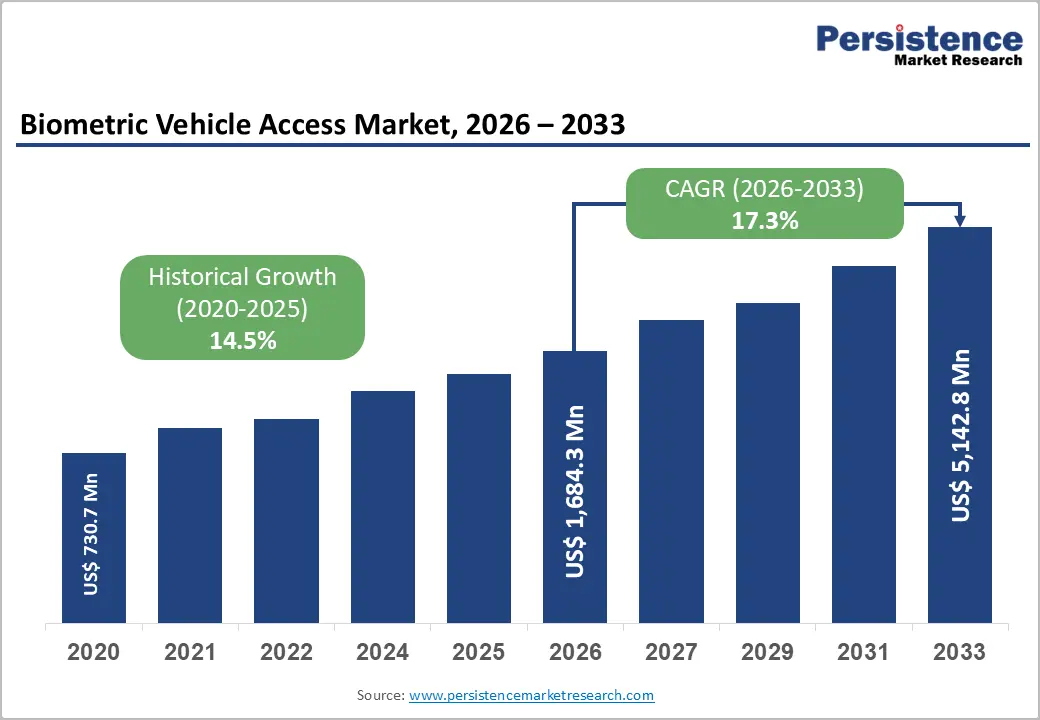
Biometric Vehicle Access Market Size and Growth Outlook
The global Biometric Vehicle Access Market is entering a high-growth phase as automotive manufacturers increasingly shift toward intelligent, connected, and software-defined vehicles. The market size is expected to reach US$ 1,684.3 million in 2026 and is projected to expand to US$ 5,142.8 million by 2033, growing at a strong CAGR of 17.3% between 2026 and 2033.
The rapid adoption of biometric authentication technologies across next-generation vehicles is reshaping traditional vehicle security systems. Automakers are moving beyond conventional keys, remote controls, and digital access cards toward advanced identity-based solutions using fingerprint recognition, facial recognition, voice authentication, and AI-powered multi-modal biometric systems.
Increasing vehicle theft incidents, rising consumer demand for seamless access experiences, and the expansion of connected mobility ecosystems are major factors accelerating market growth. At the same time, falling sensor costs, improvements in artificial intelligence, and stronger cybersecurity requirements are making biometric vehicle access solutions more commercially viable across passenger and commercial vehicles.
As electric vehicles (EVs) and autonomous driving technologies continue to evolve, biometric authentication is becoming a critical component of future mobility platforms by enabling secure access, personalized driving experiences, and advanced vehicle-user interaction.
Key Trends Driving the Biometric Vehicle Access Industry
Growing Vehicle Theft Concerns Fuel Demand for Advanced Authentication
Vehicle theft remains a major challenge worldwide, pushing consumers and automotive manufacturers to adopt more secure authentication technologies. Traditional vehicle access methods, including mechanical keys and remote key fobs, have become increasingly vulnerable due to advanced hacking techniques and relay attacks.
Global vehicle theft incidents are estimated to surpass 7 million cases in 2026, driven by organized theft networks and cyber-enabled attacks. In the United States alone, more than 1.02 million vehicle thefts were reported in 2023, highlighting the continued need for stronger vehicle security mechanisms.
Biometric vehicle access systems provide enhanced protection by verifying the driver's unique physical identity rather than relying only on possession-based credentials. Fingerprint scanners, facial recognition cameras, and voice authentication systems enable real-time identity verification, reducing unauthorized vehicle access.
Automakers are increasingly integrating these technologies into premium vehicles and expanding them into mainstream models as consumers become more concerned about vehicle security.
Electric Vehicles and Connected Cars Accelerating Market Expansion
The transition toward electric vehicles and software-defined vehicles is creating significant opportunities for biometric vehicle access technologies.
Modern EV platforms are designed around digital ecosystems, connected services, and intelligent software architectures. This makes them highly suitable for integrating advanced authentication solutions.
Unlike traditional vehicles, EVs rely heavily on electronic control units (ECUs), digital cockpits, cloud connectivity, and over-the-air software updates. These characteristics allow manufacturers to introduce biometric features more efficiently.
Companies across the automotive industry are exploring biometric-enabled EV experiences, including:
- Fingerprint-based vehicle unlocking
- Facial recognition-based driver identification
- Personalized seat and climate settings
- Customized infotainment profiles
- Secure digital payments
- Driver monitoring and safety systems
Chinese EV manufacturers have been particularly active in deploying facial recognition and fingerprint authentication technologies across various vehicle segments. Leading global manufacturers, including Tesla and Ford, are also exploring next-generation biometric access solutions.
The development of automotive-grade biometric components capable of operating under extreme temperature conditions, ranging from −40°C to +105°C, is further supporting wider adoption.
Market Challenges: Cost and Privacy Concerns
Despite strong growth potential, several challenges could impact widespread adoption of biometric vehicle access systems.
High Integration Costs Limiting Mass Adoption
Biometric vehicle access systems require advanced hardware components, including:
- Fingerprint sensors
- Infrared cameras
- Facial recognition modules
- Secure processing units
- Encryption systems
- Vehicle communication interfaces
The integration of these technologies requires significant investment in hardware development, software integration, cybersecurity compliance, and testing.
For entry-level vehicles, additional system costs can limit adoption. Automotive manufacturers typically follow long development cycles, with vehicle technology integration often requiring three to five years from design approval to production.
Aftermarket installation also presents challenges due to compatibility issues with existing vehicle electronics and security systems.
Data Privacy Concerns Affecting Consumer Adoption
Biometric technologies collect highly sensitive personal information, including fingerprint patterns, facial geometry, and voice characteristics.
Regulations such as the European Union’s General Data Protection Regulation (GDPR) and the Illinois Biometric Information Privacy Act (BIPA) require companies to implement strict data protection measures.
Automakers and technology providers must ensure:
- Secure biometric data storage
- Encryption protection
- User consent management
- Transparent data handling policies
Concerns about biometric data breaches and unauthorized tracking may slow adoption in privacy-sensitive markets, particularly in Europe and North America.
Opportunities Emerging From AI-Based Multi-Modal Authentication
The future of biometric vehicle access extends beyond security. Artificial intelligence is transforming biometric systems into personalized mobility platforms.
Multi-modal biometric solutions combine multiple authentication methods, such as:
- Fingerprint recognition
- Facial recognition
- Voice authentication
- Behavioral analysis
- Driver monitoring
These systems can identify individual drivers and automatically customize vehicle settings.
Future vehicles could automatically adjust:
- Seat position
- Mirror settings
- Steering preferences
- Climate control
- Infotainment preferences
- Driving modes
Biometric authentication is also creating new opportunities for connected services and revenue generation.
For example, Mercedes-Benz partnered with Mastercard to enable biometric in-car payments in Germany, allowing users to authorize transactions using vehicle-integrated fingerprint sensors.
As software-defined vehicles become more common, biometric capabilities can be upgraded through over-the-air updates, creating new subscription-based service opportunities for automakers.
Fleet Management and Commercial Vehicle Applications
Biometric vehicle access is gaining importance in commercial transportation and fleet management.
Fleet operators are increasingly adopting biometric authentication to:
- Prevent unauthorized vehicle usage
- Improve driver accountability
- Enhance operational security
- Reduce theft risks
- Support regulatory compliance
Logistics companies, ride-sharing operators, and corporate fleets are integrating biometric systems with telematics, GPS tracking, and fleet management platforms.
By ensuring that only authorized drivers can operate vehicles, biometric solutions help improve safety, reduce operational losses, and optimize fleet performance.
The growing adoption of connected fleet ecosystems is expected to create additional demand for biometric authentication solutions.
Segment Analysis
Hardware Segment Dominates Market Share
The hardware segment leads the biometric vehicle access market, accounting for approximately 62% market share in 2026, valued at more than US$ 1,044.3 million.
Hardware components remain essential because biometric authentication depends on physical sensing technologies.
Key hardware components include:
- Fingerprint sensors
- Camera modules
- Biometric scanners
- Authentication controllers
Increasing integration of advanced driver assistance systems (ADAS), smart cockpits, and connected vehicle platforms is encouraging manufacturers to adopt automotive-grade biometric hardware.
Meanwhile, the software segment is expected to experience faster growth due to increasing demand for:
- AI-based identity verification
- Cloud connectivity
- Cybersecurity solutions
- Digital identity management
Electric Vehicles Emerging as the Fastest-Growing Vehicle Segment
Passenger vehicles currently dominate the market, representing more than 53% share in 2026, valued at over US$ 892.7 million.
Consumer demand for improved security, convenience, and personalized driving experiences is driving adoption in passenger cars.
However, electric vehicles represent the fastest-growing segment due to their software-focused architecture.
EV manufacturers prioritize digital experiences, making biometric integration easier compared with traditional vehicles.
Key EV applications include:
- Digital key replacement
- Personalized driving profiles
- Secure charging authentication
- Connected mobility services
Fingerprint Recognition Leads Authentication Technologies
Fingerprint recognition remains the largest authentication segment, capturing approximately 45% market share in 2026, valued at more than US$ 757.9 million.
Its dominance is supported by:
- Lower implementation costs
- High reliability
- Simple user experience
- Easy integration
Fingerprint systems provide a balance between security and convenience, making them suitable for both premium and mass-market vehicles.
Facial recognition is emerging as the fastest-growing authentication technology due to its contactless operation and ability to support additional features such as:
- Driver monitoring
- Fatigue detection
- Personalized cabin settings
OEM Channel Dominates While Aftermarket Adoption Accelerates
OEM sales channels account for approximately 76% of the market in 2026, valued at around US$ 1,280.1 million.
Factory-installed biometric systems provide:
- Better integration
- Improved reliability
- Enhanced safety compliance
- Optimized performance
However, the aftermarket segment is expanding rapidly with a projected CAGR of 22.6%.
Growing consumer interest in upgrading existing vehicles with advanced security features is driving demand for retrofit biometric solutions.
Regional Market Insights
North America Leads Global Market Growth
North America holds the largest market share, accounting for approximately 34% in 2026.
Growth is supported by:
- High connected vehicle adoption
- Strong premium vehicle demand
- Advanced automotive technology ecosystems
- Increasing vehicle security concerns
The United States remains a key contributor, with companies such as Tesla, Ford, and General Motors exploring biometric authentication technologies.
Europe Focuses on Secure Automotive Authentication
Europe represents more than 26% market share in 2026, driven by strong automotive innovation in Germany and other major markets.
Luxury automakers including:
- BMW
- Mercedes-Benz
- Volkswagen Group
- Jaguar Land Rover
are investing in biometric-enabled vehicle technologies.
Strict cybersecurity regulations, including GDPR and ISO/SAE 21434 standards, are encouraging secure biometric implementation.
Asia Pacific Represents the Fastest-Growing Region
Asia Pacific is projected to expand at a CAGR of 21.7% during 2026–2033.
Growth is driven by:
- Rapid EV adoption
- Vehicle digitization
- Strong semiconductor ecosystems
- Growing automotive technology investments
China leads regional growth, with companies such as BYD, NIO, and Geely integrating biometric features into electric vehicles.
India is also emerging as a promising market due to increasing connected vehicle adoption and growing demand for advanced security features.
Competitive Landscape
The biometric vehicle access market features competition among automotive suppliers, semiconductor companies, and AI technology providers.
Key competitive factors include:
- Authentication accuracy
- Cybersecurity capabilities
- Automotive qualification standards
- AI integration
- OTA update support
Leading companies operating in this market include:
- Continental AG
- Robert Bosch GmbH
- Denso Corporation
- Valeo SA
- Hyundai Mobis
- Gentex Corporation
- Magna International
- ZF Friedrichshafen AG
- Synaptics Incorporated
- Fingerprint Cards AB
- Hitachi Ltd.
- NEC Corporation
- Thales Group
- HID Global
Future Outlook: Biometric Access Will Become a Core Vehicle Technology
The biometric vehicle access market is expected to experience sustained growth as vehicles become increasingly connected, intelligent, and personalized.
The convergence of AI, electric mobility, cybersecurity, and digital identity management will transform biometric authentication from a premium feature into a mainstream automotive capability.
Future vehicles will not simply recognize keys—they will recognize people.
As automakers continue developing software-defined vehicles and smart mobility ecosystems, biometric access technologies will play a central role in improving security, enhancing user experiences, and enabling new digital services.
With strong growth opportunities across EVs, fleet management, and connected vehicles, the biometric vehicle access market is positioned to become a critical technology segment shaping the future of transportation.

 English
 Arabic
 French
 Spanish
 Portuguese
 Deutsch
 Turkish
 Dutch
Dutch
 Russian
 Romaian
 Portuguese (Brazil)
 Greek
Greek