


Mental health providers spend countless hours helping patients manage anxiety, depression, trauma, substance use disorders, and many other conditions. But behind every successful practice is another important responsibility—billing. Insurance claims, coding updates, payer rules, and reimbursement delays can quickly become overwhelming.
This is where third party billing for mental health services becomes valuable. Instead of handling billing in-house, many behavioral health practices choose experienced billing professionals to manage claims, payments, and insurance processes. The result is often fewer billing errors, faster reimbursements, and more time for patient care.
Whether you operate a solo counseling practice, a psychiatric clinic, or a multi-provider behavioral health organization, understanding how third-party billing works can help you make informed decisions for your practice.
Why Mental Health Billing Is More Complex Than Many Medical Specialties
Mental health billing is different from billing for many other healthcare services. Providers often deal with:
- Time-based psychotherapy codes
- Telehealth billing requirements
- Prior authorization rules
- Multiple insurance plans
- Documentation requirements
- Frequent payer policy updates
- Coordination of benefits
- Different reimbursement rates for various provider credentials
Even a small mistake in coding or documentation can lead to claim denials, payment delays, or audits.
Because regulations continue to evolve, many practices find it difficult to keep up while also focusing on patient care.
What Is Third Party Billing for Mental Health Services?
Third-party billing means hiring an outside billing company to handle insurance claims and payment-related tasks on behalf of your practice.
Rather than employing a full in-house billing team, providers work with specialists who manage the billing cycle from claim creation through payment posting and denial management.
Typical responsibilities include:
- Insurance eligibility verification
- Claim preparation
- Accurate coding review
- Claim submission
- Payment posting
- Denial follow-up
- Appeals management
- Accounts receivable monitoring
- Financial reporting
The goal is to create a smoother billing process while reducing administrative work for the practice.
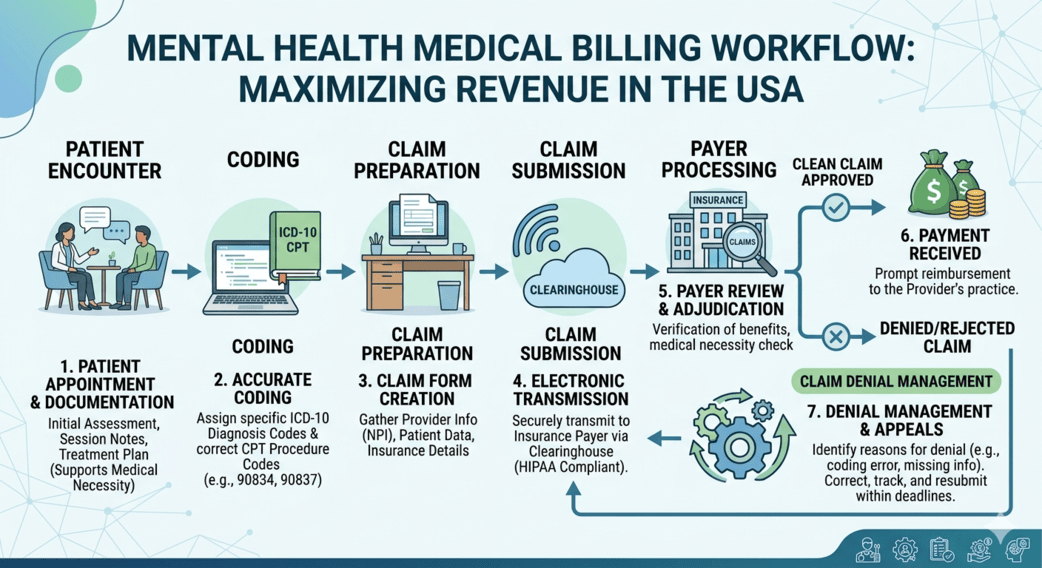
How the Billing Process Typically Works
Although every billing company has its own workflow, the overall process usually follows several key steps.
Patient Insurance Verification
Before appointments, insurance information is verified to confirm coverage, benefits, deductibles, and authorization requirements.
Early verification helps prevent unexpected billing problems later.
Clinical Documentation Review
Providers complete documentation that supports medical necessity and meets payer requirements.
Accurate documentation forms the foundation of successful claim submission.
Coding the Services
Correct diagnosis and procedure coding is essential for payment accuracy.
Experienced teams providing medical coding services understand mental health coding guidelines and help reduce coding-related claim denials.
Claim Submission
Claims are submitted electronically to insurance companies after quality checks.
Many billing specialists review claims before submission to identify common errors that could delay reimbursement.
Payment Posting
Once insurers process claims, payments are posted into the practice management system.
Patient balances are updated accordingly.
Denial Management
If claims are denied or underpaid, billing specialists investigate the reason and submit corrected claims or appeals when appropriate.
Consistent follow-up often improves overall collections.
Benefits of Using Third-Party Billing
Many behavioral health practices outsource billing because it offers practical advantages beyond simply submitting claims.
More Time for Patient Care
Administrative work can consume hours every week.
By outsourcing billing responsibilities, therapists, psychologists, psychiatrists, and administrative staff can spend more time focusing on patient treatment and practice growth.
Better Billing Accuracy
Billing professionals stay current with changing payer policies and coding updates.
This can help reduce:
- Coding errors
- Missing documentation
- Duplicate claims
- Incorrect modifiers
- Filing deadline issues
Faster Reimbursements
Clean claims are generally processed more quickly than claims requiring multiple corrections.
A streamlined billing process often improves cash flow and financial stability.
Lower Administrative Burden
Hiring, training, and managing an internal billing department can require significant resources.
Third-party billing may reduce staffing challenges while providing access to experienced billing professionals.
Improved Revenue Tracking
Many billing companies provide reports showing:
- Collection rates
- Outstanding claims
- Denial trends
- Accounts receivable aging
- Revenue performance
These insights help practice owners make better financial decisions.
What Should You Look for in a Third-Party Billing Company?
Not every billing company has experience with behavioral health.
When evaluating potential partners, consider the following factors.
Mental Health Billing Expertise
Choose a company that understands psychotherapy, psychiatry, counseling, addiction treatment, and behavioral health billing requirements.
Specialized experience often leads to smoother claim processing.
Knowledge of Insurance Policies
Insurance requirements frequently change.
A knowledgeable billing team monitors payer updates and adjusts billing processes accordingly.
Strong Compliance Practices
Healthcare billing involves strict compliance standards.
Reliable billing companies follow HIPAA requirements, maintain secure systems, and protect patient information.
Transparent Reporting
Clear financial reporting allows providers to monitor billing performance without guessing where claims stand.
Communication
Good communication is essential.
Providers should receive timely updates regarding denials, payer changes, outstanding claims, and reimbursement trends.
The Role of Credentialing in Successful Billing
Many payment issues begin long before the first claim is submitted.
If providers are not properly enrolled with insurance companies, claims may be rejected regardless of documentation quality.
This is why credentialing plays an important role in mental health billing.
Proper credentialing helps:
- Verify provider qualifications
- Complete insurance enrollment
- Maintain active payer participation
- Prevent unnecessary claim rejections
- Reduce delays in reimbursement
Keeping provider credentials updated is just as important as submitting accurate claims.
Revenue Cycle Management Matters More Than You Think
Billing is only one part of a much larger financial process.
Successful practices focus on complete revenue cycle management, which includes every financial step from scheduling appointments to collecting final payments.
Effective revenue cycle management supports:
- Accurate patient registration
- Insurance verification
- Coding accuracy
- Clean claim submission
- Payment collection
- Denial resolution
- Financial reporting
When every stage works together, practices often experience healthier cash flow and fewer outstanding balances.
Is Third-Party Billing Right for Every Mental Health Practice?
There isn't a single answer for every organization.
Some larger healthcare systems maintain internal billing departments, while many independent practices benefit from outsourcing.
Third-party billing may be a good option if your practice experiences:
- Frequent insurance denials
- Slow reimbursements
- Growing patient volume
- Limited administrative staff
- Difficulty keeping up with coding updates
- Increasing payer requirements
Evaluating current billing performance can help determine whether outsourcing would improve efficiency.
Choosing a Reliable Billing Partner
A billing company should function as an extension of your practice rather than simply processing claims.
For example, organizations like 247 Medical Billing Services offer support across areas such as medical billing services, medical coding services, credentialing, and broader revenue cycle management. The right partner should emphasize compliance, accuracy, transparency, and responsive communication while helping providers focus more on delivering quality mental healthcare.
Ultimately, the best billing relationship is one built on trust, consistent reporting, and a clear understanding of the unique needs of behavioral health providers.
Frequently Asked Questions
1. What is third party billing for mental health services?
It is the process of outsourcing insurance billing and reimbursement tasks to a specialized billing company that manages claims, payments, denials, and related administrative work for mental health providers.
2. Can small counseling practices benefit from outsourced billing?
Yes. Solo therapists and small counseling practices often outsource billing to reduce administrative workload, improve billing accuracy, and spend more time with patients.
3. Does third-party billing reduce claim denials?
While no company can eliminate denials completely, experienced billing professionals often reduce preventable denials by improving coding accuracy, documentation review, and claim quality before submission.
4. Why is accurate coding important in mental health billing?
Accurate coding ensures that services are billed correctly according to payer guidelines. Incorrect codes can result in claim denials, delayed payments, or reimbursement issues.
5. How does credentialing affect insurance billing?
Credentialing allows providers to become approved participants with insurance companies. Without proper credentialing, insurers may reject claims even if services were provided appropriately.
6. What is included in revenue cycle management?
Revenue cycle management covers the complete financial process, including patient registration, insurance verification, coding, billing, payment posting, denial management, collections, and financial reporting.
7. What should providers consider before choosing a billing company?
Providers should evaluate the company's mental health billing experience, compliance standards, reporting capabilities, communication practices, coding expertise, and ability to support long-term financial efficiency.

 English
 French
 Spanish
 Portuguese
 Deutsch
 Turkish
 Dutch
Dutch
 Italiano
 Russian
 Romaian
 Portuguese (Brazil)
 Greek
Greek