


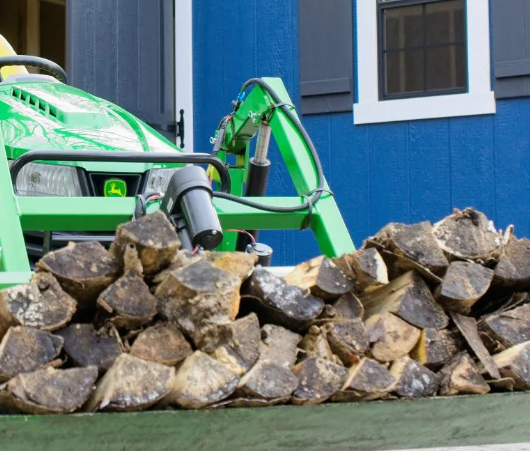
As an industry insider, I see a common mistake made by first time buyers. They shop for a loader based on two things: price and lift capacity. This is a critical error. A "for sale" listing is a marketing tool; it will not tell you the most important information, which is the actual build quality and engineering of the machine. A cheap loader that lifts 400 pounds but cracks your tractor frame is not a good deal. A high quality loader is a balanced system, and you need to know what to look for. Companies like LGM USA, for example, have built their entire platform on precision engineering and modern, high quality components.
When you are looking at a garden tractor front end loader for sale, you need to ignore the marketing and become an inspector. The first thing you must analyze is the loader's "skeleton": the sub frame, or mounting system. This is the most important part of the entire package. A cheap loader will have a "universal" mount, which is a collection of flimsy brackets and U bolts. This is a high risk system that will damage your tractor. A high quality system will have a heavy gauge, model specific sub frame that is custom engineered to bolt directly to the reinforced, pre drilled holes in your tractor's frame. This is a non-negotiable feature.
The second thing to inspect is the steel and weld quality. Look closely at the loader arms. Are they made from thick, heavy gauge steel, or thin, flimsy metal that is prone to twisting? Look at the welds. Are they clean, consistent, and "stacked" properly? Or are they sloppy, "globbed on," and full of pits? A bad weld is a future failure point. Also, check the pivot points where the arms connect. A quality build will use large, hardened steel pins and replaceable bronze bushings, which can be greased. A cheap build will just have a bolt through a drilled hole, which will wear out and become sloppy very quickly.
Third, you must inspect the "muscles" of the system. In a traditional loader, this means the hydraulic cylinders. Check if they are "serviceable," meaning they can be rebuilt, or if they are cheap, "welded" cylinders that must be completely replaced when a seal fails. In a modern, all electric loader, this means the linear actuators. You need to ask if they are industrial grade components. Are they environmentally sealed (IP rated) against water and dust? Or are they cheap, unsealed actuators that will fail after the first rainstorm? The quality of these actuators is the difference between a 10 year tool and a 1 year toy.
Fourth, consider the design. Is it lightweight and efficient, or heavy and clumsy? A heavy hydraulic system puts a massive, permanent strain on your tractor's front axle and steering components. A modern, all electric loader is engineered to be much lighter without sacrificing power, as it eliminates the heavy pump, fluid, and reservoir. This lightweight design is a sign of smart engineering and is much healthier for your tractor in the long run.
Finally, look at the controls. A cheap system will use a clunky, plastic box with toggle switches. A premium system will use a fully sealed, ergonomic, and intuitive joystick controller. This is not just a "luxury" feature; it is a sign of quality and a critical component for safe, one handed operation.
When you are in the market for a loader, do not be fooled by a low price. You are buying a piece of heavy machinery, not an appliance. Look for the hidden signs of quality: a model specific mount, clean welds, heavy steel, and high quality components like sealed actuators.
To see what a system built with these high quality, modern components looks like, explore the LGMUSA loader.

 English
 Arabic
 French
 Portuguese
 Deutsch
 Turkish
 Dutch
Dutch
 Italiano
 Russian
 Romaian
 Portuguese (Brazil)
 Greek
Greek