


Education ERP Market Overview
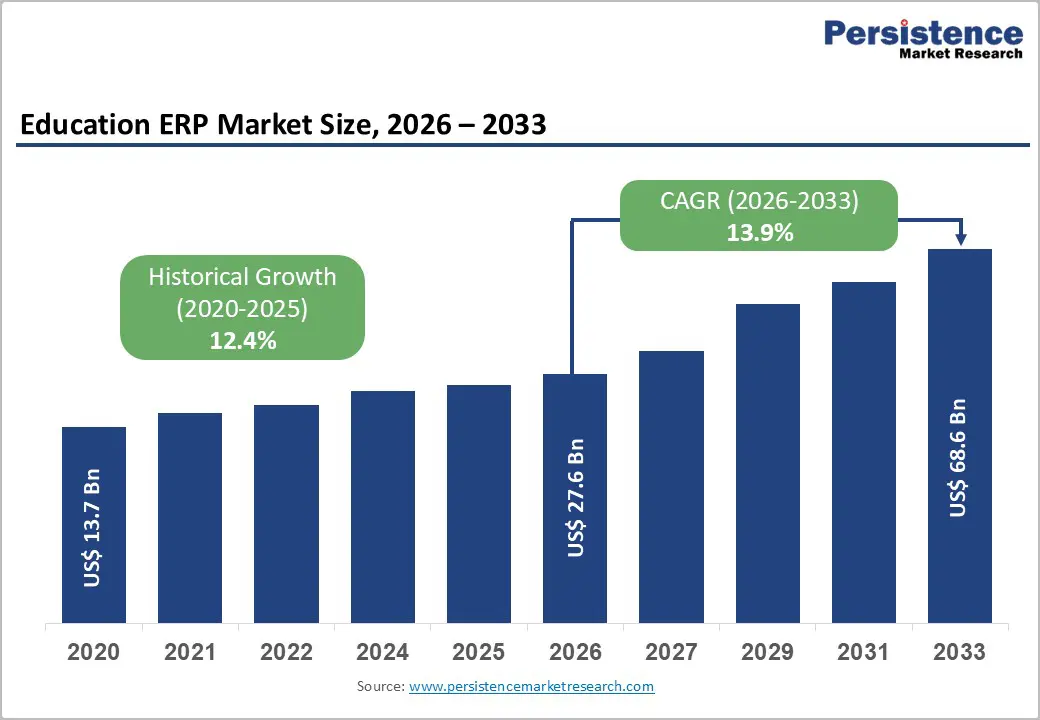
The global Education ERP market size is expected to reach US$ 27.6 billion in 2026 and is projected to grow significantly to US$ 68.6 billion by 2033, expanding at a CAGR of 13.9% between 2026 and 2033. The market is witnessing strong growth as educational institutions worldwide accelerate digital transformation initiatives, adopt cloud-based technologies, and seek integrated platforms to manage increasingly complex academic and administrative operations.
Education Enterprise Resource Planning (ERP) systems have become essential tools for schools, colleges, and universities by enabling centralized management of student information, admissions, finance, human resources, examinations, compliance, and institutional analytics. The growing pressure to improve operational efficiency, enhance student experiences, and comply with evolving regulatory requirements is encouraging institutions to replace fragmented legacy systems with comprehensive ERP platforms.
The rapid expansion of global education infrastructure is another major factor supporting market growth. According to UNESCO, global tertiary education enrollment exceeded 235 million students in 2023, creating significant demand for automated administrative systems capable of managing large-scale student data. Governments across North America, Europe, and Asia Pacific are also increasing investments in EdTech infrastructure, further supporting the adoption of Education ERP solutions.
Key Highlights of Education ERP Market
- Market Size (2026): US$ 27.6 billion
- Projected Market Size (2033): US$ 68.6 billion
- Forecast CAGR (2026–2033): 13.9%
- Leading Region: North America with approximately 35% market share in 2025
- Fastest-Growing Region: Asia Pacific with a CAGR of 16.8% through 2033
- Leading Component: Software segment with around 62% share in 2025
- Fastest-Growing Deployment: Cloud-based ERP solutions with a 15.5% CAGR through 2033
- Major Growth Opportunity: Artificial intelligence and advanced analytics integration
Market Dynamics Driving Education ERP Growth
Government-Led Digital Transformation Initiatives Accelerating Adoption
Government initiatives aimed at modernizing education systems are among the strongest drivers of Education ERP market growth. Countries worldwide are introducing policies focused on digital learning infrastructure, data-driven decision-making, and improved administrative efficiency.
In the United States, regulations such as the Every Student Succeeds Act (ESSA) encourage educational institutions to leverage data analytics for improving student performance and institutional outcomes. Compliance requirements such as the Family Educational Rights and Privacy Act (FERPA) are also encouraging schools and universities to implement secure systems capable of managing sensitive student information.
In India, the National Education Policy (NEP) 2020 has created significant momentum for digital transformation across more than 1.5 million schools and thousands of higher education institutions. Government-supported initiatives such as SAMARTH ERP are promoting centralized digital platforms for universities and educational organizations.
Similarly, Europe's Digital Education Action Plan 2021–2027 is encouraging institutions to upgrade administrative infrastructure through advanced digital technologies. These government-backed programs are helping educational institutions transition from disconnected systems toward integrated ERP platforms.
Increasing Student Enrollment Creating Demand for Automated Administration
Rising student enrollment worldwide is significantly increasing operational complexity for educational institutions. Schools and universities are required to manage enormous volumes of information related to admissions, attendance, examinations, fees, academic performance, and student engagement.
Traditional manual processes and disconnected software systems are becoming inefficient as institutions expand. Universities managing tens of thousands of students require automated workflows, real-time reporting capabilities, and centralized databases to improve efficiency.
Higher education growth in emerging economies is particularly contributing to ERP adoption. Countries across Asia Pacific, Latin America, and Africa are experiencing rapid expansion in private education networks, increasing the demand for scalable administrative solutions.
Additionally, regulatory requirements related to student data management and reporting are encouraging institutions to adopt ERP systems that provide better transparency, accuracy, and compliance capabilities.
Challenges Limiting Education ERP Market Growth
High Implementation Costs Restricting Adoption Among Smaller Institutions
Despite strong demand, high implementation costs remain a major challenge for Education ERP adoption. Large-scale ERP deployments often require significant investment in software licensing, customization, infrastructure upgrades, employee training, and ongoing maintenance.
Small schools and mid-sized educational institutions frequently face budget limitations that prevent them from adopting enterprise-grade ERP platforms. Public institutions in developing countries may also struggle with limited technology budgets and competing funding priorities.
The total cost of ownership extends beyond initial implementation, as institutions must invest in system integration, cybersecurity measures, technical support, and regular upgrades. These financial barriers continue to slow adoption among smaller educational organizations.
Data Security Concerns and Legacy System Migration Challenges
Educational institutions manage large amounts of sensitive information, including student records, financial details, and employee data. As cyber threats such as ransomware attacks and data breaches increase, security concerns have become an important factor influencing ERP adoption decisions.
Cloud-based ERP platforms, while offering scalability and flexibility, raise concerns regarding data privacy and regulatory compliance. Institutions must ensure that vendors follow strict security standards and comply with regulations such as GDPR and FERPA.
Migration from outdated legacy systems also creates operational challenges. Many institutions have relied on older platforms for years, making data migration complex and time-consuming. Concerns related to data loss, downtime, and workflow disruption can delay ERP modernization projects.
Growth Opportunities in the Education ERP Market
Cloud-Based ERP Adoption Creating New Market Potential
Cloud-based ERP solutions are emerging as one of the biggest growth opportunities in the education sector. Unlike traditional on-premise systems, cloud ERP platforms require lower upfront investment and provide flexible subscription-based pricing models.
Cloud deployment enables institutions to access systems remotely, receive automatic software updates, and scale operations based on changing requirements. These benefits are particularly attractive for smaller institutions that lack extensive IT infrastructure.
Emerging markets such as India, Indonesia, Brazil, and Nigeria present significant opportunities as private education networks expand and institutions seek affordable digital solutions.
ERP vendors are increasingly introducing modular cloud platforms that allow institutions to implement solutions gradually based on their priorities and budgets.
Artificial Intelligence Integration Enhancing ERP Capabilities
Artificial intelligence is transforming Education ERP platforms by introducing advanced automation and predictive capabilities. AI-powered ERP solutions can analyze institutional data to generate valuable insights and improve decision-making.
Key AI applications include:
- Predicting student dropout risks
- Personalized learning recommendations
- Automated scheduling
- Intelligent financial management
- AI-based academic advising
- Predictive enrollment analysis
Educational institutions are increasingly adopting data-driven approaches to improve student success and operational performance. Vendors integrating AI directly into ERP platforms are gaining competitive advantages by offering more intelligent and efficient solutions.
Education ERP Market Segment Analysis
Component Insights
The software segment dominates the Education ERP market, accounting for approximately 62% market share in 2025. ERP software serves as the foundation of institutional digital transformation by integrating student management, finance, HR, compliance, and analytics functions.
The increasing need for centralized platforms and regulatory compliance requirements continues to drive demand for advanced ERP software solutions.
The services segment is expected to witness strong growth as institutions require implementation support, consulting, customization, training, and system integration services.
User Type Insights
The higher education segment leads the market, accounting for approximately 52% share in 2025. Universities and colleges require complex ERP solutions due to their diverse operations, including admissions, research management, international programs, housing, and financial administration.
The K-12 segment is expected to experience faster growth due to increasing government investments in school digitization. Schools are adopting ERP platforms to improve communication between administrators, teachers, students, and parents.
Deployment Insights
The cloud deployment segment dominates the Education ERP market, holding approximately 57% share in 2026. Cloud ERP solutions are preferred because of their affordability, flexibility, scalability, and reduced infrastructure requirements.
The shift toward remote learning and digital administration following the pandemic has accelerated cloud adoption across educational institutions.
On-premise ERP solutions continue to serve organizations requiring greater control over data management and customization, particularly institutions with strict security requirements.
Application Insights
Student Information Systems (SIS) represent the leading application segment, accounting for around 24% market share in 2026. SIS platforms manage essential student-related processes, including enrollment, attendance, academic records, and compliance reporting.
Meanwhile, Learning Management System (LMS) integration is emerging as the fastest-growing application area. The increasing adoption of hybrid and digital learning models is encouraging institutions to integrate academic delivery platforms with administrative ERP systems.
Regional Analysis of Education ERP Market
North America Education ERP Market
North America leads the global Education ERP market with approximately 35% revenue share in 2025. The region benefits from strong technology infrastructure, high education spending, and widespread adoption of advanced EdTech solutions.
The United States represents the largest market due to its extensive network of schools and universities. Regulatory requirements such as FERPA and Title IV compliance continue to encourage institutions to adopt secure ERP platforms.
Europe Education ERP Market
Europe accounts for approximately 24% of the global market in 2025. Growth is supported by GDPR compliance requirements, government digital education initiatives, and investments in university modernization.
Germany represents the largest European market due to its strong higher education ecosystem and emphasis on operational efficiency.
The United Kingdom and France are also witnessing increasing adoption as educational institutions modernize their administrative infrastructure.
Asia Pacific Education ERP Market
Asia Pacific is the fastest-growing region, expanding at a 16.8% CAGR between 2026 and 2033.
Growth is driven by:
- Rising student enrollment
- Government digital education programs
- Expansion of private schools and universities
- Increasing cloud adoption
India represents one of the most promising markets due to its large education ecosystem and initiatives such as NEP 2020 and SAMARTH ERP.
China, Japan, Indonesia, Vietnam, and other Southeast Asian countries are also investing heavily in education technology modernization.
Competitive Landscape
The Education ERP market is moderately consolidated, with major global technology providers competing through advanced functionality, AI integration, cloud capabilities, and industry-specific solutions.
Leading companies focus on improving user experience, enhancing analytics capabilities, and developing mobile-first platforms to address evolving institutional requirements.
Key players operating in the Education ERP market include:
- SAP
- Oracle Corporation
- Microsoft
- Workday
- Ellucian
- Blackbaud
- Jenzabar
- Unit4
- Infor
- Tyler Technologies
- Sage Group
- Ramco Systems
- Serosoft
- Foradian Technologies
- Focus Softnet
Recent developments highlight the industry's focus on artificial intelligence and cloud innovation. In 2025, Ellucian expanded its cloud ERP platform with AI-powered analytics capabilities designed to improve student retention and financial planning. Oracle also introduced enhanced AI features within Oracle Student Cloud to support academic advising and automated reporting.
Future Outlook of Education ERP Market
The Education ERP market is expected to maintain strong growth through 2033 as institutions worldwide continue investing in digital transformation. The combination of increasing enrollment, regulatory requirements, cloud adoption, and AI-powered analytics will shape the future direction of the industry.
Educational institutions are moving beyond basic administrative automation toward intelligent platforms capable of improving student outcomes, operational efficiency, and strategic decision-making.
As cloud technologies become more accessible and AI capabilities mature, Education ERP solutions will become increasingly important components of modern education ecosystems. Vendors that provide flexible, secure, and AI-enabled platforms will be best positioned to capture emerging opportunities across global markets.
Conclusion
The global Education ERP market is entering a high-growth phase, driven by the urgent need for digital modernization across schools and universities. With market value expected to rise from US$ 27.6 billion in 2026 to US$ 68.6 billion by 2033, ERP platforms will play a critical role in improving education administration, enhancing student experiences, and enabling data-driven decision-making.
Cloud adoption, artificial intelligence integration, and government-supported digital initiatives will remain the primary forces shaping market expansion over the coming years.

 Arabic
 French
 Spanish
 Portuguese
 Deutsch
 Turkish
 Dutch
Dutch
 Italiano
 Russian
 Romaian
 Portuguese (Brazil)
 Greek
Greek