


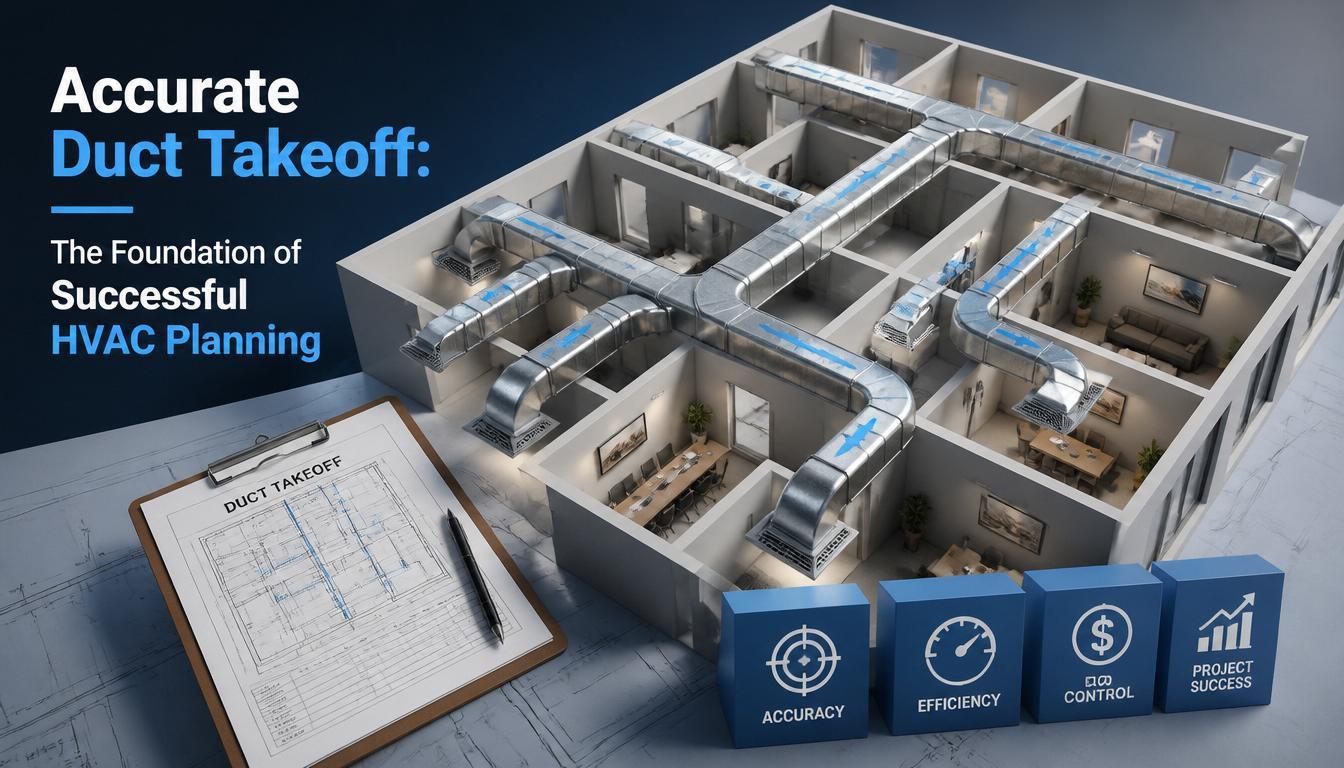
The process of the exact measurement and quantification of each duct item is called accurate duct takeoff. This includes duct pieces, fittings, transitions, and accessories from construction drawings to generate an accurate material list and cost estimate. It is important because the ductwork is a significant portion of the HVAC material and labor costs. A slight error in measurement will result in cost overruns, delayed procurement, and issues with airflow when the ducts are installed.
What Is HVAC Duct Take-Off?
Duct takeoff is a quantity survey that is done on mechanical drawings before construction. For instance, an estimator will measure:
-
Linear feet of trunk and branch duct
-
Fittings (elbows, transitions)
-
Terminal devices (diffusers and grilles)
The results are directly used for:
-
Material Ordering
-
Labour Hour Estimates
-
Pricing Bids
How Is An Accurate Duct Takeoff Important To HVAC Project Planning?
The U.S. Department of Energy (DOE) reports that a typical home duct system has only 67% functional air conditioners. The remaining 33% is wasted before it ever reaches space. That loss is a direct result of poor duct design. An accurate takeoff is designed to eliminate that loss. A common duct design shortcut is to ignore any fittings and wrongly measure runs. This will lead to a decrease in system efficiency and an increase in heating and cooling costs. The U.S. capital facilities industry is estimated to be losing $15.8 billion a year due to poor coordination in:
-
Design
-
Fabrication
-
Procurement
Specialty fabricators and suppliers contributed $2.2 billion to this loss. Most of this loss is attributed to mismatched quantities and rework. This is where duct takeoff is helpful. At this point, the fabricator evaluates the project. Accurate estimates lead to greater financial significance. The Department of Energy has given the efficiency standards for HVAC equipment that are designed to reduce utility costs for consumers.
What Does An Expert Duct Takeoff Service Consist Of?
The complete HVAC duct takeoff service usually includes:
-
Linear footage is used for the supply, return, and exhaust trunk and branch ducts.
-
Equivalent Length Calculations: Fitting Schedules (elbows, eyes, transitions, reducers)
-
Number of terminal devices (diffusers, grilles, registers)
-
Duct sizing is cross-checked with known design and pressure references.
-
Materials and gauge by pressure classes
-
A quantity report with each item listed for bidding and procurement
What Is The Role Of Duct Takeoff In HVAC Construction Planning?
Takeoff is the first link in the planning chain. It is usually done before a load calculation becomes a purchase order. These errors can be present throughout the project in the form of the following issues:
-
Scheduling delays
-
Budget problems
-
Change-order disagreements
According to NIST, this is one of the biggest contributors to unnecessary industry costs. Takeoff numbers are crucial for reliable HVAC construction planning because procurement and labor scheduling are based on them.
In-House Teams Vs Duct Takeoff Specialists: Who Should Do It?
Small contractors may not have the time to do a detailed takeoff on each bid. Manual in-house duct counting results in a slower turnaround time and increased errors. Dedicated HVAC project planning can offer much quicker turnaround time with fewer errors than manual in-house duct counting. This is because the drawing review software is used to verify the design and efficiency.
Universe Estimating has established itself as one of the most dependable duct takeoff services. This is supplemented by their thorough review of drawings and quantity check against standards. This ensures that your bids are accurate the first time around.
Conclusion
Finally, accurate duct takeoff is not a simple office procedure. It is the number on which all the downstream HVAC decisions are based. This includes equipment sizing, bid pricing, and installation quality. Almost one-third of the duct system energy is wasted due to poor design. Contractors who invest in precise, standards-based takeoff reduce rework, protect margins, and keep construction schedules intact. Working with an experienced takeoff service can be the quickest option to get there.

 English
 Arabic
 French
 Spanish
 Portuguese
 Turkish
 Dutch
Dutch
 Italiano
 Russian
 Romaian
 Portuguese (Brazil)
 Greek
Greek